How to use set difference in relational algebra
TL;DR
The set difference operation outputs the tuples that are in relation R but not in relation S. It is a binary operation that requires R and S to have the same arity and matching attribute domains. The video walks through concepts, formal requirements, and example problems to illustrate how R minus S works and how projections can enable the difference for single-attribute comparisons.
Transcript
foreign welcome back in this presentation we are going to focus on the set difference operation in relational algebra we know basically there are six fundamental relational algebra operations number one the select number two project number three Union we have already elaborately focused on these three topics in the previous presentations and we are... Read More
Key Insights
- R minus S is a binary operation that yields tuples present in R but not in S, forming a new relation from the difference.
- R and S must have the same arity, meaning they must have the same number of attributes, for the difference operation to be valid.
- For each corresponding attribute, the domain in R must match the domain in S, ensuring compatibility in the subtraction.
- Projection can be used to reduce the relations to a common single attribute when the full arity does not match, enabling a valid minus operation.
- The difference operation is conceptually identical to the set difference in mathematics, applied to relational data in a database context.
- Examples in the video show how to subtract one relation from another to produce a new set of tuples that meet the given criteria.
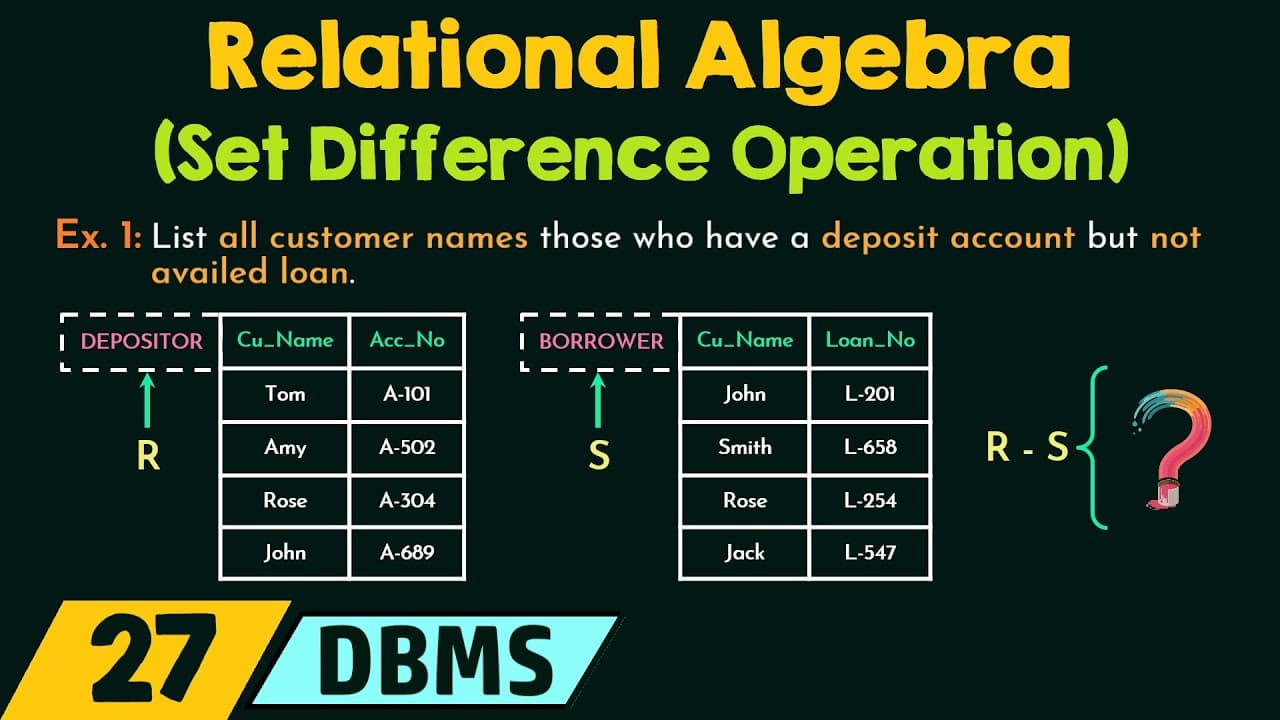
- The method can be applied to answer practical questions, such as identifying customers with deposits but no loans, by projecting the relevant attribute before applying minus.
- The video highlights two key conditions repeatedly: same arity and matching attribute domains, which ensure the minus operation yields meaningful results.
- More videos from this channel:
- More from this channel: Neso Academy
Install to Summarize YouTube Videos and Get Transcripts
Explore YouTube Video Summarizer or Get YouTube Transcript Extractor
Questions & Answers
Q: What is the basic purpose of the set difference operation in relational algebra?
The set difference operation (R minus S) identifies the tuples that are present in the first relation R but absent from the second relation S. It produces a new relation that contains exactly those tuples, provided both input relations share the same arity and have matching attribute domains. This allows queries like listing customers with deposits who have not taken loans, or courses offered in one semester but not another.
Q: Why must R and S have the same arity for R minus S to be valid?
For R minus S to be valid, both relations must have the same number of attributes, or arity. This ensures that each corresponding column in R aligns with a column in S, making it meaningful to compare tuples across the two relations. If arity differs, there is no one-to-one correspondence between attributes, and the operation cannot determine which values to subtract from which.
Q: How does the video demonstrate using projection to enable set difference?
The video shows that when the full relations do not have the same arity or when only a single attribute is relevant, projecting the needed attribute from each relation can create two single-attribute relations. If those projected relations have the same domain on that attribute, the minus operation can be performed, yielding the desired results while ignoring extraneous attributes.
Q: What are the two essential conditions for a valid set difference operation?
The two essential conditions are: first, the two relations must have the same arity, meaning they have the same number of attributes; second, for each position i, the domain of the ith attribute in R must be the same as the domain of the ith attribute in S. When both conditions hold, the minus operation can be applied correctly.
Q: Can you explain the example of listing customers with deposits but no loans?
Yes. The example projects customer names from the depositor relation to obtain a single-attribute relation of customer names with deposits. It does the same for the borrower relation to obtain customer names with loans. Subtracting the second set from the first using minus yields the customers who have deposits but no loans, such as Tom and Amy, as shown in the video.
Q: What is the role of projection in the second example about courses?
In the second example, projection is used to extract only the course IDs from two temporary results: one for courses taught in Fall 2009 and another for Spring 2010. Each projection yields a single-attribute relation, enabling the minus operation to identify courses offered in Fall 2009 but not in Spring 2010, despite differing original table structures.
Q: What does the video say about the result when there are no matching attributes for minus?
If there are no common attributes or if resulting projected relations do not share the same domain for the key attribute, the minus operation cannot be performed. The video emphasizes ensuring compatible arity and domain alignment; otherwise, one must adjust by projecting the relevant attribute so that both sides of the operation become comparable.
Q: What homework is suggested to practice the set difference concept?
The homework suggests performing s minus r, which is the inverse of the main example, to practice how the results change when the order of operands is swapped. It also recommends applications of set difference after projection in different relation contexts, reinforcing the need to align arity and attribute domains and to choose the right attributes for projection.
Summary & Key Takeaways
-
Set difference is defined as the output of relation R minus relation S, meaning elements in R that do not appear in S, with both relations sharing the same number of attributes. The operation is binary and relies on compatible domains for each corresponding attribute. The video emphasizes arity and domain compatibility as prerequisites.
-
Two worked examples demonstrate the minus operation on full relations and on projected attributes. The first example lists customers with a deposit account but no loan, using projection to a single attribute before applying the minus operation. The second example compares courses across different semesters by projecting the relevant course IDs.
-
The speaker concludes with essential conditions for validity, reiterating that arity must match and attribute-wise domains must align. Homework is provided to practice s minus r and to apply set difference after projection, reinforcing how relational algebra uses minus to derive new relations from existing data.
Read in Other Languages (beta)
Share This Summary 📚
Summarize YouTube Videos and Get Video Transcripts with 1-Click
Try YouTube Summary with ChatGPT & Claude or YouTube Transcript Generator
Explore More Summaries from Neso Academy 📚






Summarize YouTube Videos and Get Video Transcripts with 1-Click
Try YouTube Summary with ChatGPT & Claude or YouTube Transcript Generator