How to Begin C Programming and Data Structures
TL;DR
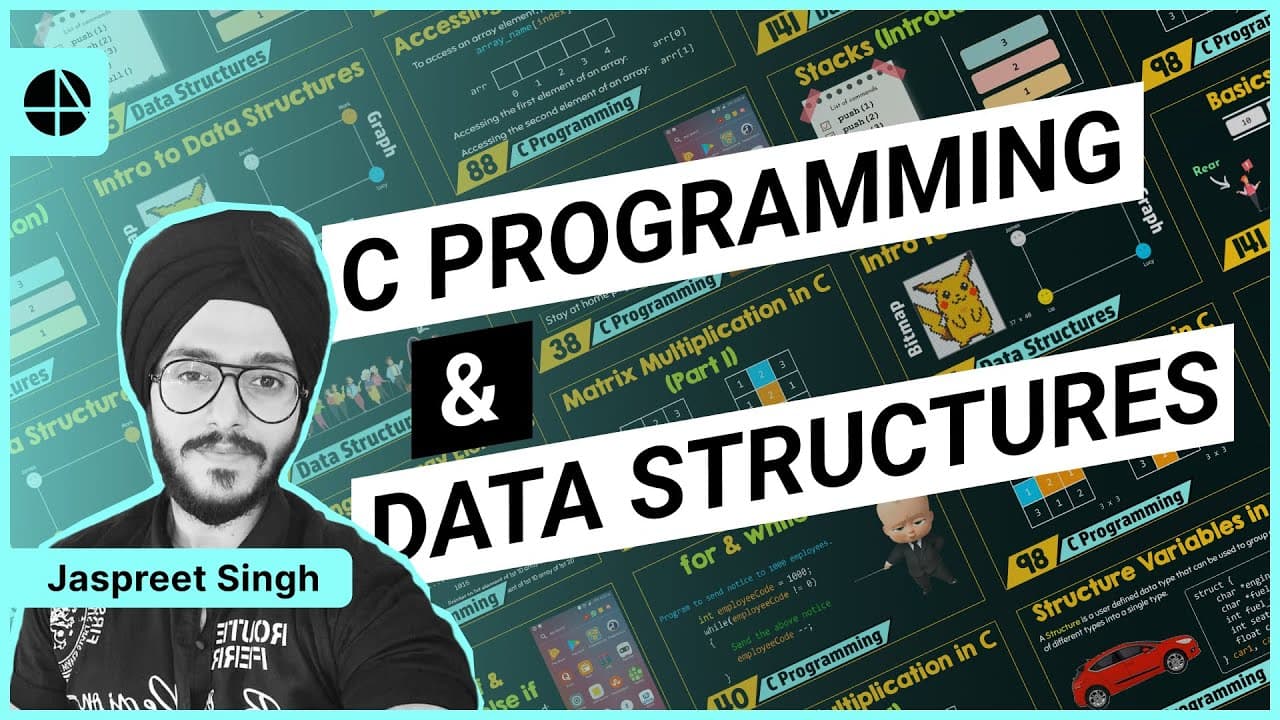
The course explains why C programming and data structures matter for GATE and interviews, then outlines the syllabus from variables, operators, conditionals, loops, functions, and recursion to pointers, arrays, and classic data structures. It emphasizes practical coding, portability of C, and building a foundation for efficient data management.
Transcript
Hello friends, I'm your instructor to teach you the subject C programming and Data Structures. Who is the target audience? This course is intended for the students who are preparing for GATE. This course is structured specifically to teach you the topics according to the official GATE syllabus. It doesn't mean that this course is not intended for o... Read More
Key Insights
- C programming and data structures are presented as essential for GATE preparation and IT industry recruiters. The course targets both students and self-learners, emphasizing portability and efficiency that C provides over assembly language.
- The syllabus starts with foundational elements like variables and operators, then advances through control structures and functions, culminating in recursion and data structures, ensuring a comprehensive skill set for practical programming tasks.
- C history is used to motivate why C exists, highlighting the shift from assembly to C for portability and reduced code length, which underpin the course’s teaching philosophy.
- The course stresses hands on practice, encouraging coding live and solving problems rather than passive listening, to deepen understanding and retention of concepts.
- A focus on data management efficiency is tied to real world analogies like dictionary ordering, illustrating why data structures matter beyond syntax.
- In addition to lectures, the course offers homework and attempts to cover previous year GATE questions, aligning learning with evaluation standards.
- The material underscores that C programming builds problem solving and logical thinking, which are transferable to other languages and computing environments.
- The instructor commitment to addressing doubts through comments and interactive sessions signals a learner friendly approach and ongoing support.
Install to Summarize YouTube Videos and Get Transcripts
Explore YouTube Video Summarizer or Get YouTube Transcript Extractor
Questions & Answers
Q: What is the main purpose of this course on C programming and data structures
The main purpose of the course is to teach C programming and data structures in a way that aligns with the official GATE syllabus while remaining useful for college students and self learners. It emphasizes practical coding, understanding of fundamentals such as variables, operators, conditionals, loops, and functions, and later explores advanced topics like recursion, pointers, arrays, structures, unions, and core data structures. The course also highlights how C's portability and concise syntax help in interview preparation and real world software development. By combining theory with live coding exercises and prior year questions, learners gain hands on experience and conceptual clarity essential for exams and job interviews.
Q: Who is the intended audience for this course
The intended audience includes students preparing for GATE, college students who study computer science, and self learners who want to understand C programming and data structures deeply. It also targets individuals preparing for campus interviews by covering concepts and interviewer favorite questions. The course is designed to be accessible to beginners while also offering depth for more advanced learners, making it suitable for anyone interested in programming fundamentals and data management.
Q: What topics are covered in the syllabus according to the transcript
The syllabus includes variables used to store values, various operators including logical, bit wise, assignment, and arithmetic, conditionals like IF-ELSE and SWITCH, loops FOR, WHILE, DO WHILE, functions, recursion, pointers and arrays, and finally structures and union. In the data structures portion, topics include stacks and their applications, queues, linked lists in various forms, trees, binary search trees, binary heaps, and graphs. The course also promises to cover some important previous year GATE questions.
Q: Why is C described as portable and why is that important
C is described as portable because it runs on different machines with the same code base, unlike assembly language which is hardware specific. Portability matters because it allows software like the UNIX operating system to be rewritten in C for broader compatibility, enabling code reuse and easier maintenance. The course uses this context to motivate learning C, showing how it reduces code length and complexity compared to assembly, while enabling software to function across diverse hardware.
Q: How does the course approach learning and practice
The course emphasizes a practical approach rather than passive listening. Learners are encouraged to code on their own, run programs live, and experiment with concepts to cement understanding. A mix of micro lectures, homework assignments, and opportunities to work through previous year GATE questions helps reinforce learning and ensures skills are applicable in real coding tasks and exam scenarios.
Q: What is the motivation behind teaching C and data structures together
Teaching C and data structures together is motivated by the need to understand how data is stored, managed, and manipulated efficiently while using a language that is portable and concise. C provides low level access and performance benefits, while data structures offer the organized methods to store and retrieve data effectively. Combining the two gives learners a solid foundation for building robust software, solving real world problems, and performing well in technical interviews.
Q: What historical context is provided about C and programming
The transcript explains that programming began with assembly language, which was not portable across machines. UNIX was originally developed in that era using assembly, but portability concerns led to rewriting UNIX in C in 1972, marking an important milestone in computing. This historical context helps learners appreciate C’s design goals, such as portability and reduced coding effort, which underpin the course’s teaching philosophy.
Q: What additional resources and community support are mentioned
The course mentions additional resources such as Instagram and other social links, a website, an app, and a Discord channel for community support. It invites learners to post doubts in the comment section and promises to answer as many queries as possible. This indicates an ecosystem designed to extend learning beyond lectures and into ongoing engagement and assistance.
Summary & Key Takeaways
-
This summary conveys the course aim to teach C programming and data structures aligned with GATE syllabus, emphasizing practical coding and a progression from basics to advanced topics. It notes the historical context of C and the importance of portability and efficiency in programming. The content encourages hands on practice and engagement with exercises and prior year questions.
-
The second summary highlights the course structure including topics like variables, operators, conditionals, loops, functions, recursion, pointers, arrays, structures, unions, stacks, queues, linked lists, trees, graphs, and binary search trees, with an emphasis on real world applications and recruiter interest.
-
The third summary reiterates the course's practical focus, the plan to cover theoretical aspects alongside live coding, and the promise of resolving doubts through comments and interactive sessions, all aimed at building mastery in C and data structures.
Read in Other Languages (beta)
Share This Summary 📚
Summarize YouTube Videos and Get Video Transcripts with 1-Click
Try YouTube Summary with ChatGPT & Claude or YouTube Transcript Generator
Explore More Summaries from Neso Academy 📚





Summarize YouTube Videos and Get Video Transcripts with 1-Click
Try YouTube Summary with ChatGPT & Claude or YouTube Transcript Generator