What Is String Slicing in Python and How to Use It?
TL;DR
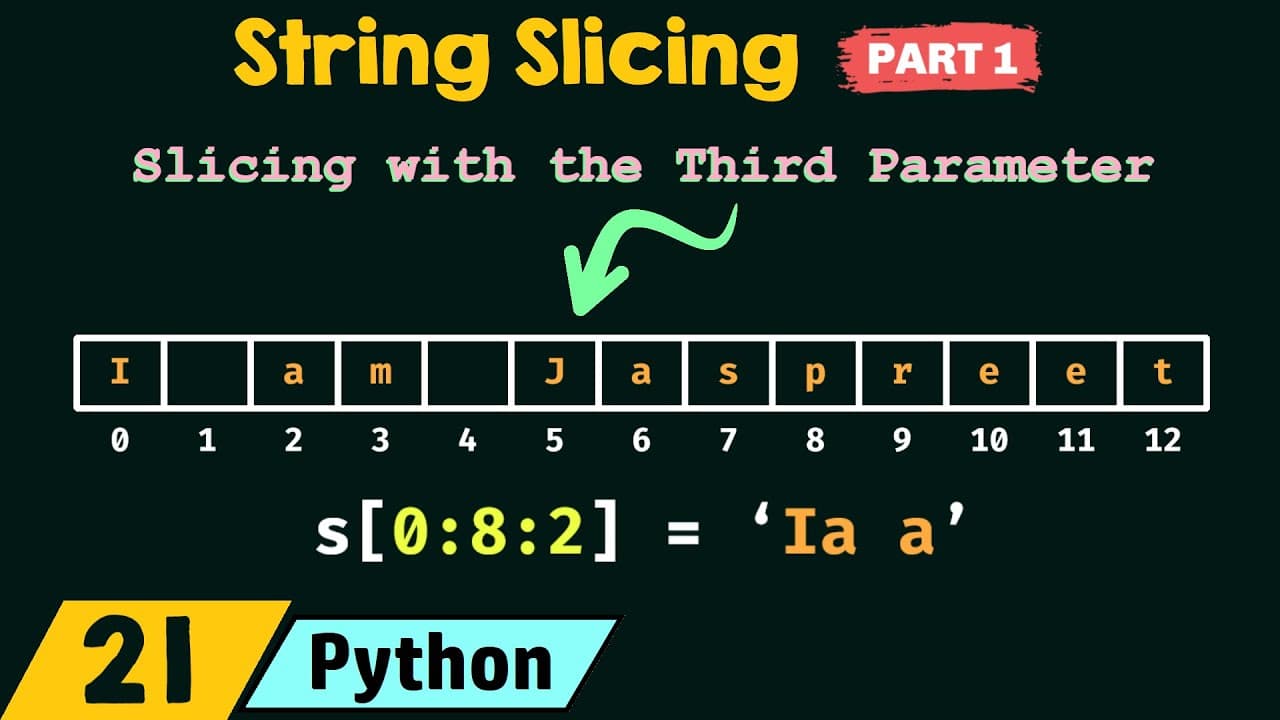
String slicing in Python allows you to extract substrings by specifying a start index, an end index plus one, and optionally a step value to skip elements. This flexibility enables efficient string manipulation, where omitting parameters defaults to accessing the entire string or starting from the first character. Understanding string slicing is key for effective coding in Python.
Transcript
Read and summarize the transcript of this video on Glasp Reader (beta).
Key Insights
- String slicing in Python allows accessing substrings by specifying start and end indices, facilitating efficient string manipulation.
- The slicing syntax requires specifying the start index, end index plus one, and optionally a step value, which defaults to one.
- The step value, when specified, determines the number of elements to skip during slicing, allowing for more flexible substring extraction.
- Eliminating the first or second parameter in slicing defaults to accessing the entire string or starting from the beginning, respectively.
- Using a step value greater than one can result in non-contiguous substrings, useful for specific data extraction tasks.
- The concept of string slicing is crucial for Python programming, enabling precise control over string data manipulation.
- String slicing syntax is versatile, allowing combinations of parameters to achieve different substring extraction results.
- Understanding string slicing with examples helps in mastering Python string operations and enhances coding efficiency.
Install to Summarize YouTube Videos and Get Transcripts
Explore YouTube Video Summarizer or Get YouTube Transcript Extractor
Questions & Answers
Q: What is string slicing in Python?
String slicing in Python is a technique used to access a part of a string, called a substring, by specifying the start and end indices. This method allows for efficient manipulation of string data, enabling programmers to extract specific parts of a string for further processing.
Q: How do you specify a substring using string slicing?
To specify a substring using string slicing, you use the syntax string[start:end], where 'start' is the index of the first character you want to include, and 'end' is the index of the character just after the last character you want to include. The indices are zero-based, and the end index is not included in the substring.
Q: What is the purpose of the third parameter in string slicing?
The third parameter in string slicing, known as the step value, determines the number of elements to skip between each character in the substring. By default, the step value is one, meaning no elements are skipped. Specifying a different step value allows for more complex substring patterns, such as skipping characters.
Q: Can you omit the first or second parameter in string slicing?
Yes, you can omit the first or second parameter in string slicing. Omitting the first parameter defaults to starting at the beginning of the string, while omitting the second parameter defaults to ending at the last character of the string. This flexibility allows for accessing different parts of the string easily.
Q: What happens if you use a step value greater than one?
Using a step value greater than one in string slicing results in a substring that skips the specified number of characters between each included character. This can be useful for extracting non-contiguous parts of a string or creating patterns within the substring, depending on the step value used.
Q: How does eliminating both the first and second parameters affect slicing?
Eliminating both the first and second parameters in string slicing means the entire string is considered for slicing. When only a step value is specified, the string is processed according to the step value, allowing for operations like skipping elements or reversing the string without specifying start or end indices.
Q: What is the significance of the step value being default to one?
The default step value of one in string slicing means that no elements are skipped, and the substring includes all characters between the specified start and end indices. This default behavior ensures that the slicing operation is straightforward and predictable unless a different step value is explicitly provided.
Q: How can string slicing improve Python programming efficiency?
String slicing improves Python programming efficiency by providing a concise and flexible way to manipulate string data. It allows for quick extraction of substrings, supports advanced operations with step values, and reduces the need for complex loops or conditional logic to achieve the same results, thereby streamlining code.
Summary & Key Takeaways
-
The video explains Python string slicing, a technique used to access substrings by specifying start and end indices. It covers the basics of slicing syntax and demonstrates how to extract specific parts of a string using examples.
-
An important aspect of string slicing is the step value, which can be specified to skip elements during slicing. This allows for flexible substring extraction and is demonstrated through practical examples in the video.
-
The concept of eliminating slicing parameters is discussed, showing how omitting the first or second parameter affects the slicing operation. This versatility in syntax is key to efficient string manipulation in Python.
Read in Other Languages (beta)
Share This Summary 📚
Summarize YouTube Videos and Get Video Transcripts with 1-Click
Try YouTube Summary with ChatGPT & Claude or YouTube Transcript Generator
Explore More Summaries from Neso Academy 📚



Summarize YouTube Videos and Get Video Transcripts with 1-Click
Try YouTube Summary with ChatGPT & Claude or YouTube Transcript Generator