What Is the Theory of Computation?
TL;DR
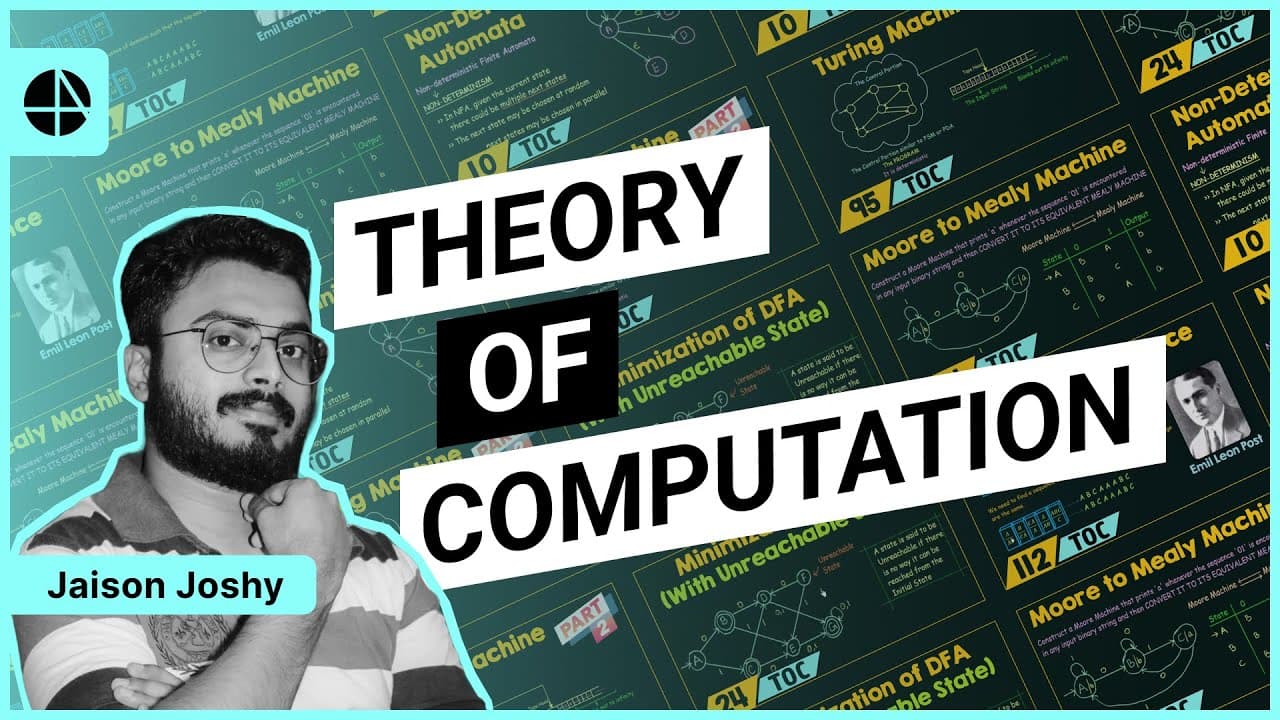
Theory of Computation studies what can be computed mechanically, how fast computations can be performed, how much space they require, and which problems machines cannot solve. The course progresses through Finite State Machines, Context Free Languages, Turing Machines, and undecidable problems, using examples such as recognizing binary strings and validating Java code. Read on to understand these computational models and the limits they reveal.
Transcript
hello everyone welcome to the first lecture in the course theory of computation in this lecture I will be giving you an introduction to the course theory of computation where we shall see what this course is all about what can we study from this course and what this course has to offer all right so let's get started so what is theory of computation... Read More
Key Insights
- Theory of Computation is a fundamental and abstract course in computer science.
- It focuses on what can be computed mechanically and the resources required.
- Some problems can be solved by machines, while others cannot.
- Finite State Machines (FSM) are the simplest computation models with limited memory.
- Context Free Languages (CFL) are more powerful than FSMs and perform higher-level computations.
- Turing Machines can perform high-level computations and are more powerful than CFLs and FSMs.
- Undecidable problems cannot be solved mechanically and fall under the undecidable layer.
- Compiler design is rooted in the concepts of Theory of Computation.
Install to Summarize YouTube Videos and Get Transcripts
Explore YouTube Video Summarizer or Get YouTube Transcript Extractor
Questions & Answers
Q: What is the Theory of Computation?
Theory of Computation is a fundamental and abstract area of computer science that studies what can be computed mechanically. It also examines how quickly computations can be performed, how much space they require, and which problems machines cannot solve.
Q: What does a machine do in Theory of Computation?
A machine receives an input and processes it according to a formula or set of rules. It then either accepts or rejects that input.
Q: How can a machine recognize binary strings that end in zero?
The machine checks the last digit of the binary string. It accepts the string if that digit is zero and rejects it if the digit is one.
Q: Can a machine determine whether Java code is valid?
Yes, a system can distinguish valid Java code from invalid code. A compiler demonstrates this by compiling correctly written code while reporting an error and refusing to run code that contains mistakes.
Q: Can a system guarantee that valid Java code never enters an infinite loop?
No, the lecture says such a system cannot be designed. Any attempted system would either produce a wrong output or run forever without producing an output.
Q: What is a Finite State Machine in Theory of Computation?
A Finite State Machine, or FSM, is one of the simplest models of computation. It has a very limited amount of memory, performs low-level computations, and serves as the first building block introduced in the course.
Q: How do Context Free Languages and Turing Machines compare with Finite State Machines?
A Context Free Language, or CFL, is more powerful than an FSM and supports higher-level computations. A Turing Machine can perform still higher-level computations and is described as much more powerful than both CFLs and FSMs.
Q: What are undecidable problems?
Undecidable problems are problems that cannot be solved mechanically. They form the undecidable layer introduced after Finite State Machines, Context Free Languages, and Turing Machines.
Summary & Key Takeaways
-
Theory of Computation is crucial for understanding what can be computed mechanically and the limitations of computational systems. It involves designing machines to accept or reject inputs based on specific rules, highlighting the boundaries of computability.
-
The course introduces various models like Finite State Machines, Context-Free Languages, and Turing Machines, each representing different levels of computational power and complexity.
-
Undecidable problems, which cannot be solved by any mechanical computation, are an essential aspect of this study, illustrating the limits of what machines can achieve.
Read in Other Languages (beta)
Share This Summary 📚
Summarize YouTube Videos and Get Video Transcripts with 1-Click
Try YouTube Summary with ChatGPT & Claude or YouTube Transcript Generator
Explore More Summaries from Neso Academy 📚
Summarize YouTube Videos and Get Video Transcripts with 1-Click
Try YouTube Summary with ChatGPT & Claude or YouTube Transcript Generator