What Are the Four Basic Characteristics of Computer Networks?
TL;DR
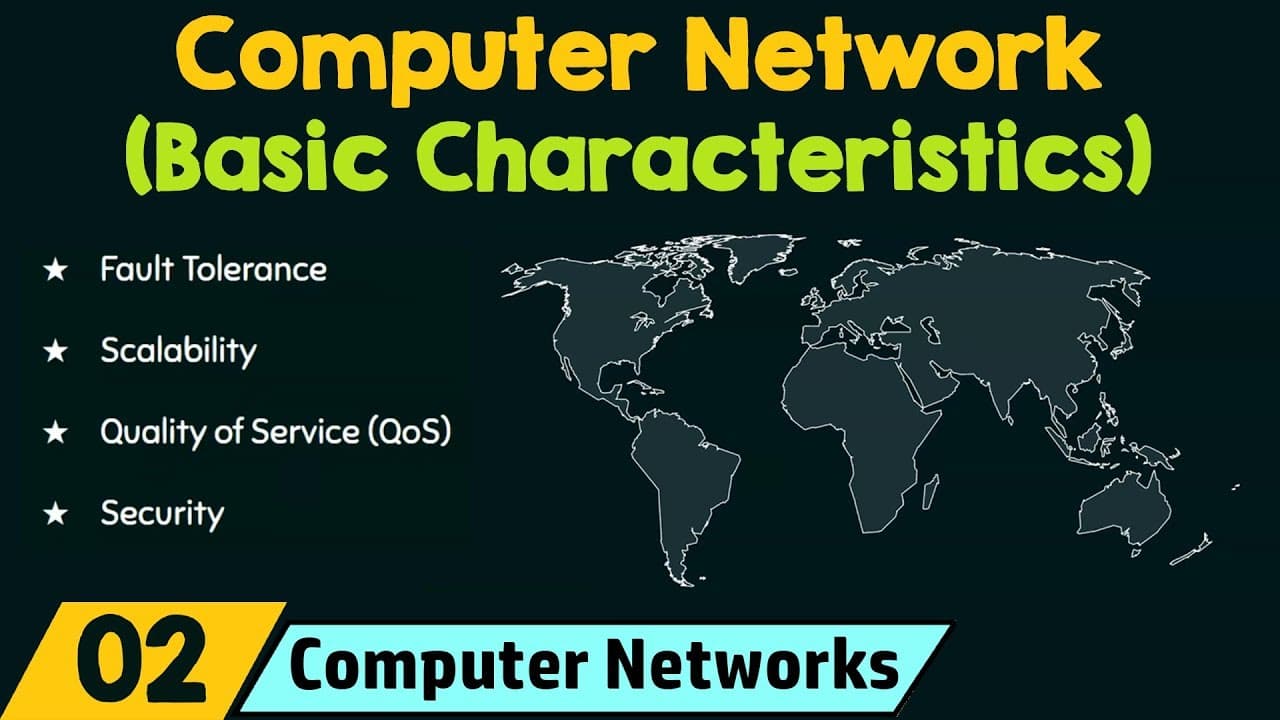
Fault tolerance, scalability, QoS, and security are the four core characteristics of computer networks. The video defines each trait, provides practical examples such as choosing alternate routes for fault tolerance and prioritizing real time traffic for QoS, and explains why security covers confidentiality, integrity, and availability.
Transcript
Hello everyone, welcome back to the computer networks course. Today we shall see the basic characteristics of computer network. Before we step in to the basic characteristics, we shall set some outcomes of this session. Upon the completion of this session, we will be able to understand the need for fault tolerant networks and scalable networks. We ... Read More
Key Insights
- Fault tolerance is the ability of the network to continue working despite failures and to prevent loss of service.
- Scalability is the ability to grow and maintain good performance as more devices join the network, with the Internet cited as a prime example.
- Quality of Service (QoS) is the system of prioritizing traffic to reduce delays and data loss, especially for real time communications like voice over IP.
- QoS decisions involve selecting which data to process first when multiple types arrive simultaneously, prioritizing real time data over non real time data.
- Security in networks aims to prevent unauthorized access and to ensure confidentiality, integrity, and availability of data.
- Confidentiality means data is protected and unreadable to unauthorized parties.
- Integrity means data is not altered in transit and remains trustworthy.
- Availability means resources are accessible when needed and protected from attacks or failures.
- More videos from this channel:
- More from this channel: Neso Academy
Install to Summarize YouTube Videos and Get Transcripts
Explore YouTube Video Summarizer or Get YouTube Transcript Extractor
Questions & Answers
Q: What is fault tolerance in computer networks?
Fault tolerance is the ability of a computer network to continue functioning even if a part of the network fails, ensuring there is no loss of service. The video explains this with a scenario where a router failure is bypassed by routing data through an alternative path, maintaining connectivity between a computer and a web server.
Q: How does scalability work in networks?
Scalability refers to a network's capacity to grow by adding more devices while preserving performance. The video uses the Internet as the best example, noting that even with thousands of new devices connecting, the network maintains service quality and handles growth without degradation.
Q: What does QoS do in a network?
QoS, or Quality of Service, is the ability to set priorities and manage data traffic to reduce data loss and delays. The video emphasizes prioritizing real time traffic like voice data over email when both are transmitted simultaneously to avoid unacceptable delays.
Q: Why is real time communication given priority in QoS?
Real time communication, such as voice over IP, is highly sensitive to delays, unlike email. The video explains that routers prioritize real time data to prevent noticeable delays, ensuring clearer voice quality and timely delivery of information in live conversations.
Q: What is the role of security in computer networks?
Security in computer networks is the ability to prevent unauthorized access, misuse, or forgery, and to ensure confidentiality, integrity, and availability. The video uses an example of confidential data traversing networks and attackers attempting to steal or alter information, highlighting the need for secure transmission.
Q: What are the three security properties mentioned in the video?
The three security properties are confidentiality, integrity, and availability. Confidentiality ensures data is unreadable to unauthorized users, integrity ensures data is not altered, and availability ensures resources are accessible when needed, all to protect data as it moves through networks.
Q: How is confidentiality maintained in networks according to the video?
Confidentiality is maintained by transforming data into a form that only the sender and receiver can understand, preventing unauthorized access. The video illustrates this by describing how sensitive information should be protected as it travels through routers and other network devices.
Q: What example does the video use to illustrate fault tolerance in action?
The video uses a scenario where two entities communicate through a network with a potential router or link failure. Instead of dropping the connection, data is redirected via an alternate path, preserving the communication between the computer and the web server and demonstrating fault tolerance in practice.
Summary & Key Takeaways
-
The video introduces four core network characteristics: fault tolerance, scalability, QoS, and security, and explains why each is essential for a robust network.
-
Fault tolerance is the ability of a network to continue operating despite failures, ensuring no loss of service by rerouting around problems.
-
QoS prioritizes certain data types, like real time communications, to minimize delays and data loss, while security ensures confidentiality, integrity, and availability of data.
Read in Other Languages (beta)
Share This Summary 📚
Summarize YouTube Videos and Get Video Transcripts with 1-Click
Try YouTube Summary with ChatGPT & Claude or YouTube Transcript Generator
Explore More Summaries from Neso Academy 📚






Summarize YouTube Videos and Get Video Transcripts with 1-Click
Try YouTube Summary with ChatGPT & Claude or YouTube Transcript Generator