How to Learn the OSI Seven-Layer Model Quickly
TL;DR
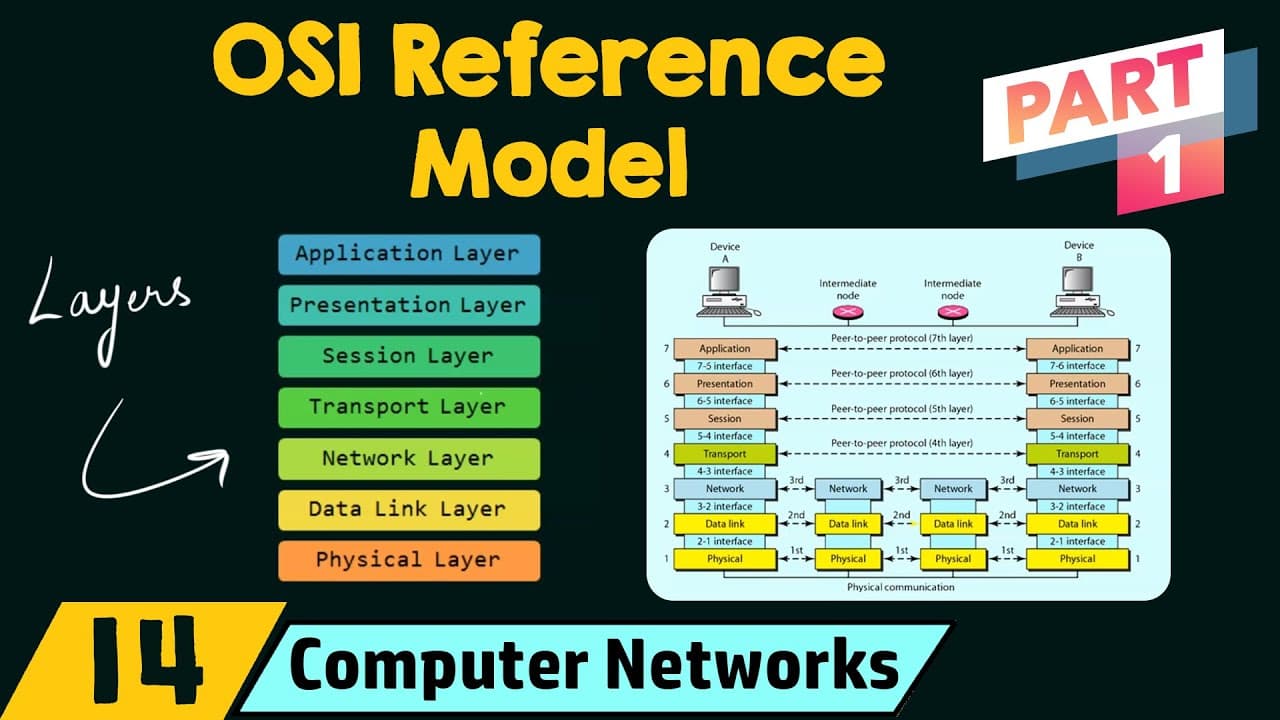
The OSI model consists of seven layers arranged in a fixed order from Application to Physical. Data travels down through the layers for sending and up for receiving, with intermediaries focusing only on the physical, data link, and network layers to avoid accessing application data. Understanding layer roles and interactions is key to troubleshooting and design.
Transcript
Hello everyone, welcome to the next lecture in the computer networks series. Today we will see the part one of the OSI reference model. We will see the outcomes of today's session. Upon the completion of this session, the learner will be able to understand the OSI reference model. We will list various layers in the OSI reference model. And we will ... Read More
Key Insights
- The OSI model is composed of seven layers in a fixed order.
- Layering provides modular design and easier troubleshooting.
- Data moves from the top (Application) to the bottom (Physical) when sending, and reverses on reception.
- Intermediary devices mainly process physical, data link, and network layers.
- The order of layers is crucial and must not be changed.
- A mnemonic helps remember the order: Please Do Not Throw Sausage Pizza Away.
- The bottom-up approach starts with the physical layer and progresses upward.
- Each layer interacts only with adjacent layers during data processing.
- More videos from this channel:
- More from this channel: Neso Academy
Install to Summarize YouTube Videos and Get Transcripts
Explore YouTube Video Summarizer or Get YouTube Transcript Extractor
Questions & Answers
Q: How many layers are in the OSI model and what are they?
The OSI model comprises seven layers in a defined sequence from Application down to Physical. The order is Application, Presentation, Session, Transport, Network, Data Link, and Physical. This order is important for correct data encapsulation and de-encapsulation as data moves through a sender to a receiver. Understanding each layer’s general role helps explain how systems communicate across diverse hardware and software.
Q: What is the purpose of layering in computer networks as explained in the video?
Layering in computer networks is used to decompose the complex task of building a network into manageable components. It provides modular design so each layer handles specific functions, and it makes troubleshooting easier because issues can be isolated to a particular layer. The OSI model uses layering to enable communication between different systems without changing the underlying hardware or software.
Q: Which layers do intermediary nodes typically process, and why?
Intermediary nodes typically process the physical layer, data link layer, and network layer. This is because higher layers carry data that must remain inaccessible to intermediaries to protect application information. Processing these three layers allows routers and similar devices to route and transmit data without exposing the actual application payload.
Q: How is data moved through the OSI layers during sending and receiving?
During sending, data generated by the application is passed down through the layers from seven to one, with each layer adding its own header or processing. At the physical layer, the data is placed on the transmission medium. During receiving, the process reverses from one back up to seven, removing headers and processing at each adjacent layer until it reaches the application.
Q: What is the role of the mnemonic for remembering the OSI layers, and how is it used?
The mnemonic provided is Please Do Not Throw Sausage Pizza Away, which helps remember the layer order from Physical to Application while noting that the last one is always Physical. A practical takeaway is that P appears twice because there are two Ps, but the final P represents the Physical layer. This mnemonic makes the correct order easy to recall for exams and study.
Q: Why is it important to keep the layer order unchanged in OSI?
Keeping the layer order unchanged is important because the OSI model defines how data is encapsulated and decapsulated across layers. Altering the order would disrupt the established interactions between adjacent layers, potentially causing communication failures, misinterpretation of headers, or incorrect data processing. Consistency ensures predictable networking behavior across different systems.
Q: What is the bottom-up approach mentioned for studying the OSI model in the video?
The bottom-up approach starts with the physical layer and then progresses through data link, network, transport, and finally the application layer. This method aligns with how devices physically connect and process signals first, before addressing higher-level functions. It emphasizes building foundational knowledge of hardware and transmission before understanding application-level protocols.
Q: How does the video suggest students will be examined on the OSI model?
The video emphasizes that examination questions focus on the order of the layers and how each layer interacts with adjacent layers. Students are encouraged to memorize the sequence and understand the layer-to-layer interactions, including how data moves across the stack during transmission and reception. This foundational knowledge supports more advanced networking topics in later chapters.
Summary & Key Takeaways
-
This video introduces the OSI reference model, explains why layering is used, and clarifies the seven layers and their order. It emphasizes a bottom-up approach to studying the layers and highlights how devices communicate without altering underlying hardware or software. It also shows how data moves through the layers on send and receive paths.
-
The content covers the purpose of the OSI model, the benefits of layering for modular design and troubleshooting, and the interaction rules between adjacent layers. It provides a mnemonic to remember the layer order and explains which layers routers typically process.
-
A practical takeaway is the fixed seven-layer sequence, the direction of data flow, and the role of intermediaries in handling only three layers. This foundation is presented as essential groundwork for more advanced topics in computer networks.
Read in Other Languages (beta)
Share This Summary 📚
Summarize YouTube Videos and Get Video Transcripts with 1-Click
Try YouTube Summary with ChatGPT & Claude or YouTube Transcript Generator
Explore More Summaries from Neso Academy 📚






Summarize YouTube Videos and Get Video Transcripts with 1-Click
Try YouTube Summary with ChatGPT & Claude or YouTube Transcript Generator