How to perform single bit error correction with Hamming code
TL;DR
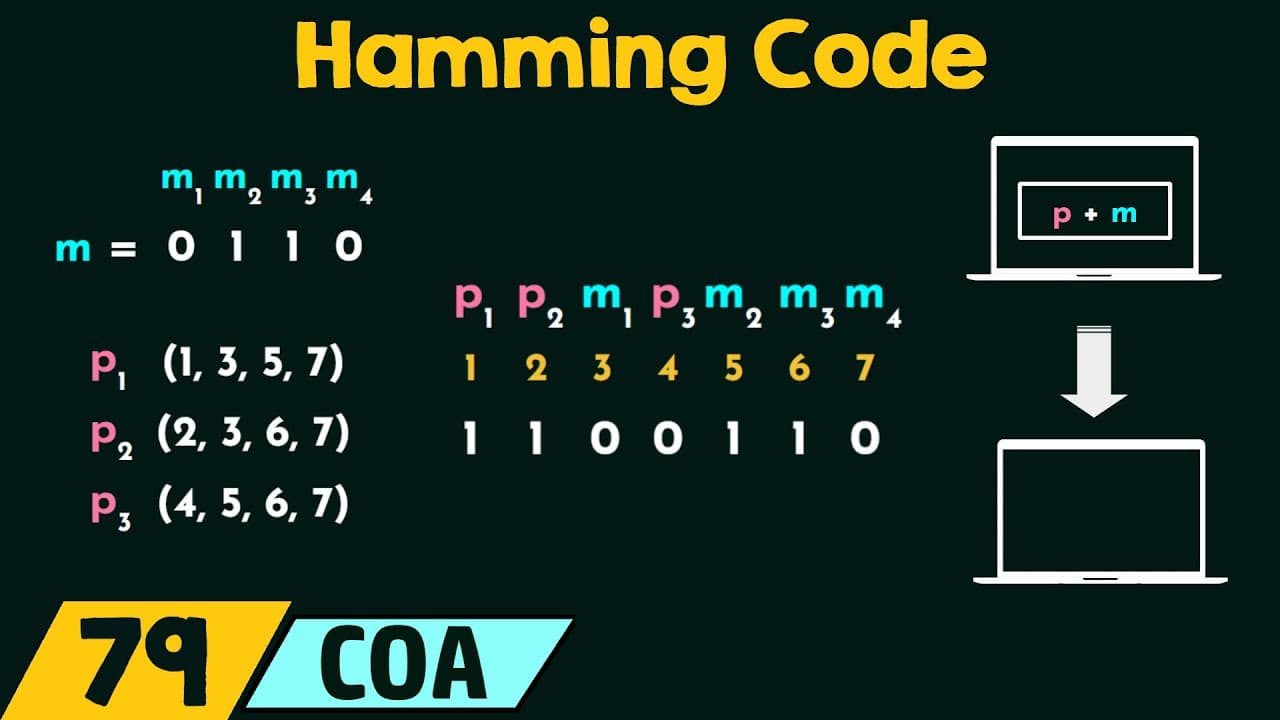
Single bit errors can be detected and corrected using parity bits. The Hamming code uses P parity bits with M data bits to create a P+M bit code, capable of correcting one erroneous bit by interpreting C1, C2, and C3 parity patterns. Example: for a 4-bit data word, 3 parity bits suffice and position the parity checks to locate the faulty bit.
Transcript
foreign and welcome back in the previous session only we observed that the simple binary codes are not capable enough in facilitating the error detection or error correction abilities so in this session we are going to learn about a code which actually is capable and that is Hamming code so without any further Ado let's get to learning coming to th... Read More
Key Insights
- Hamming code augments data with parity bits to enable single bit error detection and correction.
- The number of parity bits P must satisfy 2^P >= P + M + 1 for reliable coverage of all single-bit errors.
- Bits are organized so that parity checks C1, C2 and C3 cover specific bit positions to locate errors.
- Parity bits are placed in positions that align with the bit sets they monitor, enabling straightforward correction.
- Correction relies on the intersection of parity results to identify the exact corrupted bit.
- Even parity is used in the example to determine the value of parity bits based on the data bits.
- The receiver computes parity across designated bit groups to determine which bit failed.
- If the results indicate a single erroneous bit, it is flipped to restore the original data sequence.
- More videos from this channel:
- More from this channel: Neso Academy
Install to Summarize YouTube Videos and Get Transcripts
Explore YouTube Video Summarizer or Get YouTube Transcript Extractor
Questions & Answers
Q: What is the basic goal of Hamming code in data transmission?
The basic goal of Hamming code is to enable detection and correction of single bit errors in a transmitted sequence. By adding a small number of parity bits to the original data, the receiver can determine whether an error occurred and locate exactly which bit is erroneous. This allows automatic correction without retransmission, increasing reliability.
Q: How many data bits and parity bits are used for a 4-bit message in the example?
For a 4-bit message, the example uses 3 parity bits and 4 data bits, for a total of 7 bits transmitted. The parity bits are named P1, P2, and P3 and are placed at specific positions so that a received pattern of C1, C2, C3 parity checks can indicate which bit is corrupted.
Q: What condition determines the minimum number of parity bits needed?
The minimum number of parity bits P is determined by the condition 2^P >= P + M + 1, where M is the number of data bits. This inequality ensures there are enough unique parity patterns to cover all possible single-bit error scenarios plus the no-error case.
Q: How are the parity bits assigned to monitor specific bit positions?
Parity bits are assigned so that each one monitors a particular set of bit positions. For example, P1 monitors bit places 1, 3, 5, 7 via C3, P2 monitors 2, 3, 6, 7 via C2, and P3 monitors 4, 5, 6, 7 via C1. This arrangement enables the receiver to deduce the erroneous bit from the parity results.
Q: What do C1, C2, and C3 represent at the receiver?
C1, C2, and C3 are the parity checks computed at the receiver to evaluate the corresponding bit groups. Each Ci indicates whether the associated group of bit positions contains an error. The combination of the three values forms a pattern that points to the exact bit that may be corrupted, allowing correction.
Q: How does the receiver decide which bit to flip when an error is detected?
The receiver uses the intersection of the parity indicators: if C1 shows a problem in a certain group and C2 and C3 show problems in others, their combination narrows down to a single bit position. That position is then flipped to correct the detected single-bit error and restore the original data sequence.
Q: Why is even parity used in the example, and how does it affect the parity bits?
Even parity is used to determine the value of each parity bit by ensuring the total number of ones in the monitored bit set remains even. If the data bits in a monitored set result in an odd number of ones, the parity bit is set to 1 to achieve even parity; otherwise the parity bit is 0.
Q: What is the overall outcome after correcting a single bit error with Hamming code?
The overall outcome is that the corrupted bit is identified and flipped, restoring the original seven-bit sequence (in the given example) and thereby recovering the original four data bits. This correction happens without needing retransmission, improving reliability in data communication and storage systems.
Summary & Key Takeaways
-
Hamming code adds parity bits to data to enable single bit error detection and correction, using a calculated arrangement of bits and a three-parity check at the receiver.
-
The method relies on the relation 2^P >= P + M + 1 to determine the required number of parity bits for a given data size, ensuring all single-bit error cases are covered.
-
At the receiver, parity results C1, C2, C3 indicate which bit is corrupted by intersecting the active parity sets and correcting that bit.
Read in Other Languages (beta)
Share This Summary 📚
Summarize YouTube Videos and Get Video Transcripts with 1-Click
Try YouTube Summary with ChatGPT & Claude or YouTube Transcript Generator
Explore More Summaries from Neso Academy 📚





Summarize YouTube Videos and Get Video Transcripts with 1-Click
Try YouTube Summary with ChatGPT & Claude or YouTube Transcript Generator