Prime Numbers in Cryptography
TL;DR
Prime numbers are crucial for cryptography due to their unique properties.
Transcript
hello everyone welcome back in this presentation we will focus on prime numbers as usual let's start the session with the outcomes upon the completion of the session the learner will be able to outcome number one we will understand about prime numbers and composite numbers outcome number two we will know some facts about prime numbers and o... Read More
Key Insights
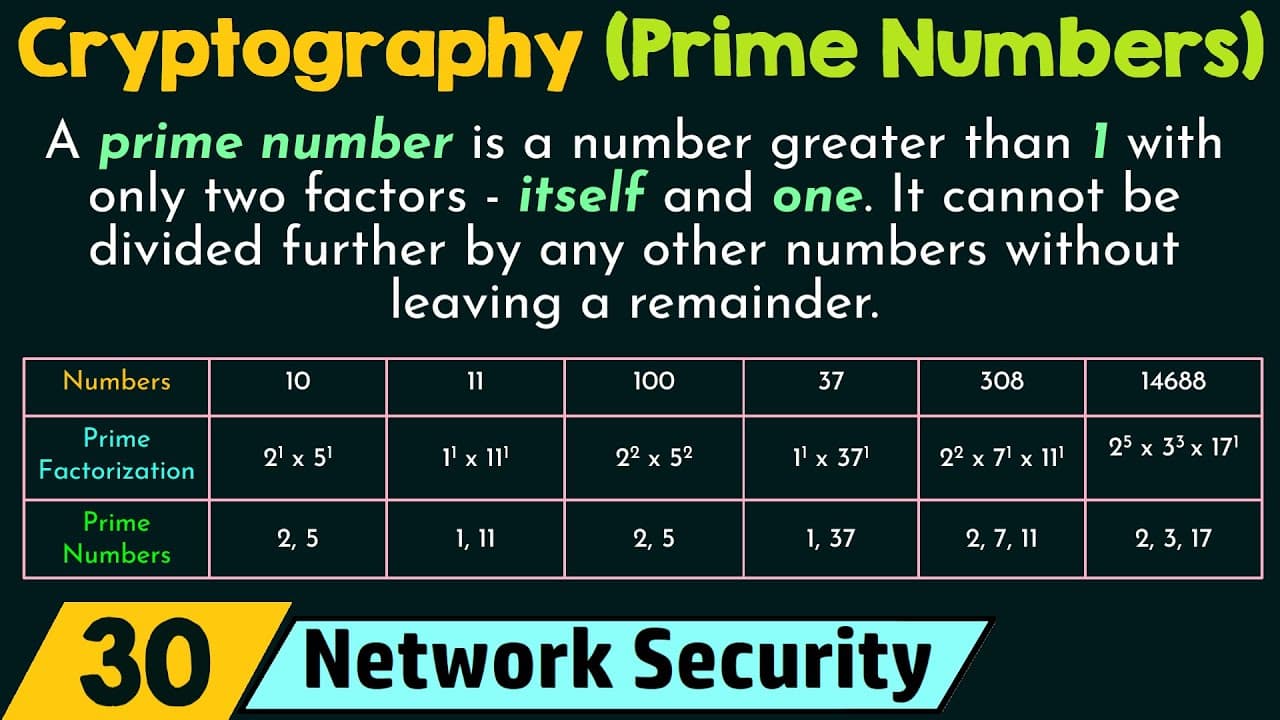
- Prime numbers are defined as numbers greater than one that have exactly two divisors: one and themselves. This property makes them unique and significant in various applications.
- Every number can be broken down into prime factors. For example, 10 has prime factors of 2 and 5, illustrating that composite numbers are built from primes.
- Prime numbers are foundational in cryptography because multiplying two large primes is computationally easy, but factoring their product is extremely difficult, providing security.
- The only even prime number is 2, and most prime numbers end in 1, 3, 7, or 9. This pattern helps in identifying potential prime numbers quickly.
- In cryptography, the security of encryption algorithms often relies on the difficulty of factoring large numbers into their prime components.
- A composite number, like 9 or 33, has more than two divisors, distinguishing it from prime numbers. This distinction is crucial in number theory and cryptography.
- The presentation emphasizes that prime numbers are not only mathematically interesting but also practically vital in securing data through encryption.
- Algorithms exist to test for primality, which are essential for cryptographic applications where large prime numbers are used.
Install to Summarize YouTube Videos and Get Transcripts
Explore YouTube Video Summarizer or Get YouTube Transcript Extractor
Questions & Answers
Q: What defines a prime number?
A prime number is defined as a number greater than one that has exactly two divisors: one and itself. This means it cannot be evenly divided by any other numbers without leaving a remainder, making it unique among integers.
Q: Why are prime numbers important in cryptography?
Prime numbers are crucial in cryptography because their properties make them ideal for encryption algorithms. Multiplying two large prime numbers is easy, but factoring their product is extremely difficult, providing a secure basis for data encryption.
Q: How can you determine if a number is prime?
To determine if a number is prime, check if it has exactly two divisors: one and itself. This involves testing divisibility by numbers up to its square root. If it can be divided by any other number, it is not prime.
Q: What is the significance of prime factorization?
Prime factorization is significant because it breaks down a number into its basic building blocks, the prime numbers. This process is straightforward for small numbers but becomes computationally intensive for large ones, which is a key aspect of cryptographic security.
Q: What are some interesting properties of prime numbers?
Interesting properties of prime numbers include that 2 is the only even prime number, and most primes end in 1, 3, 7, or 9. These properties assist in identifying and working with prime numbers in mathematical and cryptographic contexts.
Q: What is a composite number?
A composite number is an integer greater than one that has more than two divisors. Unlike prime numbers, composite numbers can be divided evenly by numbers other than one and themselves, making them a product of prime factors.
Q: How do cryptographic algorithms use prime numbers?
Cryptographic algorithms use prime numbers by relying on the difficulty of factoring large numbers into their prime components. This difficulty provides a secure method for encrypting data, as reversing the multiplication of large primes is computationally intensive.
Q: What is the role of algorithms in testing for primality?
Algorithms for testing primality play a crucial role in cryptography by efficiently determining whether a number is prime. These algorithms are essential for generating large prime numbers needed for secure encryption and data protection.
Summary & Key Takeaways
-
Prime numbers are numbers greater than one with exactly two divisors: one and themselves. They are essential in cryptography due to their unique properties, making them vital for secure encryption.
-
Every number can be expressed as a product of prime factors. This factorization is straightforward for small numbers but becomes computationally challenging for large numbers, enhancing cryptographic security.
-
Cryptographic algorithms leverage the difficulty of factoring large numbers into primes, providing a foundation for secure communications. Prime numbers, especially large ones, are crucial for this process.
Read in Other Languages (beta)
Share This Summary 📚
Summarize YouTube Videos and Get Video Transcripts with 1-Click
Try YouTube Summary with ChatGPT & Claude or YouTube Transcript Generator
Explore More Summaries from Neso Academy 📚






Summarize YouTube Videos and Get Video Transcripts with 1-Click
Try YouTube Summary with ChatGPT & Claude or YouTube Transcript Generator