How Does Geometry Solve the Basel Problem?
TL;DR
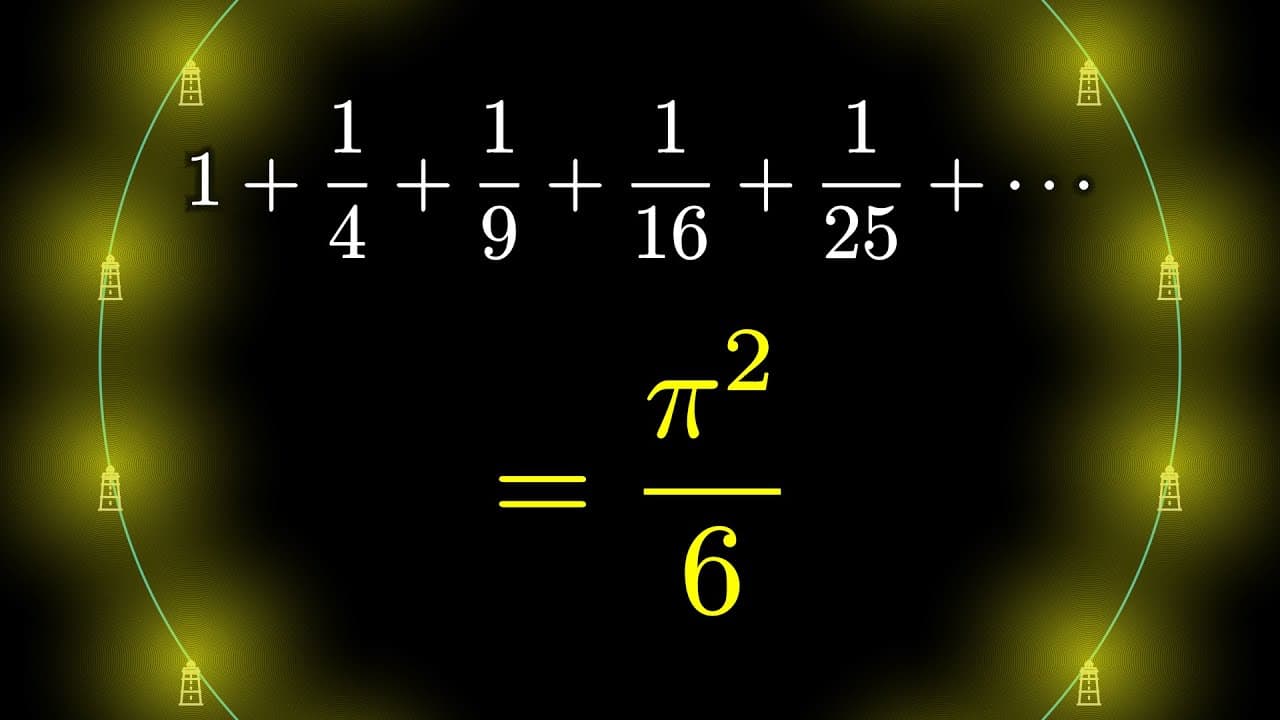
The infinite sum of reciprocal squares equals pi squared divided by 6 because inverse-square brightness can be preserved while rearranging an infinite array of identical lighthouses into a circular geometric construction. The inverse Pythagorean theorem permits each light to split into two equivalent lights, while expanding circles eventually approach the desired evenly spaced line.
Transcript
Take 1 plus 1 fourth plus 1 ninth plus 1 sixteenth and so on where you're adding the inverses of the next square number What does this sum approach as you keep adding on more and more terms? Now this is a challenge that remained unsolved for 90 years after it was initially posed until finally it was Euler who found the answer Super surprisingly to ... Read More
Key Insights
- The Basel problem is the question of evaluating the infinite series 1 + 1/4 + 1/9 + 1/16 and so on. Euler found that this series approaches pi squared divided by 6 after the challenge had remained unsolved for 90 years.
- Apparent brightness is inversely proportional to the square of the distance from a point source. Doubling the distance spreads the same rays over twice the width and twice the height, so an equal screen receives only one fourth of the original light.
- An infinite row of identical lighthouses at the positive integers physically represents the reciprocal-square series. Relative to the first lighthouse, the lights at distances two, three, and four have apparent brightnesses of 1/4, 1/9, and 1/16.
- The inverse-square law is not limited to visible light. The same spreading behavior appears when quantities such as sound, heat, or radio signals emanate evenly from a point source, making the lighthouse model an intuitive representation of a broader three-dimensional phenomenon.
- The inverse Pythagorean theorem states that 1/a squared plus 1/b squared equals 1/h squared in the described right-triangle arrangement. It lets a single lighthouse be replaced by two axis-aligned lighthouses whose combined apparent brightness remains unchanged for the observer.
- The inverse Pythagorean relationship can be understood with a tiny screen shaped first as a triangle's hypotenuse and then as its two legs. Similar triangles show that the corresponding limited angles of rays deliver matching amounts of light to these screen segments.
- The circular construction begins with an observer and lighthouse at opposite edges of a lake whose circumference is two. Its diameter is 2 divided by pi, so the original lighthouse has apparent brightness pi squared divided by 4 under the chosen brightness convention.
- The repeated construction uses circles with successively doubled circumferences and the fact that a triangle formed from a circle's diameter and any point on that circle has a right angle. This permits repeated brightness-preserving splits until the expanding circle approaches an evenly spaced line.
Install to Summarize YouTube Videos and Get Transcripts
Explore YouTube Video Summarizer or Get YouTube Transcript Extractor
Questions & Answers
Q: What is the Basel problem and what is its answer?
The Basel problem asks what value is approached by the infinite sum 1 + 1/4 + 1/9 + 1/16 and so on, where each term is the inverse of the next square number. Euler found that the sum equals pi squared divided by 6. The challenge had remained unsolved for 90 years before Euler obtained this surprising result.
Q: Why does pi appear in the reciprocal-square sum?
Pi appears because the reciprocal-square sum can be represented through a geometric construction involving circles. Identical lighthouses are repeatedly rearranged on circles without changing their total apparent brightness. The circle diameters depend on circumference divided by pi, so squaring those distances introduces pi squared. As the expanding circular arrangement approaches a line, it connects the circular quantity with the original series.
Q: Why is pi squared in the Basel problem result?
Pi is squared because the construction combines circular geometry with an inverse-square brightness law. For a circle of circumference two, the diameter is 2 divided by pi. Apparent brightness is one divided by the square of distance, so a lighthouse across that diameter has brightness 1 divided by the diameter squared, which simplifies to pi squared divided by 4.
Q: How do lighthouses represent the Basel problem?
Place identical lighthouses at every positive integer on a number line and observe them from the origin. If the first lighthouse has apparent brightness one, the inverse-square law gives brightnesses of 1/4, 1/9, and 1/16 for the next three. Therefore, the combined brightness of the infinite row equals the reciprocal-square series asked about in the Basel problem.
Q: Why does light brightness follow an inverse-square law?
Light from a point source spreads through three-dimensional space. When the distance is doubled, the same rays cover an area with twice the width and twice the height, requiring four copies of the original screen to collect them. Each equal screen therefore receives one fourth as much light. At three times the distance, nine screens are required, so each receives one ninth.
Q: What is the inverse Pythagorean theorem used in the proof?
In the described geometric arrangement, distances a and b from the observer to two replacement lighthouses and distance h to the original lighthouse satisfy 1/a squared + 1/b squared = 1/h squared. Consequently, the two replacement lights have exactly the same combined apparent brightness as the original light, assuming every lighthouse emits the same power.
Q: How does the screen argument explain the inverse Pythagorean theorem?
A tiny scaled copy of the triangle is treated as a screen receiving rays from the original lighthouse. Reshaping its hypotenuse into its two legs does not change which rays are collected. Similar triangles then match the light reaching each leg from the original source with the light reaching that same segment from one replacement lighthouse. The argument applies in the limiting case of a very small screen.
Q: How do expanding circles help solve the Basel problem?
The construction starts with an observer and lighthouse opposite each other on a circle, then introduces circles with successively doubled circumferences. Diameter-based right angles allow the inverse Pythagorean theorem to replace every lighthouse with two new ones while preserving total brightness. Repeating the process creates larger circular arrays that approach a line, while contributions from lights on the far side become negligible.
Summary & Key Takeaways
-
The Basel problem asks for the limiting value of 1 plus 1/4 plus 1/9 plus 1/16 and the remaining reciprocal squares. Euler found that the sum equals pi squared divided by 6. The geometric proof represents every term as the apparent brightness of an identical lighthouse placed at a positive integer.
-
Apparent brightness follows an inverse-square law because radiation from a point source spreads across an area whose width and height both scale with distance. A screen twice as far away receives one fourth as much light, while a screen three times as far away receives one ninth as much light.
-
The inverse Pythagorean theorem allows one lighthouse to be replaced by two without changing total observed brightness. Repeated transformations place growing numbers of lights on circles with successively doubled circumferences. As the circles approach a line and distant contributions become negligible, the construction connects circular geometry with the reciprocal-square sum.
Read in Other Languages (beta)
Share This Summary 📚
Summarize YouTube Videos and Get Video Transcripts with 1-Click
Try YouTube Summary with ChatGPT & Claude or YouTube Transcript Generator
Explore More Summaries from 3Blue1Brown 📚



Summarize YouTube Videos and Get Video Transcripts with 1-Click
Try YouTube Summary with ChatGPT & Claude or YouTube Transcript Generator