How Do Major Scientific Breakthroughs Happen?
TL;DR
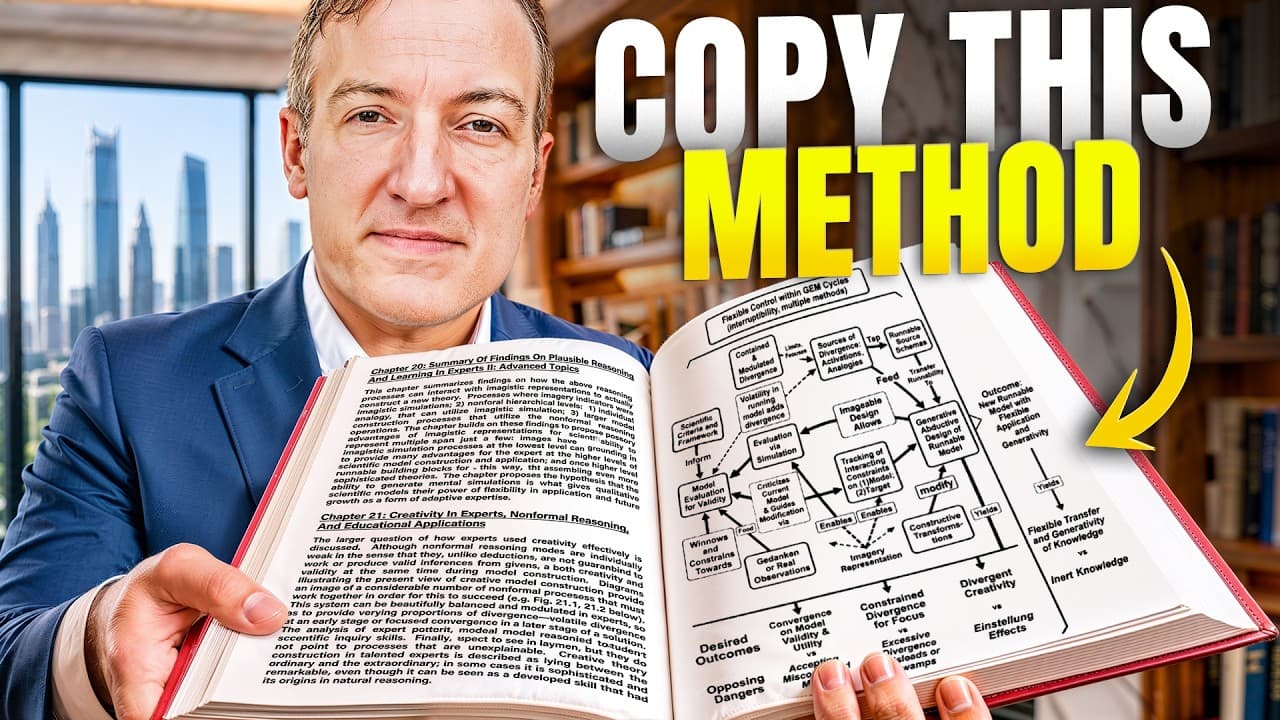
Breakthroughs follow a six step blueprint: visualize ideas as runnable pictures, then use analogy, extreme cases, thought experiments, bridging, and the GEM cycle to iterate. The myth of the lone genius is challenged by Clementada’s framework, showing progress comes from structured thinking and repeated modeling, not sudden insight alone.
Transcript
We picture a scientific breakthrough as a sort of lightning bolt, a lone genius struck out of nowhere by an idea. But that image is almost entirely wrong. And we know it's wrong because of the work of the cognitive scientist John Clement, who discovered a hidden, repeatable blueprint behind every major scientific breakthrough. Over my more than 13 ... Read More
Key Insights
- Experts think in mental pictures, not words, and this visualization guides problem solving.
- Reason by analogy is an active transformation of the problem, not just recalling a similar example.
- Push it to the extreme by expanding or shrinking variables to reveal hidden relationships.
- Thought experiments, or Gedankenexperimente, yield clear conclusions without lab work.
- Bridge cases help cross large conceptual gaps by providing intermediate, related examples.
- The GEM cycle (generate, evaluate, modify) is the core loop of refinement.
- Breakthroughs come from iterative modeling and testing, not a single flash of insight.
- Historical examples show how visualization, analogy, and iteration cohere into real progress.
- More videos from this channel:
- More from this channel: Stephen Petro
Install to Summarize YouTube Videos and Get Transcripts
Explore YouTube Video Summarizer or Get YouTube Transcript Extractor
Questions & Answers
Q: What is the six step blueprint for breakthroughs and how does it start?
The six step blueprint starts with thinking in runnable pictures rather than words. Experts build vivid mental images of how a system works and animate them like a movie in their minds. If you cannot run the picture in your mind, you have memorized facts but not understood the principle.
Q: How does analogy function in Clement's approach to problem solving?
Analogy functions as an active transformation of the problem rather than a simple recall of a memory. By distorting, simplifying, and reshaping the problem, the thinker maps it onto something familiar. This creates a workable mechanism or model that can be analyzed with mathematics or logic.
Q: What role does pushing variables to extremes play in reasoning?
Pushing the key variable to extreme values reveals hidden relationships and the true nature of the underlying principle. By imagining limits such as infinity or zero, the thinker can see contradictions and clarifications that were not visible under normal conditions, guiding the correct conceptual direction.
Q: What is a Gedankenexperiment and why is it useful?
A Gedankenexperiment is an imaginary experiment run in the mind with conviction to derive clear conclusions. It is useful because it allows reasoning about scenarios that are difficult or impossible to test physically, helping to separate competing explanations and generate testable hypotheses that can later be checked against reality.
Q: What is a bridging case and how does it aid understanding?
A bridging case is an intermediate example that shares features with both sides of a gap, enabling a walk across the conceptual divide in steps. It helps prevent leaps that are too large and provides a sequence of comprehensible, connected insights that lead to a deeper understanding and the ability to form a correct model.
Q: What does the GEM cycle stand for and how is it applied?
GEM stands for generate, evaluate, and modify. You generate a rough model, run it to identify where it breaks, then modify the model to fix the break and repeat. This iterative loop brings you closer to a robust explanation or functional model through continuous refinement.
Q: How did historical figures illustrate the blueprint in practice?
Historically, figures like Maxwell, Galileo, and Watson and Crick built mental or physical models, tested them against data and observations, and iterated the design. They used visualization, extreme reasoning, and bridging ideas to converge on correct theories such as electromagnetism, gravity, and the DNA structure.
Q: Why is the belief in the lone genius challenged by this framework?
The framework shows breakthroughs arise from structured, repeatable practices rather than solitary flashes of insight. By combining mental imagery, active problem transformation, extreme case analysis, thought experiments, bridging strategies, and iterative GEM cycles, progress emerges as a disciplined process that multiple thinkers can practice and refine over time.
Summary & Key Takeaways
-
This summary explains how breakthroughs emerge from six coordinated practices that start with visual thinking and progress through analogy, extreme cases, thought experiments, bridging, and a repeating GEM cycle, illustrating a repeatable method rather than a flash of genius.
-
The six step blueprint emphasizes turning abstract ideas into vivid mental simulations, then refining them through systematic variation and cross checks against data or analogies, ultimately producing robust models that explain observations and guide further work.
-
The video uses historical examples like Maxwell, Galileo, and Watson Crick to demonstrate how iterative models and bridging ideas bridge gaps between familiar and unfamiliar concepts, underscoring a disciplined approach to scientific discovery.
Read in Other Languages (beta)
Share This Summary 📚
Summarize YouTube Videos and Get Video Transcripts with 1-Click
Try YouTube Summary with ChatGPT & Claude or YouTube Transcript Generator
Explore More Summaries from Stephen Petro 📚

Summarize YouTube Videos and Get Video Transcripts with 1-Click
Try YouTube Summary with ChatGPT & Claude or YouTube Transcript Generator