How to test ideas and stay ahead with Popper
TL;DR
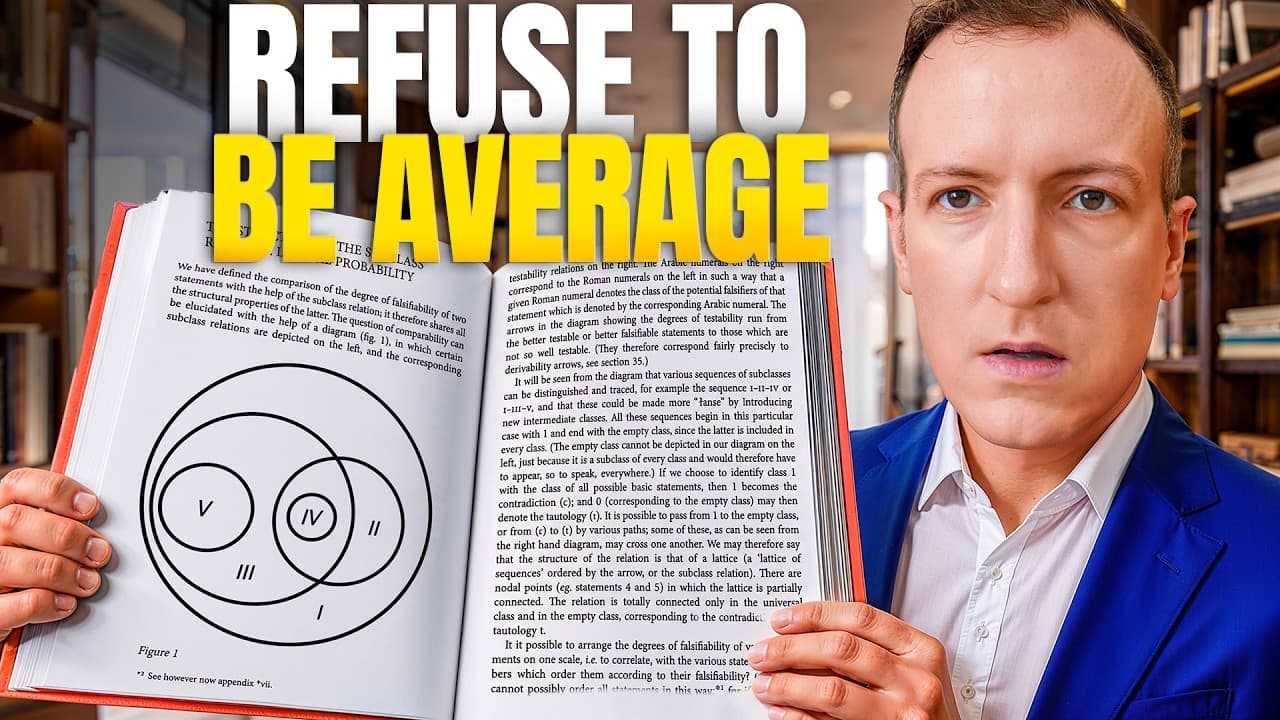
The core answer is that progress comes from trying to falsify ideas, not proving them true. Use five techniques: hunt the black swan to seek disconfirming evidence, run a premortem to imagine failure in advance, kill the post hoc story by testing rival explanations, build a falsifiable model with a calibration log, and hold beliefs as provisional conjectures. Together these habits turn thinking into a repeatable validation process.
Transcript
Here's a quick test. I have a secret rule and the sequence 2 4 6 obeys it. You can propose other sequences and I'll tell you whether they also obey the rule. So what would you test next? Maybe 8 102 or 20 22 24. Well, if so, you'd be walking straight into a trap. And in psychologist Peter Wson's original experiment, only one in five people escaped ... Read More
Key Insights
- Hunting the black swan requires seeking evidence that could disprove your belief rather than confirming it.
- A premortem asks stakeholders to imagine a future failure in detail, forcing brutal honesty about risks before acting.
- Killing the post hawk story means generating and testing all plausible explanations for an outcome, not just the most obvious one.
- A falsifiable model is built by making specific predictions and logging outcomes to compare against initial beliefs.
- Calibration logs turn subjective gut feelings into testable data and progressively refine a personal model.
- Holding beliefs as provisional conjectures keeps theories adaptable and open to revision when new data arrives.
- Corroboration is not proof; it means a belief has survived testing so far but could still be falsified.
- The five techniques are interdependent, each reinforcing disciplined, evidence-based thinking and decision making.
Install to Summarize YouTube Videos and Get Transcripts
Explore YouTube Video Summarizer or Get YouTube Transcript Extractor
Questions & Answers
Q: What is the basic idea behind Popperian science as described in the video?
Popperian science emphasizes that knowledge advances not by proving things true, which is impossible in principle, but by trying to falsify ideas and paying attention to what survives rigorous testing. This asymmetry means that a single disconfirming instance can refute a claim, while many confirmations do not guarantee truth.
Q: What does the video mean by hunting the black swan?
Hunting the black swan means actively seeking evidence that could disprove a belief rather than collecting confirming data. By testing the idea in ways that would reveal its weaknesses, you avoid the trap of confirmation bias and strengthen the robustness of your conclusions.
Q: How is the premortem technique supposed to be used in real life?
A premortem involves imagining a project or plan has failed in the future and then listing all the reasons for that failure. This forces brutal honesty, helps identify major risks, and guides proactive defenses before committing to the plan, making risk management more effective.
Q: What does it mean to kill the post hawk story?
Killing the post hawk story means resisting the urge to settle on a single causal explanation after an outcome. Instead, generate all plausible explanations first and test how to distinguish among them, ensuring decisions are based on evidence about actual causes rather than comforting narratives.
Q: How does building a falsifiable model work according to the video?
Building a falsifiable model involves making specific predictions and then keeping a calibration log. Before outcomes occur, you write down predictions and confidence. When results come in, you compare them to your predictions, which helps reveal where your model is inaccurate and needs adjustment.
Q: Why should beliefs be held as provisional conjectures?
Beliefs should be provisional conjectures because even the best-tested theories are not proven; they are not yet falsified. Keeping them slightly open to revision encourages ongoing testing, reduces overconfidence, and aligns thinking with new evidence as it emerges.
Q: What role does corroboration play in the described framework?
Corroboration means a belief has not been falsified yet, but it is not the same as proof. It represents a state where a hypothesis has withstood attempts to disprove it so far, yet it remains open to future testing and potential revision based on new data.
Q: How can a person apply these techniques to everyday decisions?
Apply these techniques by incorporating explicit predictions, seeking disconfirming evidence, performing premortems for plans, testing multiple explanations for outcomes, and maintaining provisional beliefs with a calibration log. This creates a disciplined approach to decision making that reduces bias and improves outcomes.
Summary & Key Takeaways
-
A method for thinking more rigorously uses disconfirmation over confirmation, applying Popperian ideas to everyday decisions and projects. The process combines deliberate search for failures with structured prediction logging, creating a practical workflow for better judgment and decision making.
-
The five techniques form an integrated system: challenge beliefs before acting, anticipate failures, separate plausible causes, and maintain adaptive, testable beliefs. This makes knowledge advance by survival of robust tests, not by untestable assumptions.
-
The video emphasizes that practical thinking benefits from explicit predictions, regular reflection, and a willingness to revise beliefs. By treating theories as conjectures and logging outcomes, individuals can reduce cognitive biases and improve strategic choices.
Read in Other Languages (beta)
Share This Summary 📚
Summarize YouTube Videos and Get Video Transcripts with 1-Click
Try YouTube Summary with ChatGPT & Claude or YouTube Transcript Generator
Explore More Summaries from Stephen Petro 📚


Summarize YouTube Videos and Get Video Transcripts with 1-Click
Try YouTube Summary with ChatGPT & Claude or YouTube Transcript Generator