How to Build Expertise With Landau's Five Principles
TL;DR
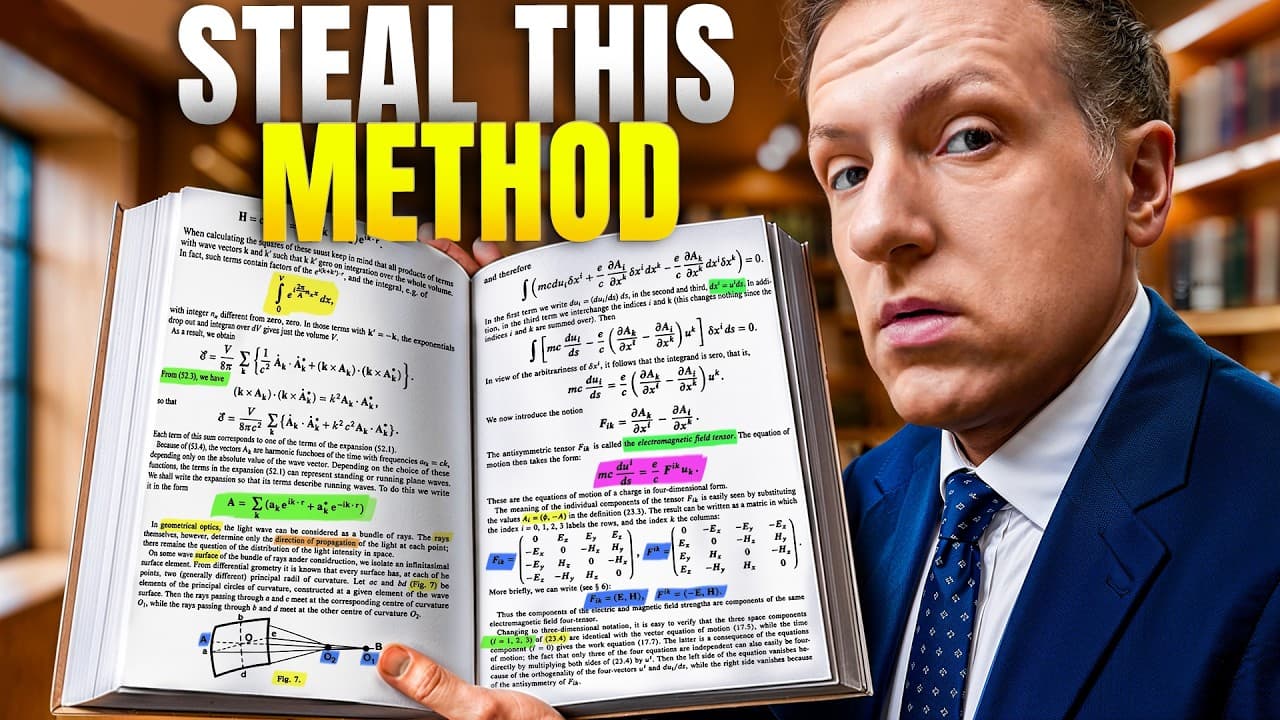
Build deep expertise by identifying the indispensable foundations of your field, mastering them until you can reconstruct ideas without notes, and judging your reasoning rather than merely checking answers. Landau’s system also requires prolonged struggle with difficult problems and public defense of your conclusions, turning knowledge into an active part of how you think.
Transcript
Genius isn't born, it's built. And one Soviet physicist left behind the blueprint. Between 1933 and 1961, exactly 43 people passed a single brutal exam in the USSR. Of that tiny handful, seven went on to make some of the most world-changing contributions to human knowledge in history. You see, these exam takers mastered a training system comprised ... Read More
Key Insights
- A theoretical minimum is the small body of foundational knowledge without which serious work in a field is impossible. Landau’s version was still extensive, covering eight or nine physics subjects plus two demanding mathematics exams across the ten-volume Course of Theoretical Physics.
- Collecting more information is not the same as building expertise. Additional books and courses can feel productive while leaving weaknesses in the core concepts on which advanced work depends, so learners should identify and repeatedly drill their most important foundations.
- True mastery is the ability to rebuild an argument or derive a concept from scratch without notes. A blank page reveals whether knowledge has become part of a learner’s thinking or remains dependent on prompts, copied formulas, and memorized wording.
- Independent expression is evidence of genuine understanding. Learners should be able to explain material in their own words, reconstruct its steps through their own reasoning, and synthesize ideas instead of reproducing information through rote recall.
- The reasoning process is part of the test, not merely a path to the final answer. Landau returned every 15 or 20 minutes to observe how candidates attacked problems, allowing him to assess whether their methods reflected authentic physical understanding.
- An unconventional solution can be valid when its reasoning is sound. Boris Ioffe reached a correct answer through a route Landau had not anticipated, and Landau accepted the work after examining it rather than rejecting it for departing from an expected method.
- Productive struggle develops capability when learners resist premature access to solutions. Ioffe deliberately collected problems without their answers and spent nearly two years completing the minimum, repeatedly working through frustration instead of taking shortcuts.
- Publicly defending an answer is part of rigorous mastery. The curriculum’s fifth principle extends learning beyond private problem solving by requiring learners to explain and support their conclusions before others, testing whether their understanding remains coherent under scrutiny.
Install to Summarize YouTube Videos and Get Transcripts
Explore YouTube Video Summarizer or Get YouTube Transcript Extractor
Questions & Answers
Q: How do you define a theoretical minimum for a field?
Define a theoretical minimum by identifying the small set of foundational subjects, principles, or skills that all serious work in your field depends on. Look for gaps in the three or four areas supporting everything else, then judge whether you have achieved genuine mastery or only become good enough. Revisit and drill those foundations repeatedly before accumulating more peripheral material.
Q: Why did Landau call his curriculum the theoretical minimum?
Landau called it the theoretical minimum because it represented the fundamental core a student needed for serious theoretical work, not because it was easy or narrow. His minimum included mechanics, field theory, quantum mechanics, statistical physics, continuous media, electrodynamics, additional subjects, and two demanding mathematics exams, with the material condensed into the ten-volume Course of Theoretical Physics.
Q: How can you test whether you truly understand a concept?
Close your books and notes, begin with blank paper, and try to rebuild the concept or argument from scratch. Derive the necessary steps, express them in your own words, and connect them through your own reasoning. If the empty page produces panic or nothing comes to mind, that response reveals a weakness that recognition-based studying may have concealed.
Q: Why is memorization insufficient for deep mastery?
Memorization can preserve formulas, facts, or familiar sequences without giving a learner the ability to use them independently. Landau’s candidates had to leave every book, note, and scrap of paper at the door, then derive solutions from what they genuinely understood. Mastery therefore required synthesis, reconstruction, and original expression rather than the rote reproduction of stored information.
Q: Why did Landau observe the solution process instead of only checking answers?
Landau wanted to determine whether a real physicist was reasoning at the table, not merely whether someone could produce the expected result. He returned every 15 or 20 minutes and examined each candidate’s developing work. By watching the method, he could evaluate the structure of the reasoning, including sound approaches that were unconventional, indirect, or initially unfamiliar to him.
Q: Can an inefficient or unconventional solution still demonstrate mastery?
An unconventional route can demonstrate mastery when its reasoning is sound and it reaches a correct result. During a statistical physics exam, Boris Ioffe used an approach Landau had not anticipated. Although Landau initially reacted with concern and Lifshitz wanted the attempt stopped, Ioffe received another 20 minutes, completed the solution correctly, and had his work accepted.
Q: How does discomfort help develop expertise?
Discomfort identifies the boundary between familiar performance and undeveloped capability. Landau’s problems were difficult enough to require about an hour each, with two or three appearing in a sitting. Ioffe prepared by seeking problems, refusing to request their solutions, and working through repeated frustration. Completing the theoretical minimum took him nearly two years of sustained independent effort.
Q: Why should learners defend their answers in public?
Publicly defending an answer tests whether understanding is organized, explainable, and resilient under scrutiny. It requires more than privately reaching a conclusion because the learner must articulate the reasoning and support the result before others. Within the five-principle system presented, this final practice complements foundational mastery, independent reconstruction, process-focused assessment, and sustained engagement with difficult problems.
Summary & Key Takeaways
-
Lev Landau’s theoretical minimum focused students on the core subjects required for serious theoretical work. Although called a minimum, it covered eight or nine physics subjects and two demanding mathematics exams. The broader lesson is to identify the few foundational areas supporting an entire field and repeatedly strengthen any gaps in them.
-
Landau tested whether students could reconstruct knowledge independently. Candidates left books and notes outside, entered a room with blank paper, and solved problems from principles held in their minds. This exposed the difference between memorizing material and genuinely understanding it well enough to derive, synthesize, and express it in one’s own words.
-
The examination valued reasoning, productive struggle, and defensible understanding. Landau repeatedly observed each candidate’s approach, accepted sound unconventional routes, and assigned problems demanding sustained effort. Preparation could take years and required resisting solution shortcuts. The full curriculum also expected students to defend their answers publicly rather than rely only on private confidence.
Read in Other Languages (beta)
Share This Summary 📚
Summarize YouTube Videos and Get Video Transcripts with 1-Click
Try YouTube Summary with ChatGPT & Claude or YouTube Transcript Generator
Explore More Summaries from Stephen Petro 📚
Summarize YouTube Videos and Get Video Transcripts with 1-Click
Try YouTube Summary with ChatGPT & Claude or YouTube Transcript Generator