How to Build Strong Arguments With Toulmin's Model
TL;DR
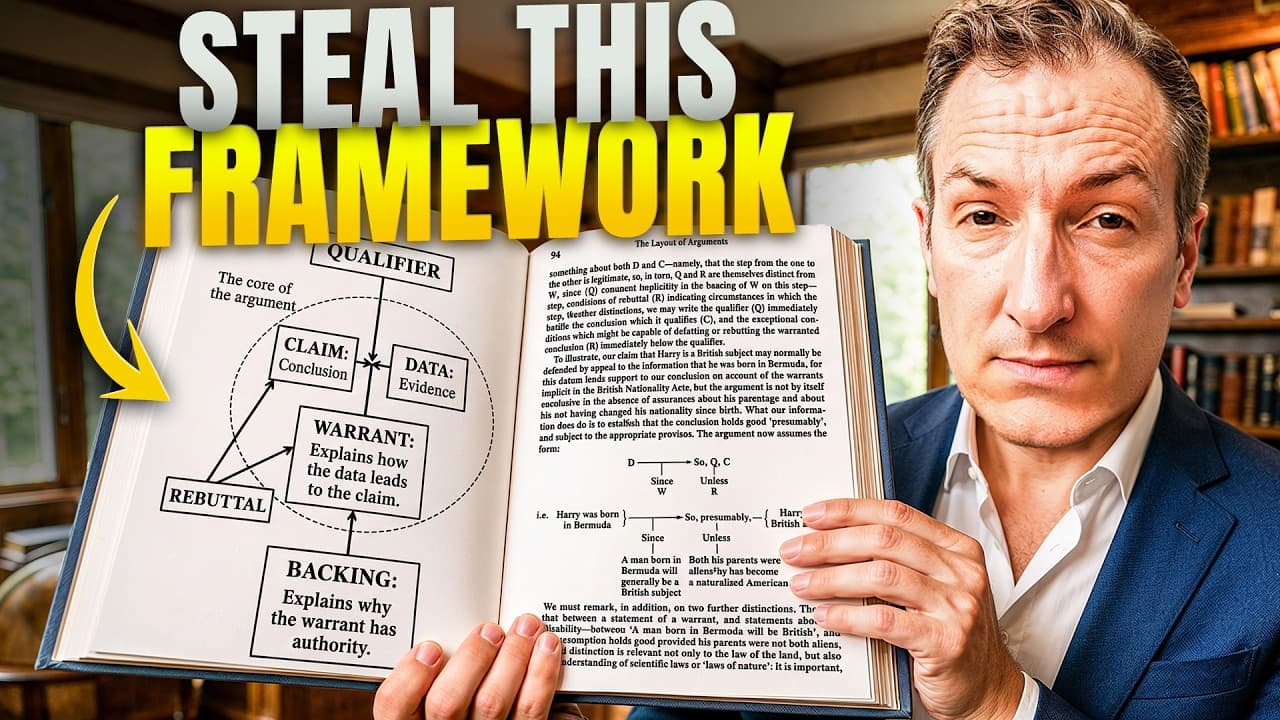
Build a persuasive argument with six connected elements: a precise claim, factual grounds, a warrant linking the evidence to the conclusion, backing for that warrant, an honest qualifier, and anticipated rebuttals. The framework strengthens reasoning by exposing hidden assumptions, matching support to the relevant field, limiting claims to what the evidence can sustain, and preparing for conditions under which the conclusion could fail.
Transcript
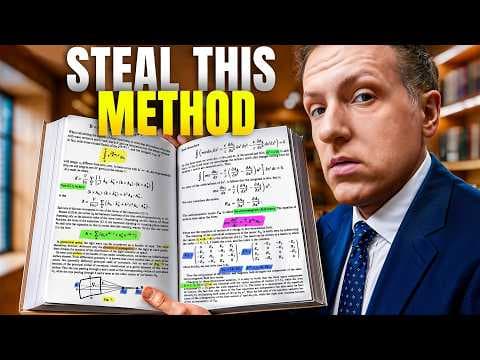
What if you could replicate the exact reasoning structure the best lawyers in the world use to win all without ever setting foot in a law school? Well, that's exactly what Stephen Toulmin lays out in his highly influential book, The Uses of Argument. Over my more than 13 years as a peer-reviewed scholar and educator, I found Toulmin's framework to ... Read More
Key Insights
- A claim is the precise conclusion an argument asks another person to accept. It should be stated in one sentence and framed specifically enough that the audience can meaningfully accept, reject, or rule on it, rather than being buried beneath complaints, feelings, and loosely connected grievances.
- Grounds are the facts and evidence on which a claim rests. Effective advocates investigate the complete factual picture, identify evidence that can persuade the intended audience, and avoid substituting subjective feelings or selectively preferred facts for information that both sides can examine.
- A warrant is the principle connecting the grounds to the claim. Because warrants are commonly assumed rather than stated, they are often the most vulnerable part of an argument, and making them explicit reveals whether the evidence is genuinely relevant to the proposed conclusion.
- Backing is the deeper authority that justifies a warrant when someone questions why its standard should be accepted. The appropriate form varies by domain, including statutes and precedents in law, experiments in science, studies in medicine, and ethical theories in value theory.
- A qualifier is an honest indication of how strongly the evidence supports a claim. Terms such as "presumably," "in most cases," and "beyond a reasonable doubt" prevent overstatement and protect an argument from being destroyed merely because an opponent finds one exception.
- Careful qualification is a strategic strength rather than an admission of failure. Charles Hamilton Houston pursued narrower cases involving graduate and law schools, where inequality was especially difficult to defend, and each qualified victory supplied backing for the next, broader legal challenge.
- A rebuttal identifies the conditions under which a claim would fail. Skilled advocates examine counterarguments early, recognize the strongest obstacle to their position, and design their strategy around it instead of ignoring vulnerabilities until an opponent raises them.
- A counterargument can be addressed directly or taken to its logical consequences. Houston responded to the separate-but-equal rule by demanding actual equality, targeting institutions where compliance would be difficult rather than beginning with a premature direct assault on the controlling precedent.
- More videos from this channel:
- More from this channel: Stephen Petro
Install to Summarize YouTube Videos and Get Transcripts
Explore YouTube Video Summarizer or Get YouTube Transcript Extractor
Questions & Answers
Q: What are the six parts of Toulmin's argument model?
The six parts are the claim, grounds, warrant, backing, qualifier, and rebuttal. The claim states the desired conclusion, while the grounds provide supporting facts. The warrant connects those facts to the conclusion, and backing justifies that connecting principle. The qualifier calibrates how strongly the conclusion follows, while the rebuttal identifies circumstances or counterarguments that could cause the claim to fail.
Q: How do you write a clear claim in an argument?
Write the claim as one precise sentence stating exactly what you want the audience to accept. It should identify a conclusion that can be meaningfully evaluated rather than merely expressing dissatisfaction or moral disapproval. Charles Hamilton Houston's argument focused specifically on whether state-mandated school segregation violated the United States Constitution, giving courts a defined proposition on which they could rule.
Q: What counts as grounds in the Toulmin model?
Grounds are concrete facts or evidence that support the claim and can be examined by both sides. A request for a raise, for example, could cite closing 40% of the team's deals rather than feeling underappreciated. Good grounds require research into the entire factual picture, including inconvenient information, rather than collecting only evidence that confirms the advocate's preferred conclusion.
Q: What is a warrant in an argument?
A warrant is the principle explaining why the stated grounds support the claim. In the advice "It is raining, so take an umbrella," the implied warrant is that rain makes people wet and that staying dry is preferable. Because this connecting assumption is often left unspoken, identifying it helps reveal where an argument is strongest or most vulnerable to challenge.
Q: What is the difference between a warrant and backing?
A warrant connects evidence to a conclusion, while backing supplies the authority or justification for accepting that connection. Houston's warrant relied on equal protection, and its backing included the text of the 14th Amendment and case law interpreting it. If an opponent asks why the warrant's standard should be accepted, the backing provides the argument's deeper supporting foundation.
Q: Why does backing change across different fields?
Backing changes because different fields recognize different forms of authority and proof. A legal warrant may be supported by constitutional text, statutes, and precedents, while a scientific warrant may require experiments and a medical warrant may require studies. The six-part argumentative structure remains consistent, but the kind of evidence capable of validating its underlying principle depends on the domain.
Q: Why should an argument include a qualifier?
A qualifier states how strongly or broadly the evidence supports a claim through language such as "presumably," "in most cases," or "beyond a reasonable doubt." It prevents the advocate from claiming more than the evidence establishes. An absolute claim may be defeated by a single exception, whereas a carefully limited claim can remain defensible and create a foundation for broader arguments later.
Q: How should you handle rebuttals in an argument?
Identify rebuttals early by asking under what conditions the claim would fail and which counterargument presents the strongest obstacle. Then either challenge the objection directly or accept its stated principle and pursue its logical consequences. Houston used the second method against separate-but-equal doctrine by demanding that institutions actually provide equality and selecting cases where unequal treatment was especially difficult to defend.
Summary & Key Takeaways
-
Toulmin's framework begins with a claim, the specific conclusion an audience is being asked to accept, and grounds, the relevant facts supporting it. Strong advocates define the claim before speaking and gather a complete body of evidence rather than relying on grievances, feelings, outrage, or only the facts they prefer.
-
The warrant is the often unstated principle that connects the grounds to the claim, while backing supplies the deeper authority that justifies that principle. Appropriate backing depends on the field: legal arguments use statutes and precedents, scientific arguments use experiments, medical arguments use studies, and value theory may rely on ethical theories.
-
Qualifiers honestly calibrate a claim's strength, making it harder to defeat with a single exception. Rebuttals identify circumstances in which the claim could fail. Charles Hamilton Houston demonstrated both practices by pursuing carefully limited legal victories and responding strategically to the separate-but-equal precedent instead of immediately attacking it head-on.
Read in Other Languages (beta)
Share This Summary 📚
Summarize YouTube Videos and Get Video Transcripts with 1-Click
Try YouTube Summary with ChatGPT & Claude or YouTube Transcript Generator
Explore More Summaries from Stephen Petro 📚

Summarize YouTube Videos and Get Video Transcripts with 1-Click
Try YouTube Summary with ChatGPT & Claude or YouTube Transcript Generator