How to Think on Paper for Clearer Learning
TL;DR
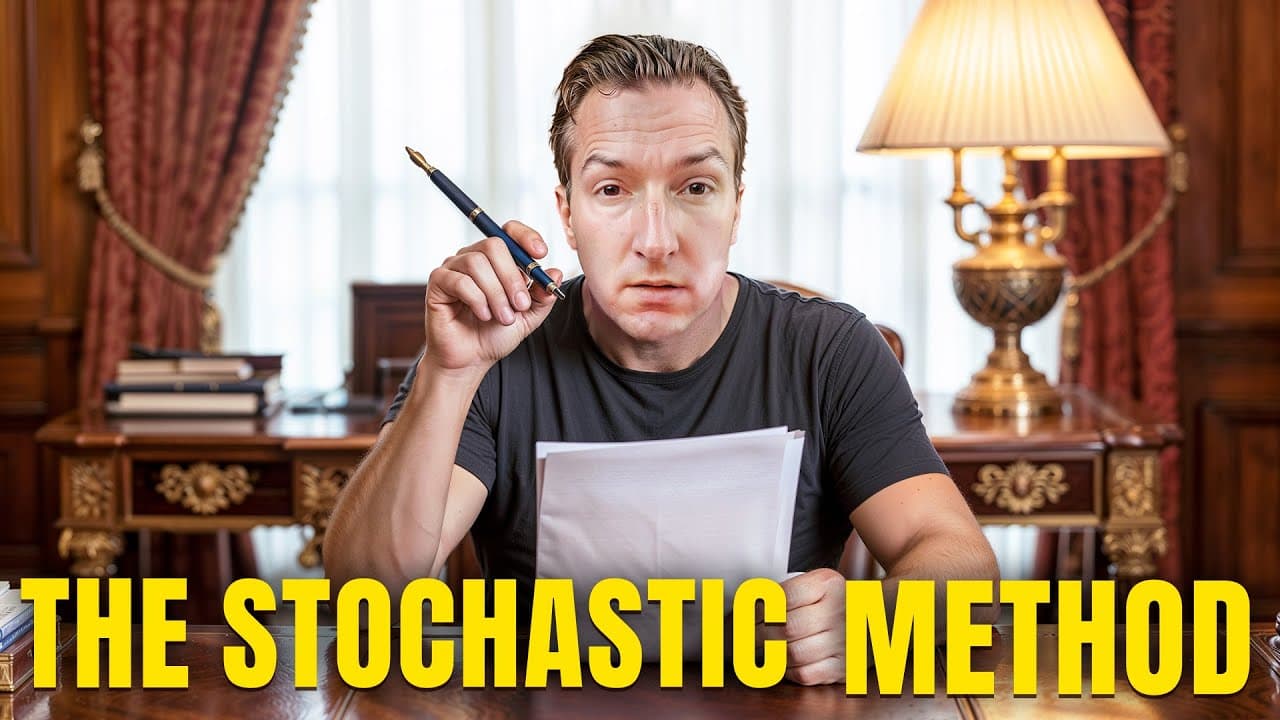
Capture interesting thoughts without judging their immediate relevance, connect those notes into narratives, then develop your strongest ideas through freewriting and weekly argumentative essays. This three-step practice turns scattered observations into organized understanding, improves retention, and gives original ideas enough time and structure to mature.
Transcript
Thinking on paper is one of the most enriching activities you can engage in for your mind, for your body, for your spirit. And no, thinking on paper isn't just another way of saying writing. In this video, I'm going to show you a three-step system I've developed over my years as a peer-reviewed researcher in the field of value theory that will help... Read More
Key Insights
- Stochastic note-taking is the practice of recording thoughts whenever a passage feels important or interesting, even when its relevance is unclear. This intentionally loose process increases the number of intellectual seeds available for later comparison, development, and selection.
- Excessive structure can limit discovery because a rigid research goal may exclude observations that later prove valuable. Some note organization is useful for focused work, but intuitive feedback, critiques, and syntheses can generate ideas that targeted note-taking would miss.
- Narrative formation is the bridge between scattered information and clarity. Laying notes out together makes patterns, recurring topics, agreements, contradictions, and cross-source implications visible, allowing separate observations to become parts of a coherent account.
- Narratives support retention by connecting complex ideas through relationships rather than storing them as isolated facts. The speaker argues that building new narratives is more effective for remembering information than primarily reviewing stored material or relying heavily on second-brain applications.
- Freewriting is a method for capturing insights that arise after the mind has processed substantial information. Because these ideas often appear during a walk, while relaxing, or before sleep, an accessible notebook or digital journal can preserve them before they fade.
- Nonjudgmental recording is essential because early censorship can prevent a promising idea from developing. An intuition may initially seem unsupported, inaccurate, unusual, or poorly reasoned, but its eventual value cannot be determined before it has been explored.
- Weekly argumentative essays turn raw notes and freewriting into larger, organized positions. Writing for a specific viewpoint forces the learner to sift ideas, build overarching narratives, identify weaknesses, improve clarity, and practice presenting evidence and reasoning.
- Polished thinking is the result of repeated intellectual practice rather than initial perfection. The speaker attributes the apparent preparedness of strong speakers, commentators, and innovators to recurring versions of note capture, narrative construction, freewriting, and argumentation.
Install to Summarize YouTube Videos and Get Transcripts
Explore YouTube Video Summarizer or Get YouTube Transcript Extractor
Questions & Answers
Q: How do you think on paper effectively?
Thinking on paper effectively involves three connected steps. First, record interesting reactions, critiques, and intuitions without demanding immediate relevance. Second, review those notes and translate their relationships into narratives that show patterns, agreements, or conflicts. Third, capture new insights through nonjudgmental freewriting and regularly turn the strongest material into essays that argue for a specific viewpoint.
Q: What is stochastic note-taking?
Stochastic note-taking is a deliberately loose method of recording thoughts based on an intuition that something is important or interesting. A note might contain feedback, criticism, or a synthesis rather than merely marking a passage. Its usefulness does not need to be obvious immediately. Later comparison with other notes can reveal which observations deserve further development.
Q: Why can highly structured note-taking restrict learning?
Highly structured note-taking can restrict learning when it filters every observation through a predetermined research goal. That approach may exclude unexpected passages or reactions whose importance becomes clear only later. The speaker still accepts structure for focused research, but recommends leaving room for intuitive notes because the learner cannot reliably predict which early thoughts will produce the strongest ideas.
Q: How can scattered notes be turned into clear ideas?
Scattered notes become clearer when they are collected, reviewed, and compared across topics and sources. The learner can identify recurring interests, agreements between authors, conflicting evidence, and conclusions implied by multiple observations. Writing those relationships in narrative form replaces a disconnected collection with a coherent sequence, giving promising ideas enough structure to develop further.
Q: Why are narratives useful for remembering complex information?
Narratives are useful because they connect separate facts, thinkers, arguments, and disagreements into a coherent account. Instead of trying to remember each item independently, the learner remembers how one idea influenced, extended, synthesized, or diverged from another. The speaker argues that actively constructing these relationships supports retention better than relying primarily on stored information, repeated review, or mind maps.
Q: When should you capture an idea through freewriting?
An idea should be captured as soon as it appears, especially because insights may arise outside scheduled writing periods. The speaker mentions ideas occurring while relaxing, walking, or preparing to sleep. A pocket notebook, physical journal, or accessible digital document can be used immediately. Fast capture prevents the thought from fading before it can be examined and connected to earlier notes.
Q: Why should freewriting be nonjudgmental?
Freewriting should be nonjudgmental because an idea's eventual value may not be visible in its earliest form. Censoring a thought because it sounds unusual, unsupported, inaccurate, or poorly reasoned can stop it before development begins. Many ideas will remain weak, but allowing unrestricted initial expression preserves the possibility that a rough intuition can mature through later evidence, reasoning, and revision.
Q: How do weekly essays improve critical thinking?
Weekly essays require the learner to sift accumulated notes, freewriting, and smaller narratives into an overarching argument. Defending a specific viewpoint exposes unclear explanations, weak evidence, logical problems, and unresolved flaws. Repeating the process builds practice in organizing and presenting ideas. The goal is not immediate satisfaction, but continued improvement through writing even when the result still feels imperfect.
Summary & Key Takeaways
-
The first step is stochastic note-taking, which means recording feedback, critiques, connections, and intuitions whenever something feels important or interesting. Notes do not need immediate relevance or a rigid structure. Treating thoughts as seeds creates a broad supply of raw material from which stronger ideas can eventually emerge.
-
The second step is translating scattered notes into narratives. Reviewing notes together reveals recurring interests, agreements, conflicts, and connections across different sources. Writing these relationships as a coherent narrative helps organize and retain complex information. At this stage, promising ideas develop roots, although they may not yet represent original conclusions.
-
The third step combines nonjudgmental freewriting with regular argumentation. Capture unexpected ideas immediately in a pocket notebook, journal, or accessible digital document without censoring unusual or unsupported intuitions. Then sift through the accumulated material and write weekly essays that defend viewpoints, expose weaknesses, and progressively sharpen both thinking and communication.
Read in Other Languages (beta)
Share This Summary 📚
Summarize YouTube Videos and Get Video Transcripts with 1-Click
Try YouTube Summary with ChatGPT & Claude or YouTube Transcript Generator
Explore More Summaries from Stephen Petro 📚

Summarize YouTube Videos and Get Video Transcripts with 1-Click
Try YouTube Summary with ChatGPT & Claude or YouTube Transcript Generator