How to Educate Yourself Like a Genius Without School
TL;DR
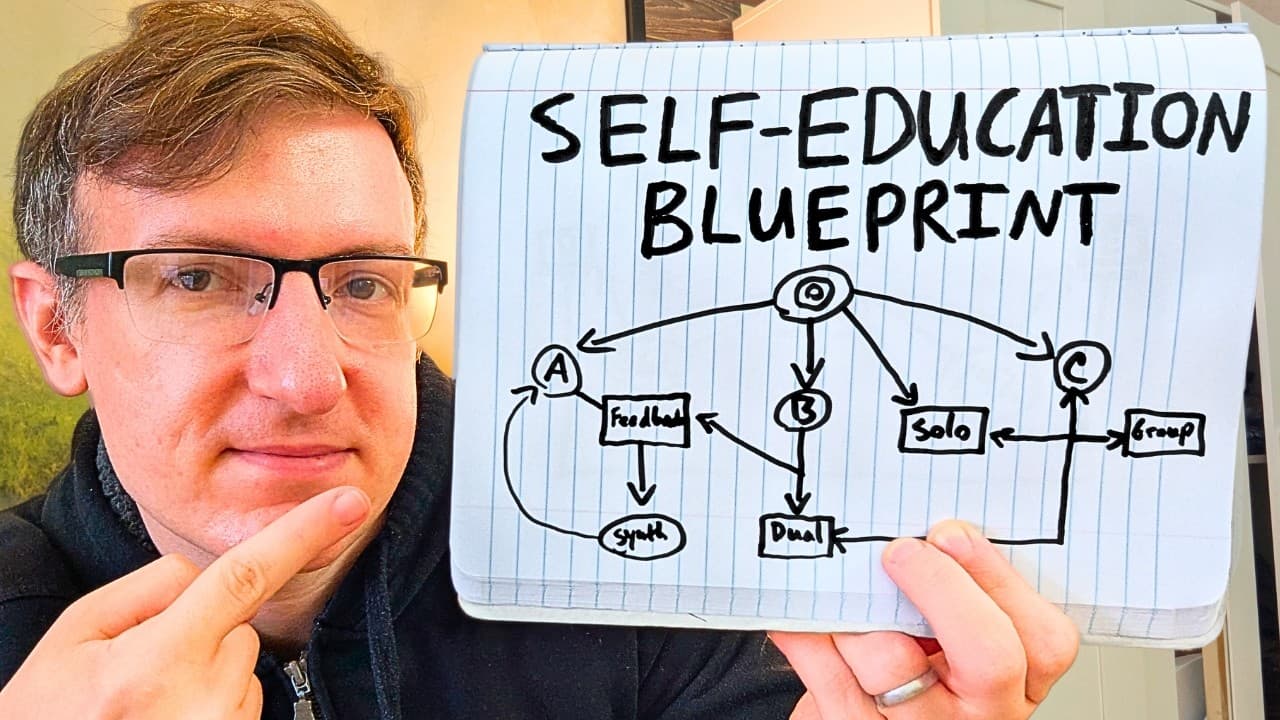
To teach yourself anything without school, choose a meaningful project, design a learning path, and reinforce your study through active practice. The three-step system recommends personalized tutoring when affordable, weekly study partners or ABC groups, and individual methods such as dual tasking, annotation, and teaching others. Read on for a practical structure that turns scattered information into relevant, memorable knowledge.
Transcript
you can teach yourself anything in fact you can literally get the equivalent of an Ivy League education and all without spending any money and I should know I have over 12 years of combined experience teaching students of all ages and abilities running a successful academic test prep agency and training highly profitable sales teams and in this vid... Read More
Key Insights
- Project-based learning is a way to identify the knowledge that matters for a real objective. A chosen project naturally reveals the skills required to complete it, reducing unfocused consumption of books, courses, and unrelated information while giving difficult subjects an immediate purpose.
- Personal relevance is a powerful source of learning motivation. Calculus and statistics became interesting to the creator only after they were needed to understand neuroscience research for a book, showing how a meaningful goal can change a learner's attitude toward previously disliked subjects.
- A teacher or tutor is the preferred learning-path option when affordable. Personalized support allows an experienced person to determine what the learner needs, introduce material at an appropriate time, customize instruction, and adjust the pace to fit the learner's progress and needs.
- Study partners are valuable because discussion adds nuance and stimulates curiosity. Other participants can correct misunderstandings, challenge assumptions, introduce unfamiliar evidence, and reveal perspectives that solitary learners may never encounter, creating new questions that guide the next stage of independent study.
- The ABC group structure is a repeatable process for collaborative learning. Participants jointly select topics, research them, present what they learned, receive constructive feedback, and accept assignments for the next meeting, combining preparation, explanation, evaluation, and continued accountability.
- Presentation assignments are effective because they expose gaps before the scheduled session. Knowing that a topic must be taught within a week pushes the presenter to locate resources, conduct research, ask unusual questions, and develop enough understanding to explain the subject clearly.
- Dual tasking is the pairing of a repetitive physical activity with a mental learning activity. Listening to an audiobook during a workout or commute uses otherwise empty time, while avoiding the conflicting cognitive demands that make conventional multitasking ineffective for focused learning.
- Annotation is an active process of recording, expanding, organizing, and connecting ideas. Quick notes or highlights can be refined later with personal observations and links to other books or concepts, while categorized notes make research easier to review instead of leaving it passively absorbed.
Install to Summarize YouTube Videos and Get Transcripts
Explore YouTube Video Summarizer or Get YouTube Transcript Extractor
Questions & Answers
Q: How can I teach myself a difficult subject without school?
Start with a project you genuinely want to complete, because it will reveal the specific knowledge and skills you need. Then create a learning path with a teacher, study partners, or individual study, and reinforce what you learn through annotation and teaching.
Q: What is the three-step system for teaching yourself anything?
First, engage in project-based learning so a concrete objective determines what you study. Second, design a learning path with a teacher or study partners; third, use targeted individual-learning techniques such as dual tasking, annotation, and teaching what you studied.
Q: What is project-based learning for self-education?
Project-based learning organizes study around completing something meaningful, such as a blog, book, hardware or software project, or YouTube channel. The project exposes the skills you actually need, helping you avoid accumulating disconnected books, courses, and information.
Q: Why can a meaningful project improve motivation to learn?
A meaningful project gives supporting subjects an immediate purpose. The creator became interested in calculus and statistics only after needing them to understand neuroscience research for a book, and ultimately earned A's in both subjects.
Q: How do I design a learning path for self-study?
If affordable, hire a teacher or tutor who can identify what you need to learn and customize the instruction and pace. Otherwise, find study partners who are interested in similar knowledge or skills and meet regularly to discuss and present new topics.
Q: How does a study group improve independent learning?
A study group adds nuance by allowing other people to correct misunderstandings and offer different perspectives. It also stimulates curiosity when participants introduce unfamiliar evidence or ideas that reveal what you need to investigate next.
Q: How should an ABC study group work?
Participants research assigned topics and present what they learned to a small group. The other attendees provide constructive feedback on strengths, weaknesses, misunderstandings, and possible improvements, after which members receive topics for the next session.
Q: What is dual tasking, and how can it support learning?
Dual tasking pairs a mental learning activity with a repetitive physical activity that requires relatively little attention. Examples include listening to a relevant audiobook during a workout or commute, allowing otherwise empty time to become consistent study time.
Summary & Key Takeaways
-
Project-based learning replaces disconnected information gathering with a concrete objective that determines which skills deserve attention. A personally meaningful project, such as writing a book, building software, or starting a channel, can make difficult supporting subjects feel relevant. That relevance increases motivation and can contribute to stronger retention of the material studied.
-
A learning path can include personalized instruction or a recurring study group. The proposed ABC group structure asks participants to research planned topics, present their findings, exchange constructive feedback, and receive new presentation assignments. Preparing to teach encourages deeper research, while feedback keeps listeners engaged and exposes misunderstandings, missing knowledge, and alternative perspectives.
-
Targeted individual learning consists of dual tasking, annotation, and teaching. Repetitive physical activities or other empty periods can support listening or reading without requiring a separate study block. Brief notes should later be expanded, categorized, and connected to prior ideas. Teaching then helps prevent organized information from becoming passive, quickly forgotten material.
Read in Other Languages (beta)
Share This Summary 📚
Summarize YouTube Videos and Get Video Transcripts with 1-Click
Try YouTube Summary with ChatGPT & Claude or YouTube Transcript Generator
Explore More Summaries from Stephen Petro 📚





Summarize YouTube Videos and Get Video Transcripts with 1-Click
Try YouTube Summary with ChatGPT & Claude or YouTube Transcript Generator