How to Read Hard Books and Retain Like a Genius
TL;DR
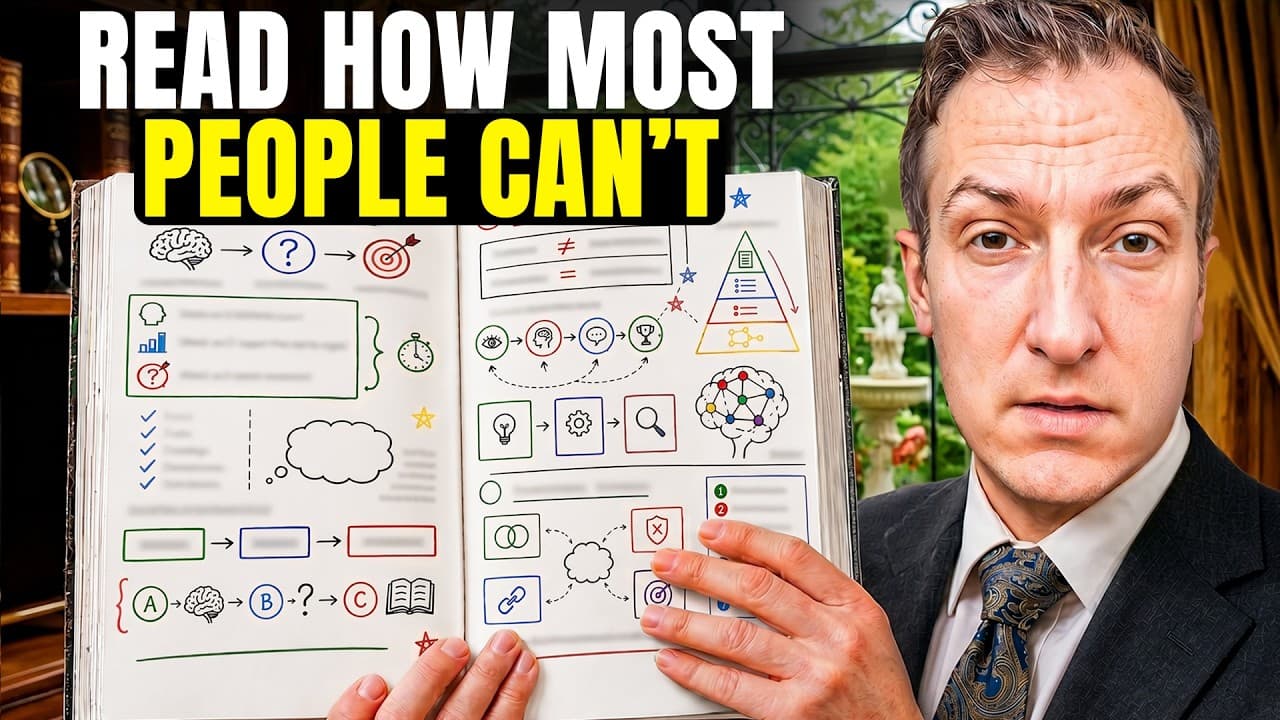
Pre activate your mind before reading to set hooks, then use active, generative reading to reproduce ideas in your own words. Compress dense material into three bullets and one sentence, then build networks by linking ideas to other concepts. Embrace difficulty and manage your mental state to improve focus and retention.
Transcript
Most people think reading comprehension is mainly about reading more carefully, taking better notes, or forcing themselves to reread difficult passages. But over my more than 13 years as an educator and peer-reviewed scholar, I found that the real difference lies in how deeply you process what you read. And in this video, I'm going to show you seve... Read More
Key Insights
- Pre activation uses schema theory to train your brain with what it already knows, guiding attention to relevant content.
- A 90 second pre eread helps you generate predictions and questions, creating mental hooks for the new material.
- Generative reading involves recalling main claims, reasoning, and examples after each section to improve deep understanding.
- Highlighting is insufficient for deep learning; reconstruction from memory is essential for true comprehension.
- Build compression layers by writing a memory based core idea, then three bullets, then a single sentence, then an analogy.
- Relational encoding links a new idea to similar concepts, oppositions, consequences, and real world applications to form a network.
- Desirable difficulties introduce strategic friction such as delayed reconstruction and closed book explanations to strengthen learning.
- State control emphasizes that attention quality profoundly affects encoding and retention during reading.
Install to Summarize YouTube Videos and Get Transcripts
Explore YouTube Video Summarizer or Get YouTube Transcript Extractor
Questions & Answers
Q: What is pre activation and why does it matter for reading comprehension?
Pre activation is the process of engaging your prior knowledge, expectations, questions, and mental categories before you read a serious text. It matters because having these hooks creates a scaffold in your mind, helping new information attach to existing structures. This leads to better attention, faster integration of ideas, and higher immediate retention, since the mind knows what to look for and how concepts relate to what you already know.
Q: What is the 90 second pre eread and what should you do during it?
The 90 second pre eread involves four steps: ask what you already know about the topic, what you expect the text will argue or explain, what you want answered by the end, and then scan the title, headings, intro, and conclusion to write one prediction. The point is to give your brain hooks and a plan, not to be right. This primes attention and supports later recall.
Q: How does generative reading differ from passive reading, and what practice reinforces it?
Generative reading treats meaning as something produced by both reader and author, not merely received. It requires you to reconstruct ideas in your own words after major sections and to explain them aloud as if teaching someone else. This practice strengthens deep understanding, because you are actively generating the idea rather than passively recognizing it, and it helps reveal gaps in comprehension.
Q: What is the compression layering technique and how is it executed?
Compression layering forces you to distill information into increasingly concise forms to strengthen memory and understanding. After finishing a section, write a memory based paragraph, reduce it to three bullets, reduce those to a single sentence, and create one analogy or concrete example. Then compare with the original notes to identify distortions. This process emphasizes core ideas and useful connections while trimming extraneous detail.
Q: What does relational encoding involve and why is it powerful?
Relational encoding connects new ideas to existing knowledge through networks. You pick a key idea and create four categories: similar to, opposes to, leads to, and applies to. You then articulate how each connection works in a single sentence. This builds a web of associations, making recall easier and understanding more transferable because new ideas relate to multiple existing concepts.
Q: What is desirable difficulty and how should it affect reading practice?
Desirable difficulty is the idea that some challenges in learning slow short term progress but strengthen long term retention. To apply it, introduce friction in reading through delayed reconstruction, closed book explanations, challenging the claim, and reading slightly above your comfort level. These strategies prevent the illusion of effortless understanding and promote deeper processing.
Q: What is state control in the context of reading, and why is it important?
State control refers to managing your attention and mental state while reading. Attention is upstream of other strategies, so a focused, stable mental state improves encoding and retention. Distractions or fragmented attention undermine comprehension, especially when tackling difficult material, making it crucial to cultivate methods that maintain concentration during reading sessions.
Q: What is the suggested workflow after each major section to reinforce learning, and what does it achieve?
After each major section, you should recall the main claim, why the author thinks it is true, and an example that clarifies it. Then you rephrase those ideas aloud if possible. This workflow forces you to reconstruct and articulate understanding, reducing reliance on the book wording and boosting long term retention and ability to apply the ideas in new contexts.
Summary & Key Takeaways
-
Pre activation primes your mind with background knowledge and questions, creating a scaffold for new information and improving immediate retention.
-
Generative reading requires you to restate ideas in your own words after sections, test understanding, and explain aloud to ensure true grasp rather than surface recognition.
-
Compression and relational encoding turn scattered notes into compact, connected networks of ideas, increasing recall and transfer to new contexts.
Read in Other Languages (beta)
Share This Summary 📚
Summarize YouTube Videos and Get Video Transcripts with 1-Click
Try YouTube Summary with ChatGPT & Claude or YouTube Transcript Generator
Explore More Summaries from Stephen Petro 📚



Summarize YouTube Videos and Get Video Transcripts with 1-Click
Try YouTube Summary with ChatGPT & Claude or YouTube Transcript Generator