How to think strategically under uncertain conditions
TL;DR
The core idea is to expand the set of possible responses before choosing a strategy. A flexible mind reduces strategic fragility when environments shift, and thinking in time helps anticipate how actions ripple through a system. Build diverse perspectives and routinely audit assumptions to stay adaptable and effective in complex situations.
Transcript
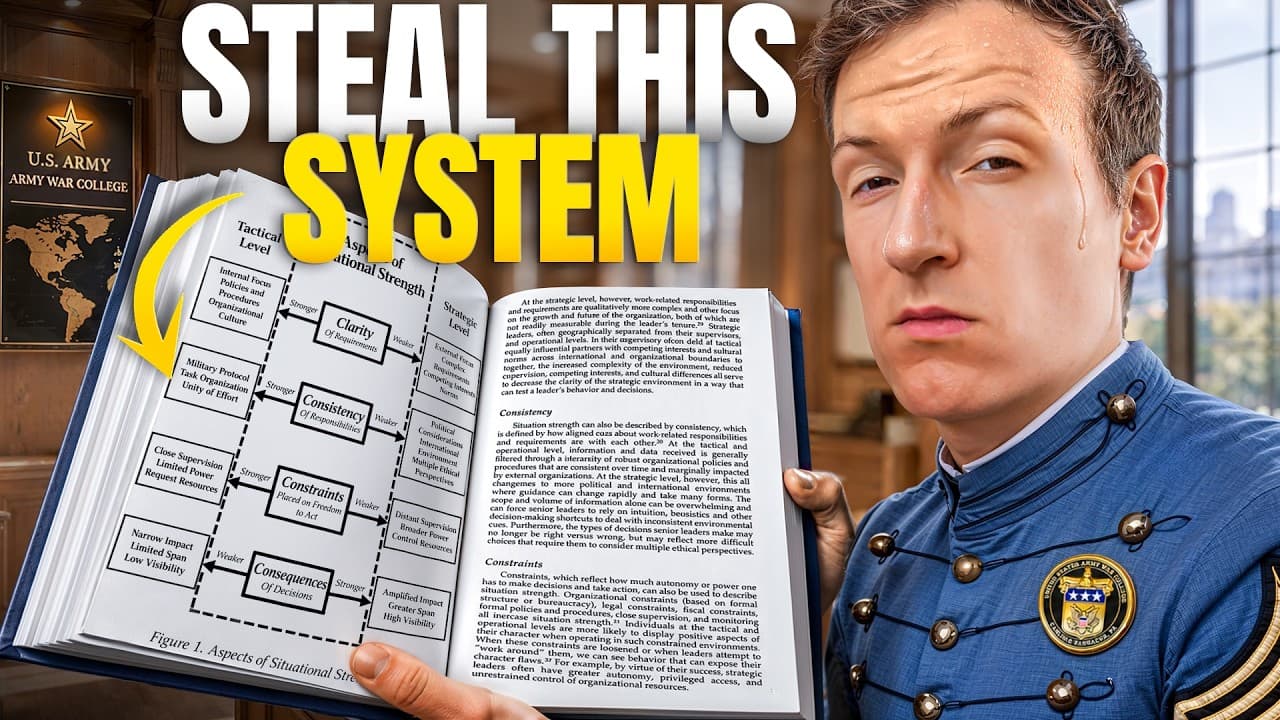
Your most dangerous failure begins long before you make a bad decision. Instead, it begins when you're faced with 10 possible situations. Yet, your mind has only one response. And this is precisely the problem the US Army War College tries to solve in its strategic leadership primer for senior leaders, fourth edition, edited by Tom Galvin and Dale ... Read More
Key Insights
- Variety matters because a single response makes you strategically fragile when the environment changes.
- Thinking in time means evaluating how conditions could remain true, what could alter them, and what new incentives or constraints will arise.
- Map the system, not the event, to understand how people and constraints will react to your actions and change the environment over time.
- A strategic council of four perspectives prevents bias and ensures you see what you might be failing to see.
- Third order effects are crucial: anticipate how initial actions will prompt responses that require new actions from you.
- Assumption audits help expose the conditions sustaining current success and identify signals that these conditions may be changing.
- Build a mind larger than your own by combining conceptual, technical, and interpersonal competencies.
- Operational success depends on leveraging teams, networks, and diverse knowledge rather than depending on a lone genius.
Install to Summarize YouTube Videos and Get Transcripts
Explore YouTube Video Summarizer or Get YouTube Transcript Extractor
Questions & Answers
Q: How does increasing variety in responses strengthen strategic decision making
Increasing variety strengthens strategic decision making by expanding the range of disturbances you can reliably manage. If you possess only one usable response to a problem, you become vulnerable when the environment shifts. Building multiple, distinct responses that work under different conditions reduces this vulnerability and improves your capacity to adapt when uncertainty rises.
Q: What does it mean to map the system rather than the event
Mapping the system means considering how people observe your actions, react, and alter the environment in which future decisions occur. It involves recognizing second and third order effects and asking what actions will cause others to do next and what those reactions will require you to do. This helps avoid unintended consequences from simple, isolated actions.
Q: Why is thinking in time important in strategic planning
Thinking in time is important because organizations repeat past successes unless the environment changes. By auditing assumptions and asking what conditions must stay true, what is out of control, and what early signals indicate a shift, you can anticipate when your current approach will stop working and begin adapting before it is too late.
Q: How can you build a mind larger than your own
You build a mind larger than your own by assembling a strategic council with four diverse perspectives: someone who understands the larger system, someone with relevant technical knowledge, someone who understands the affected people, and someone willing to challenge the conclusion. This structure helps avoid bias and enriches decision making with complementary expertise.
Q: What role does empathy play in strategic leadership
Empathy in strategic leadership is about understanding others’ perspectives, constraints, and motivations to align goals and actions. It supports better collaboration, reduces friction, and helps ensure the chosen strategy is feasible for those who must implement and adapt it, rather than merely theoretically sound.
Q: What is the core message of Ashby’s law of requisite variety in this context
Ashby’s law of requisite variety implies that the complexity of your internal responses must match environmental complexity. If your internal options are too few, you cannot effectively respond to a range of disturbances, increasing strategic fragility. The video translates this into practical advice to broaden the set of actionable responses.
Q: How does a response audit help in strategic planning
A response audit helps by forcing you to list possible situations and the concrete actions you could take in each case. It reveals gaps where you lack viable responses, highlighting strategic vulnerabilities. This process enhances preparedness and flexibility, enabling quicker, well-informed pivots when conditions change.
Q: What is the value of a four-perspective strategic council
A four-perspective strategic council provides diverse insights that enrich interpretation of complexity, mobilize necessary knowledge, and ensure accountability. Each member covers a critical domain—system understanding, technical expertise, people impact, and constructive challenge—reducing bias, improving feasibility, and supporting more robust, adaptable decisions.
Summary & Key Takeaways
-
A practical system for thinking under incomplete information is introduced, focusing on expanding your repertoire of responses and mapping how actions influence others in a complex environment. This approach emphasizes adaptability, anticipation of second and third order effects, and continuous reassessment of assumptions to maintain strategic relevance.
-
The video outlines four principles from the Army War College primer: increase variety, map the system, think in time, and build a mind larger than your own, all supported by concrete examples showing how rigid plans fail when conditions change.
-
A practical method called a response audit plus a three order map is described to help leaders foresee consequences and adapt plans, rather than relying on one fixed solution, thereby improving decision quality in dynamic settings.
Read in Other Languages (beta)
Share This Summary 📚
Summarize YouTube Videos and Get Video Transcripts with 1-Click
Try YouTube Summary with ChatGPT & Claude or YouTube Transcript Generator
Explore More Summaries from Stephen Petro 📚

Summarize YouTube Videos and Get Video Transcripts with 1-Click
Try YouTube Summary with ChatGPT & Claude or YouTube Transcript Generator