How Can Visual Math Proofs Produce False Results?
TL;DR
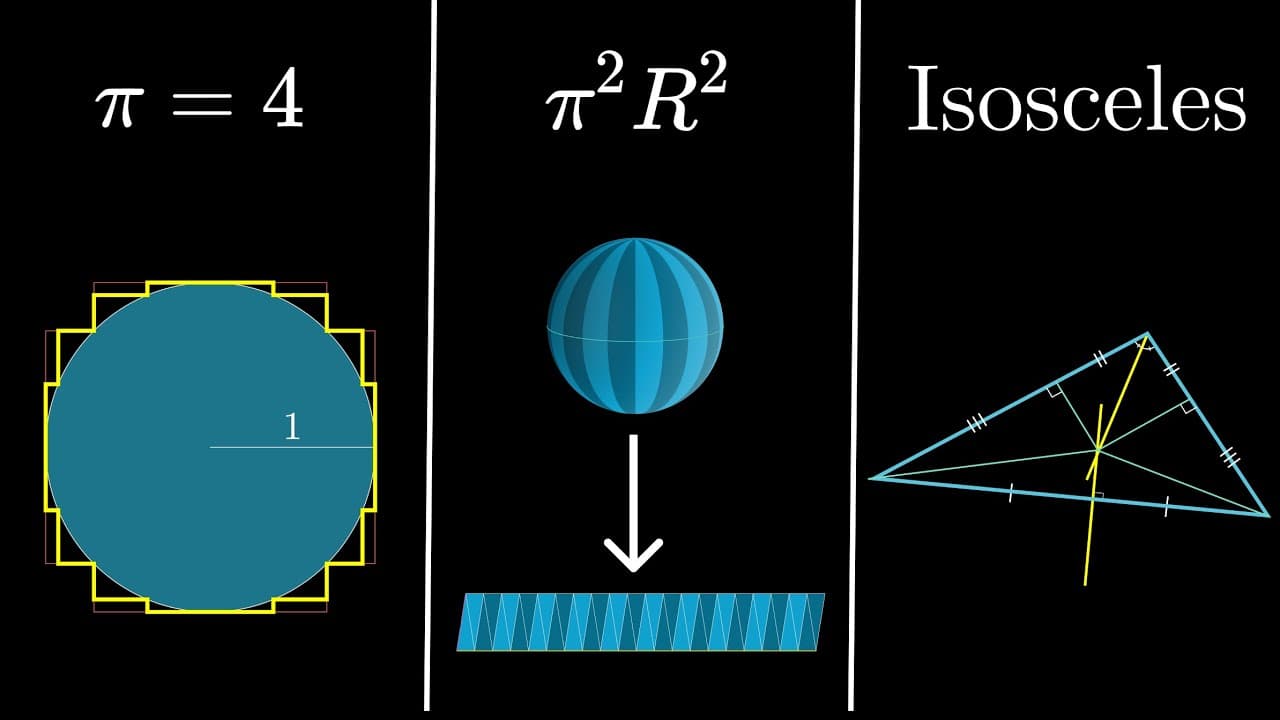
Visual proofs can produce false conclusions when limiting shapes preserve appearance but not the quantity being measured, or when a diagram hides an invalid geometric relationship. The sphere argument mishandles rearranged curved slices, the pi argument assumes curve length survives pointwise convergence, and the triangle argument incorrectly adds segments whose actual positions do not support that addition.
Transcript
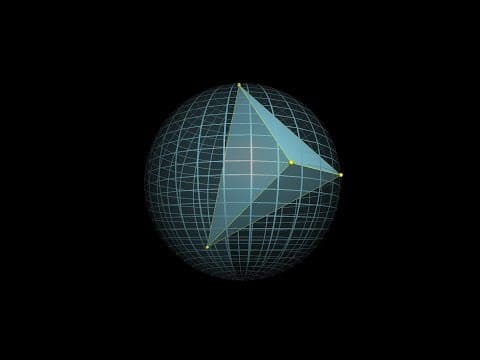
Today I'd like to share with you three fake proofs in increasing order of subtlety, and then discuss what each one of them has to tell us about math. The first proof is for a formula for the surface area of a sphere, and the way that it starts is to subdivide that sphere into vertical slices, the way you might chop up an orange or paint a beach bal... Read More
Key Insights
- The sphere’s surface area is stated as 4 pi R squared, while the rearrangement argument produces pi squared times R squared. The disagreement reveals that the apparently rectangular limiting arrangement does not preserve or represent the spherical surface area in the way the argument assumes.
- The fake sphere proof is persuasive because it translates a difficult surface-area problem into a familiar rectangle. Its elegance, surprise, and intuitive appearance resemble accepted visual arguments, which makes identifying the unjustified geometric step more difficult than merely noticing that the final formula is wrong.
- The pi-equals-4 construction starts with a unit circle inside a tangent square whose perimeter is 8. Repeatedly folding the corners changes the order of directional movement without changing total length, so every jagged curve in the sequence continues to have length 8.
- The limiting parametric function in the pi argument traces the genuine smooth circle. For every fixed parameter value, the corresponding sequence of points approaches a point on the circle, showing that the curves can converge point by point even though their lengths do not approach the circle’s circumference.
- Curve length is not guaranteed to be preserved under the limiting process used in the construction. The example separates convergence of points on parameterized curves from convergence of their measured lengths, so identifying the limiting shape alone is insufficient to determine its perimeter.
- The triangle proof begins with an arbitrary triangle and constructs the perpendicular bisector of BC, the angle bisector at A, and their intersection P. Additional perpendiculars create several right triangles whose claimed congruences generate equal segment lengths on the two sides of the original triangle.
- The triangle argument’s final addition assumes that AF plus FB equals AB and that AE plus EC equals AC. Those equations require the labeled points to lie between the corresponding vertices, but the visually convenient placement of the points cannot be accepted without geometric justification.
- Rigor requires more than formal-looking deductions from a diagram. A proof can use valid congruence relations and still reach a false result when it silently assumes an incorrect ordering, location, continuity property, or relationship between a sequence and the measurement applied to its limit.
Install to Summarize YouTube Videos and Get Transcripts
Explore YouTube Video Summarizer or Get YouTube Transcript Extractor
Questions & Answers
Q: Why does the visual proof for a sphere’s area fail?
The argument cuts the sphere into vertical wedges, rearranges them, and treats the increasingly fine arrangement as a rectangle with sides 2 pi R and pi halves times R. That multiplication gives pi squared times R squared, but the transcript states that the true surface area is 4 pi R squared. The apparent rectangle therefore does not justify the claimed preservation and calculation of surface area.
Q: How does the false proof claim that pi equals 4?
The construction surrounds a unit circle with a tangent square whose perimeter is 8. It repeatedly folds each corner inward until the new pieces touch the circle. Each fold exchanges movement in one direction followed by another direction, so no length is gained or lost. The resulting curves approach the circle, leading to the false conclusion that the circle’s circumference is 8 and pi is 4.
Q: Why do all the jagged curves in the pi construction have length 8?
At every fold, a portion that previously travels in direction A and then direction B is replaced by a portion that travels in direction B and then direction A. The same component lengths remain, only their order changes. Because this occurs at every folded corner, each complete jagged curve retains the original tangent square’s perimeter of 8 throughout the sequence.
Q: Does the limiting curve in the pi proof really equal the circle?
Yes, according to the parameterization described in the transcript. For a fixed parameter value, such as 0.2, the sequence of points produced by the successive curve functions has a well-defined limit on the circle. Applying this process to every parameter value defines a limiting function that traces the genuine smooth circle, not merely another jagged approximation.
Q: Why does convergence to a circle not make the curve lengths converge correctly?
The construction demonstrates that pointwise convergence of parameterized curves does not by itself preserve length. Each curve in the sequence has length 8, so the limit of their lengths is also 8, while the limiting function traces the smooth circle. The invalid step is assuming that measuring length and taking this limit can be interchanged simply because the points of the curves converge.
Q: How does the false proof claim that every triangle is isosceles?
The proof draws the perpendicular bisector of BC and the angle bisector at A, meeting at P. Perpendiculars from P to AB and AC create points F and E. Claimed triangle congruences imply AF equals AE and FB equals EC. Adding those equalities appears to give AB equals AC, and repeating the unrestricted reasoning would even suggest that every triangle is equilateral.
Q: What hidden assumption breaks the triangle proof?
The final calculation treats AF and FB as adjacent pieces that add to AB, and treats AE and EC as adjacent pieces that add to AC. That requires F and E to occupy the appropriate positions between the relevant vertices. The diagram makes this look obvious, but the constructed points do not necessarily have that ordering, so ordinary addition may need subtraction or directed lengths instead.
Q: What do the three false proofs teach about mathematical rigor?
The examples show that visual plausibility, a correct limiting shape, and familiar Euclidean congruence arguments are not individually sufficient. A proof must justify that rearrangement preserves the measured quantity, that a measurement behaves properly under the selected form of convergence, and that constructed points have the assumed locations. Hidden geometric and limiting assumptions can invalidate otherwise convincing reasoning.
Summary & Key Takeaways
-
The first false proof slices a sphere into vertical wedges, rearranges the northern and southern pieces, and treats the limiting shape as a rectangle. Its calculated area is pi squared times R squared, which conflicts with the stated true surface area, 4 pi R squared. Visual similarity alone does not justify the area calculation.
-
The second argument constructs increasingly circle-like curves whose lengths remain 8. Their parameterized functions converge point by point to a genuine circle, while their lengths converge to 8. The contradiction shows that convergence of curves does not automatically permit the lengths of those curves to be passed through the limiting process.
-
The third argument uses familiar bisectors, perpendiculars, and triangle congruence relations to claim every triangle is isosceles. The congruence steps can appear legitimate, but the final segment addition depends on a misleading diagram. The proof demonstrates that rigorous-looking symbolic steps still fail when hidden assumptions about geometric positions are false.
Read in Other Languages (beta)
Share This Summary 📚
Summarize YouTube Videos and Get Video Transcripts with 1-Click
Try YouTube Summary with ChatGPT & Claude or YouTube Transcript Generator
Explore More Summaries from 3Blue1Brown 📚
Summarize YouTube Videos and Get Video Transcripts with 1-Click
Try YouTube Summary with ChatGPT & Claude or YouTube Transcript Generator