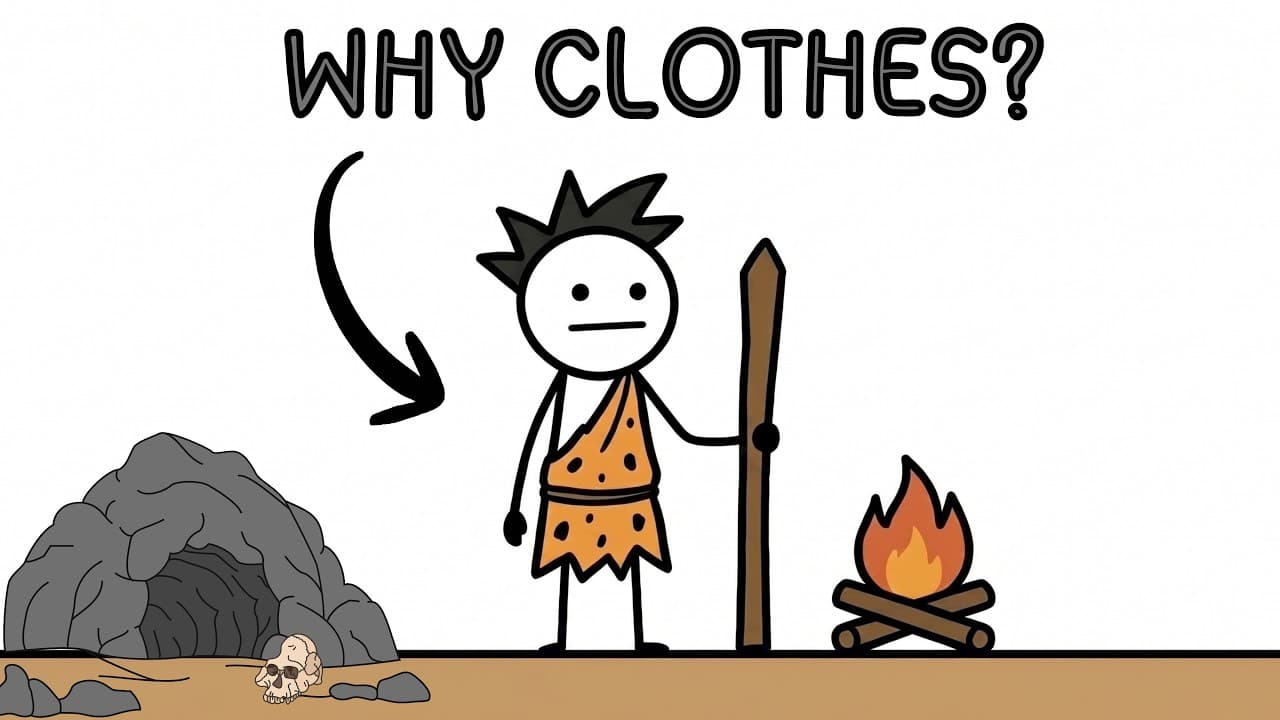
Why did humans start wearing clothes and what did it mean
TL;DR
Clothing began as a symbolic act rather than purely practical. Humans imagined future selves and used clothing to signal identity, status, and group belonging, turning fabric into a social technology. The shift was driven by cognitive advances and the desire to be seen, with shame and theory of mind playing key roles in the adoption of dress across cultures.
Transcript
Right now, you're wearing something. You probably didn't think about that decision for more than a few seconds this morning. Maybe you grabbed whatever was closest. Maybe you checked the weather. Either way, you put something on before you walked out the door because that's what humans do. We cover ourselves. Every culture on Earth, in every climat... Read More
Key Insights
- Clothing began not for warmth but as a future oriented signal that started a cognitive shift in how humans think about themselves.
- The earliest hard evidence for clothing comes from a parasite lineage divergence indicating clothing use around 170,000 years ago.
- Lice timelines show that clothing became common enough to impact human biology before practical needs like warmth did.
- The act of dressing requires theory of mind, allowing people to imagine how others perceive them.
- Clothing served as a social technology for rapid, nonverbal communication about identity and group belonging.
- Shame, understood neurologically, drives our concern with being seen and evaluated in clothing.
- Cognition, memory, and anticipate future use are central to why clothing originated and persisted.
- Across cultures, clothing persists as a marker of social complexity and status.
Install to Summarize YouTube Videos and Get Transcripts
Explore YouTube Video Summarizer or Get YouTube Transcript Extractor
Questions & Answers
Q: How did scientists use lice to date the origin of clothing
Scientists traced the split between head lice and body lice to infer when humans started wearing clothes consistently enough for a new species to depend on it. This biological timestamp, approximately 170,000 years ago, points to an origin deeper than practical needs like warmth or protection. It shows that clothing began as a cultural and cognitive adaptation that became entwined with human biology.
Q: Why do researchers say clothing is a symbolic invention
Researchers argue that clothing reflects a deeper kind of thinking that sets humans apart from other animals. To wear clothing you must imagine a future version of yourself, plan how to turn an animal hide into something usable, and actually do it. This goes beyond survival and marks a shift toward self presentation and social signaling.
Q: What role does shame play in the use of clothing
Shame is described as the neurological awareness of being perceived and evaluated by others. It requires theory of mind to imagine how you look through someone else’s eyes. This drive to be seen influences clothing choices and underpins why people care about appearance in social contexts.
Q: How does clothing function as a social technology
Clothing functions as a system of instant communication, telling strangers who you are, what group you belong to, and your status before you speak. As societies grew more complex, clothes helped navigate hierarchies and relationships, making attire a portable, visible marker of social position and affiliation.
Q: Why is the first clothing not simply about protection or warmth
The earliest clothing often covered the torso and groin, areas not the most exposed to damage, suggesting the motive was not purely practical. This pattern points to a social and symbolic purpose, where clothing signals identity, modesty, and social meaning rather than just guarding against elements.
Q: What is the cognition theory about clothing
The cognition theory, associated with archaeologist Ian Gilligan, argues that clothing was a sign of advanced mental capabilities. Choosing to cover the body demonstrates planning ahead, memory, and the capacity to imagine how one will be perceived, indicating a leap in human cognitive evolution.
Q: How does clothing relate to the emergence of social groups
As human groups became more complex, clothing served to distinguish tribes, ranks, and affiliations. The ability to convey who someone is before speaking aided social navigation, conflict avoidance, and alliance formation, reinforcing group identity through outward appearance.
Q: What does the video say about the universal presence of clothing
The video notes that every culture and climate has developed clothing, suggesting a universal human impulse tied to social signaling and identity. Even in warm regions where warmth is not a concern, decoration and adornment persist, indicating clothing is deeply connected to culture and mind rather than only practical needs.
Summary & Key Takeaways
-
Clothing originated as a symbol of future self planning and social signaling, not merely warmth or protection. The act of dressing became a cognitive achievement that separates humans from other animals and marks a fundamental shift in how we present and perceive ourselves. The practice evolved alongside increasing social complexity and the need to communicate identity.
-
Clothing functions as a social technology that conveys group belonging, rank, and threat or alliance, enabling rapid interpretation before verbal interaction. The adoption of dress tracks with larger, more complex societies and the emergence of explicit self-presentation, making attire a lasting artifact of the human mind.
-
Clothing is the oldest form of human communication, shaping how others perceive us and how we choose to be seen. The combination of memory, planning ahead, and imagining future possibilities underlines the intellectual leap involved in wearing clothes and using them to manage social impressions.
Read in Other Languages (beta)
Share This Summary 📚
Summarize YouTube Videos and Get Video Transcripts with 1-Click
Try YouTube Summary with ChatGPT & Claude or YouTube Transcript Generator
Explore More Summaries from Ink Explainer 📚




Summarize YouTube Videos and Get Video Transcripts with 1-Click
Try YouTube Summary with ChatGPT & Claude or YouTube Transcript Generator