What Happened to Other Ancient Human Species?
TL;DR
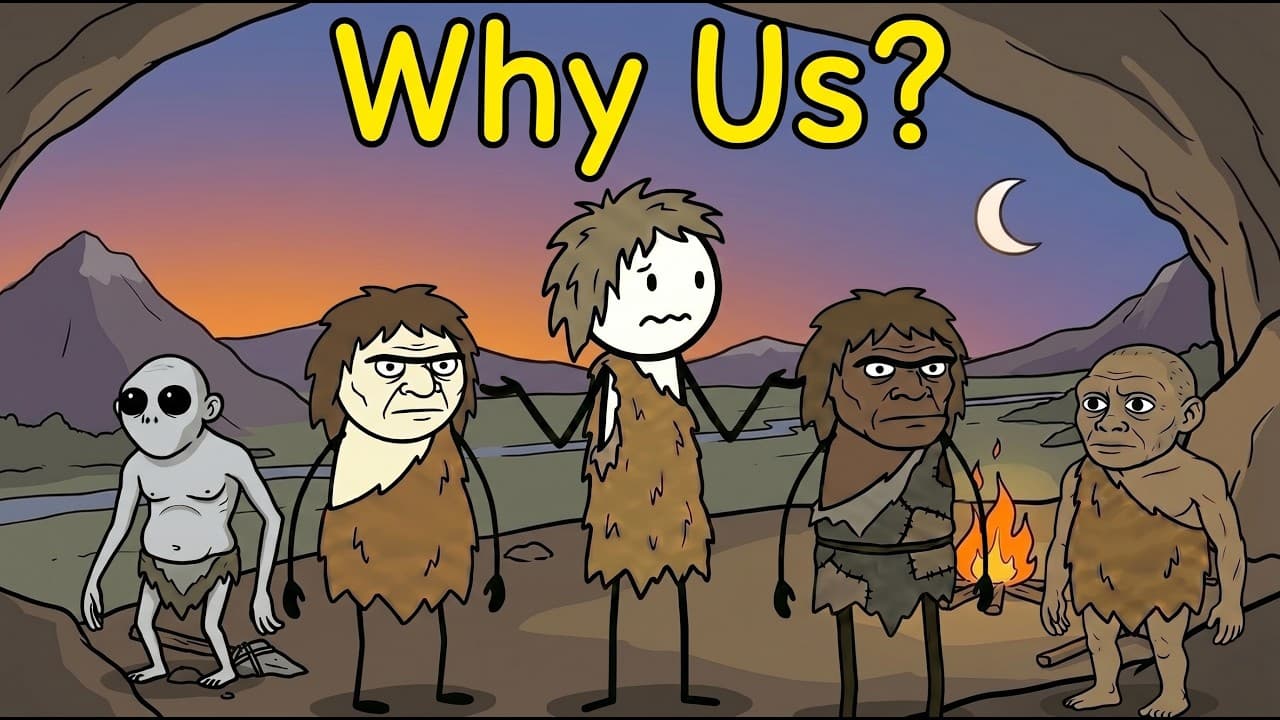
Homo erectus lasted the longest among ancient humans but eventually vanished. Neanderthals, Denisovans, and Homo floresiensis faced extinction due to climate change, competition, and small population dynamics, while Homo sapiens survived by building extensive networks and sharing knowledge. Our species endured because of mobility, adaptable strategies, and luck in the right environmental moment.
Transcript
For most of human history, we were not alone. If you could travel back 50,000 years, you'd find a planet where several different kinds of humans existed at the same time. Some looked a lot like us. Others were built completely differently. Shorter, heavier, shaped by climates and landscapes that would break a modern person. One species lived on a r... Read More
Key Insights
- Homo erectus lasted nearly 2 million years and left Java as their final stronghold before extinction.
- Neanderthals were strong, built for cold environments, and buried their dead, yet disappeared around 40,000 years ago.
- Denisovans are known from a single finger bone and have contributed up to 6 percent Denisovan DNA in some populations.
- Homo floresiensis lived on Flores, was very small, and disappeared around 50,000 years ago due to island dynamics.
- Humans did not simply replace other species; multiple lineages coexisted and interacted for a time, sharing some genetic material.
- The rise of Homo sapiens involved larger groups and broader networks that allowed resource sharing and knowledge transfer across distances.
- Environmental changes and shifting climates repeatedly reshaped available habitats, influencing survival chances for each species.
- Islands and geographic isolation can drive rapid evolutionary change, as seen with Homo floresiensis and other island species.
Install to Summarize YouTube Videos and Get Transcripts
Explore YouTube Video Summarizer or Get YouTube Transcript Extractor
Questions & Answers
Q: A real search query question about the video (e.g. 'How to...', 'What is...', 'Why does...', 'When should...'). Question 1
Homo erectus lasted for about two million years and eventually disappeared as environments changed, populations dwindled, and opportunities for expansion vanished. Their persistence demonstrates that longevity alone does not guarantee survival when ecological pressures increase and access to new territories becomes limited. This extinction illustrates broader patterns of long term turnover among ancient human species.
Q: What is Neanderthal biology and how did they differ from Homo sapiens?
Neanderthals were compact and powerful with broad chests and large noses that helped heat cold air. Their brains were, on average, slightly larger than ours, and they showed evidence of fire control, sophisticated tools, and burial practices. Despite these similarities, their smaller, more isolated groups and changing climates contributed to their decline after Homo sapiens arrived in Europe and Western Asia.
Q: How did Denisovans leave a genetic legacy in modern humans?
Denisovans are known from a single finger bone and a few teeth, yet their DNA is found across parts of Asia and Oceania. In some populations, Denisovan ancestry reaches about 6 percent, and specific genes like EPAS1 help Tibetans function at extreme altitudes. This shows a lasting, albeit indirect, influence from a largely unknown ancient lineage.
Q: What happened to Homo floresiensis and why did they disappear?
Homo floresiensis lived on Flores and were about a meter tall with small brains. They survived alongside other animals until roughly 50,000 years ago; island isolation and ecological pressures likely drove their disappearance. The evidence suggests island dynamics can lead to significant evolutionary changes and, in some cases, extinction without a catastrophic event.
Q: Why did Homo sapiens survive while other species did not?
Our survival reflects a combination of larger, more connected social networks, flexible resource sharing, and the ability to move and reorganize across regions when crises hit. These factors allowed knowledge and tools to spread, helping Homo sapiens adapt to climate shifts and geographic changes in ways that other species could not match.
Q: How did climate change influence the fate of multiple human species?
Climate fluctuations reshaped environments repeatedly, altering the availability of food, shelter, and territory. Species with smaller, isolated groups and limited mobility suffered more as resources declined. In contrast, Homo sapiens benefited from broader networks and the ability to relocate and reorganize, buffering against regional environmental shocks.
Q: What role did geographic isolation play in the evolution of island species?
Islands create isolation that drives unusual evolutionary paths, such as small-bodied pops and altered brain sizes. Floresiensis is an example where isolation produced a distinct human lineage coexisting with other megafauna. Over time, limited space and resources can push populations toward extinction without widespread catastrophe, highlighting the importance of geographic context in human evolution.
Q: What does the video imply about the term 'last human species'?
The video argues that the term 'last human species' masks a complex history of multiple human lineages coexisting, hybridizing, and then fading away. It suggests that Homo sapiens survived not by being the strongest alone but due to networks, mobility, and the ability to share knowledge across groups, enabling flexible responses to changing environments.
Summary & Key Takeaways
-
Homo erectus lasted for a very long time before disappearing and leaving the scene, highlighting a long, persistent presence that did not guarantee survival.
-
Neanderthals were capable in many respects but ultimately declined after coexisting with Homo sapiens and facing climate shifts, leading to their disappearance.
-
Denisovans left a small but significant genetic legacy in modern populations, showing how hidden lineages can still shape present humans and how isolation and sparse numbers can influence survival.
Read in Other Languages (beta)
Share This Summary 📚
Summarize YouTube Videos and Get Video Transcripts with 1-Click
Try YouTube Summary with ChatGPT & Claude or YouTube Transcript Generator
Explore More Summaries from Ink Explainer 📚
Summarize YouTube Videos and Get Video Transcripts with 1-Click
Try YouTube Summary with ChatGPT & Claude or YouTube Transcript Generator