How Did Gunpowder Evolve Into Modern Firearms?
TL;DR
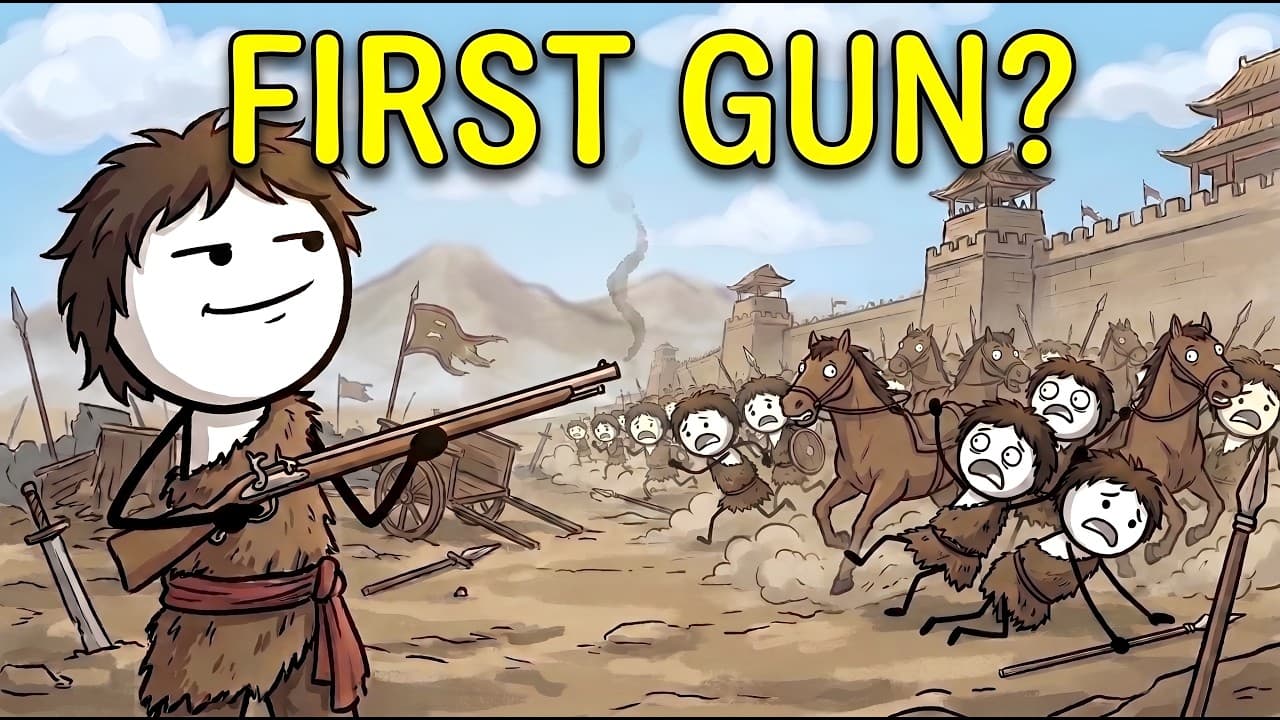
Guns emerged through repeated adaptations of gunpowder, which Chinese alchemists accidentally discovered while pursuing an immortality medicine. Fire medicine progressed from fireworks and flaming arrows to fire lances, projectile weapons, bronze hand cannons, siege artillery, matchlocks, and wheelocks as users improved pressure resistance, aiming, ignition, and reliability.
Transcript
Somewhere on Earth in the next 2 minutes, a human being is going to be shot. That's the average and it holds every single day. There are more than a billion guns on the planet right now, roughly one for every eight people alive. But how did we even get here? Because not a single one of these guns was ever supposed to exist. The men who started all ... Read More
Key Insights
- Gunpowder originated from Chinese immortality research involving sulfur, charcoal, and saltpeter. Instead of producing an elixir, the mixture created sudden flames and explosions that burned alchemists and their workshops, turning an attempted medicine into the foundation of firearms.
- Saltpeter supplies oxygen from within its own crystal structure, allowing the gunpowder mixture to burn almost instantly without waiting for oxygen from the surrounding air. When the resulting hot gas is confined, pressure forces it violently through the container's weakest opening.
- The first written record of gunpowder appeared around 850 as a warning rather than a weapons recipe. It described a mixture that burst into flames, scorched hands and faces, and burned buildings, showing that its earliest documented significance was its danger to experimenters.
- Fire medicine remained largely associated with fireworks, flares, and flaming arrows for about 200 years. Its military transformation became visible at the siege of De'an in 1132, where defenders used bamboo tubes attached to spears to project short-lived jets of fire.
- Projectiles became central to firearm development after soldiers packed broken porcelain, scrap iron, and stones into fire lances. Observations of the resulting wounds showed that this debris traveled farther than the flame and penetrated bodies, shifting attention from fire toward launched material.
- Metal barrels solved the pressure limitations of bamboo fire lances. Adding more powder could make projectiles travel farther, but bamboo might burst in the user's hands, so bronze tubes were developed to contain greater pressure and direct the expanding gas forward.
- The oldest surviving gun described in the transcript dates to 1288 and was excavated in Heilongjiang province. It is a bronze tube about the length of a forearm, weighs 3 and 1/2 kg, and has a fuse hole but no trigger, handle, or sights.
- Ignition mechanisms improved aiming and reliability. The matchlock used a metal arm to lower a burning cord into the powder while the shooter held and aimed the weapon, while the later wheelock generated sparks by spinning a steel wheel against pyrite.
Install to Summarize YouTube Videos and Get Transcripts
Explore YouTube Video Summarizer or Get YouTube Transcript Extractor
Questions & Answers
Q: How was gunpowder accidentally discovered?
Chinese alchemists discovered gunpowder while trying to create a medicine for eternal life. They mixed sulfur, charcoal, and saltpeter, ingredients associated with their experiments, but the combination produced rapid flames and explosions instead of immortality. Around 850, a Chinese text documented the danger by warning that the mixture could scorch hands and faces and burn buildings.
Q: Why does gunpowder burn so quickly?
Gunpowder burns rapidly because saltpeter contains oxygen within its crystal structure. A normal fire must draw oxygen from the surrounding air, which slows combustion. The gunpowder mixture does not have to wait for that external supply. Once ignited, it feeds itself, burns almost instantly, and releases a large cloud of hot gas.
Q: How does gunpowder propel a projectile from a gun?
Burning gunpowder rapidly releases hot gas. In an open space, this produces a flash and a bang, but inside a strong tube the gas becomes trapped and pressure builds. That pressure escapes through the weakest available opening, pushing material ahead of it. The transcript identifies this confined, self-oxygenating fire as the operating principle behind every gun.
Q: What was the fire lance and how did it work?
The fire lance was a long spear fitted with a bamboo tube containing fire medicine. At the siege of De'an in 1132, defenders lit its fuse and directed a brief jet of fire toward attackers. It functioned as a one-shot flamethrower, burning for only a few seconds, but later versions also carried pieces of porcelain, iron, or stone.
Q: How did debris in fire lances lead to bullets?
Soldiers placed broken porcelain, scrap iron, small stones, and other debris inside fire-lance tubes to make the flames more damaging. They then observed that the debris traveled farther than the flame and penetrated bodies more deeply. This shifted the weapon's purpose from projecting fire to launching material, making the projectile rather than the flame its principal destructive element.
Q: Why were bronze barrels important to early guns?
Bronze barrels allowed early weapons to contain more pressure than bamboo tubes could safely withstand. Soldiers wanted larger powder charges because they sent projectiles farther, but overloaded bamboo could burst in their hands. Metalworkers therefore cast tubes that resisted this pressure. Once the tube became metal, the fire lance had acquired the essential form of a gun.
Q: What is the oldest surviving gun described in the transcript?
The oldest surviving gun discussed is a small bronze tube excavated in Heilongjiang province in northern China. It dates to 1288 and is connected to a battle recorded there that year. The weapon is about the length of a forearm, weighs 3 and 1/2 kg, and has no trigger, handle, or sights, only a fuse hole.
Q: How did matchlock and wheelock mechanisms improve firearms?
The matchlock used a metal arm to lower a burning cord into the powder when the shooter squeezed a lever. This allowed both hands to hold the weapon and both eyes to remain on the target. Around 1500, the wheelock removed the constantly burning cord by spinning a wound steel wheel against pyrite to generate ignition sparks.
Summary & Key Takeaways
-
Chinese alchemists searching for an immortality medicine mixed sulfur, charcoal, and saltpeter, producing a substance that burned with exceptional speed. A Chinese text from around 850 recorded the dangerous mixture as a warning after it scorched people and burned buildings. The substance became known as huo yao, meaning fire medicine.
-
Fire medicine was initially used in fireworks, flares, and flaming arrows. At the siege of De'an in 1132, defenders used bamboo fire lances that projected flames. Soldiers later packed porcelain, iron, and stones inside the tubes, discovering that these projectiles traveled farther and caused more damage than the flames themselves.
-
Greater powder charges made bamboo tubes dangerously prone to bursting, so metalworkers cast stronger bronze barrels. A surviving hand cannon from Heilongjiang dates to 1288. Gunpowder weapons then spread with Mongol armies, developed into enormous siege cannons, and gained matchlock and wheelock mechanisms that made handheld firearms easier to aim and ignite.
Read in Other Languages (beta)
Share This Summary 📚
Summarize YouTube Videos and Get Video Transcripts with 1-Click
Try YouTube Summary with ChatGPT & Claude or YouTube Transcript Generator
Explore More Summaries from Ink Explainer 📚






Summarize YouTube Videos and Get Video Transcripts with 1-Click
Try YouTube Summary with ChatGPT & Claude or YouTube Transcript Generator