How Did Ancient Humans Survive Weeklong Rain?
TL;DR
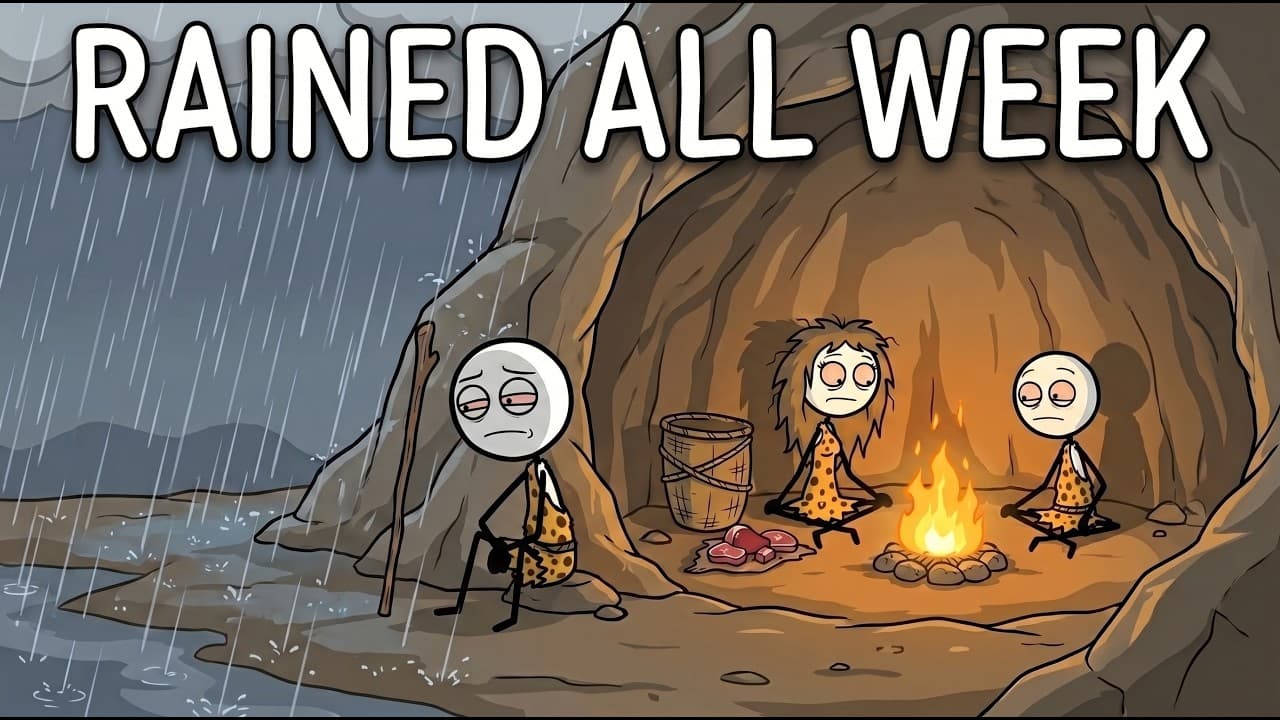
Ancient humans survived prolonged rain by protecting fire, staying in caves or rock shelters, making tools and cordage, maintaining bedding, and sharing knowledge through stories. Rain intensified threats from hypothermia, floods, predators, hunger, and injury, but enforced periods indoors may also have supported manufacturing, social bonding, cultural transmission, and artistic creation.
Transcript
Imagine you haven't eaten in 2 days. You know exactly where the herd is. You tracked it yesterday. You found the prince. You mapped the route in your head. And now all you have to do is get there. And then it starts raining. Not a light drizzle. A heavy soaking wind-driven rain that doesn't stop. It goes all day, then all night. Then the next morni... Read More
Key Insights
- • Prolonged rain was a major survival threat because wet bodies lost heat rapidly, rivers could flood occupied shelters, and predators often sought the same protected caves as humans. The storm compressed people, prey, and dangerous animals into a limited number of dry spaces.
- • Fire was essential infrastructure for ancient groups because it supplied warmth, light, cooked food, predator protection, and a center for social interaction. During storms, one person might spend hours feeding and shielding the fire so that its loss did not endanger everyone.
- • Fire maintenance was different from fire creation because evidence of controlled fire does not prove that people could reliably ignite a new one. Groups could preserve smoldering coals in green leaves or tinder fungus, while later individuals such as Ötzi carried complete fire kits.
- • Wet-weather fuel could be obtained by collecting lower conifer branches protected by the canopy, splitting wet logs to expose dry interiors, and using birch bark containing betulin. These techniques helped sustain a fire even when prolonged rainfall made ordinary surface wood difficult to burn.
- • Sheltered time supported manufacturing because caves contain stone tools in multiple production stages and concentrated piles of flaking debris. Blombos Cave also preserved a 100,000-year-old ochre-processing workshop with shells, powdered ochre, and bone implements used for mixing and application.
- • Cordage expanded technological possibilities because rope could bind tools to handles, connect materials, improve shelters, and support snares or traps. A 35,000-year-old mammoth-ivory implement from Hohle Fels Cave had holes and spiral grooves designed for twisting plant fibers into rope.
- • Prehistoric shelters could be deliberately maintained as living spaces because Sibudu Cave contained 77,000-year-old layers of sedges, rushes, and grasses arranged as bedding. Cape Laurel leaves provided natural insect resistance, while periodically burning and replacing the bedding helped keep it clean.
- • Campfires encouraged cultural transmission because fireside conversation shifted toward stories, songs, and ceremonies in the cited 2014 study of Ju Hoansi Bushmen. Shared talk also communicated practical knowledge about water, edible plants, flint, tracking, and other information important for group survival.
Install to Summarize YouTube Videos and Get Transcripts
Explore YouTube Video Summarizer or Get YouTube Transcript Extractor
Questions & Answers
Q: How did ancient humans survive several days of rain?
Ancient humans could retreat into caves or rock shelters, protect their fire, conserve movement, and use the enforced indoor time for useful work. They made and repaired stone tools, processed pigments, twisted fibers into rope, prepared bedding, and shared practical knowledge. Survival required constant attention to cold, rising water, predators, limited food, slippery terrain, and the possibility that an extinguished fire could not be easily restarted.
Q: Why was prolonged rain dangerous for prehistoric people?
Prolonged rain created several dangers at once. Wet bodies lost heat much faster, increasing the threat of hypothermia in cool conditions. Rising rivers and hillside runoff could flood caves or rock shelters. Rain also erased animal tracks, made rocky travel hazardous for bare feet, disrupted hunting, and pushed predators toward the same dry spaces that humans needed for protection.
Q: How did ancient humans keep a fire burning in wet weather?
People could move a fire deeper into a cave, shield it with hides or brush, and feed it carefully. They searched for dead lower branches protected by a tree canopy, split wet logs to reach dry wood inside, and used birch bark because its betulin helped it burn when wet. Maintaining the flame could become one person's continuous responsibility throughout a storm.
Q: Could ancient humans reliably start fire from scratch?
The transcript says humans controlled fire at least 400,000 years ago at Qesem Cave and possibly around a million years ago at Wonderwerk Cave, but it distinguishes fire control from reliable ignition. For much of human history, many people may have depended on existing flames or transported embers. Smoldering coals could be wrapped in green leaves or carried inside tinder fungus for hours.
Q: What work did prehistoric people do while sheltering indoors?
Archaeological evidence suggests that sheltered people made and repaired objects requiring time and concentration. Caves contain stone tools at different production stages and concentrated flaking debris near likely work areas. People also processed ochre, made delicate bone needles, twisted plant fibers into rope, maintained bedding, and potentially worked on artistic or ceremonial projects deeper inside cave systems.
Q: What does prehistoric bedding reveal about ancient shelters?
The 77,000-year-old bedding reported at Sibudu Cave indicates that people deliberately improved the comfort and cleanliness of their living spaces. They arranged layers of sedges, rushes, and grasses into sleeping mats and added Cape Laurel leaves, which naturally repelled insects. The bedding was periodically burned and replaced, showing planned maintenance and pest control rather than simple temporary occupation.
Q: Was cave art created during rainy weather?
The transcript does not claim that archaeology can prove cave art was a rainy-day activity. It presents the idea as a plausible inference because major paintings were created deep inside caves, sometimes hundreds of meters from entrances, where artists needed animal-fat lamps and extended focused time. Bad weather may have provided such time, but the direct connection remains unproven.
Q: How could rainy periods contribute to prehistoric culture?
Rain could confine groups of roughly 15 to 30 people near a shared fire for extended periods, creating opportunities for conversation and teaching. People could exchange knowledge about water sources, edible plants, flint deposits, and animal tracking while also telling stories, singing, and conducting ceremonies. Repeated gatherings may therefore have strengthened memory, relationships, shared explanations, and the transmission of culture.
Summary & Key Takeaways
-
Prolonged rain was a survival crisis because it erased tracks, restricted movement, raised rivers, weakened fires, and exposed people to dangerous cold. Caves offered protection but could flood or attract predators. Groups therefore had to balance the immediate need for shelter against the risks created when humans and animals sought the same dry spaces.
-
Protecting fire was a central responsibility because it provided warmth, light, predator protection, cooked food, and a social center. People could move flames deeper into caves, shield them, find protected branches, split wet logs for dry interiors, and use birch bark. Some also transported embers or carried specialized fire-making materials.
-
Time spent inside could support patient work and social activity. Archaeological sites preserve tool-making debris, ochre workshops, needles, cordage equipment, prepared bedding, and cave paintings. Around fires, people could exchange practical knowledge, tell stories, sing, and conduct ceremonies, helping skills, environmental information, explanations, and shared traditions pass between generations.
Read in Other Languages (beta)
Share This Summary 📚
Summarize YouTube Videos and Get Video Transcripts with 1-Click
Try YouTube Summary with ChatGPT & Claude or YouTube Transcript Generator
Explore More Summaries from Ink Explainer 📚




Summarize YouTube Videos and Get Video Transcripts with 1-Click
Try YouTube Summary with ChatGPT & Claude or YouTube Transcript Generator