What allowed early humans to survive predators?
TL;DR
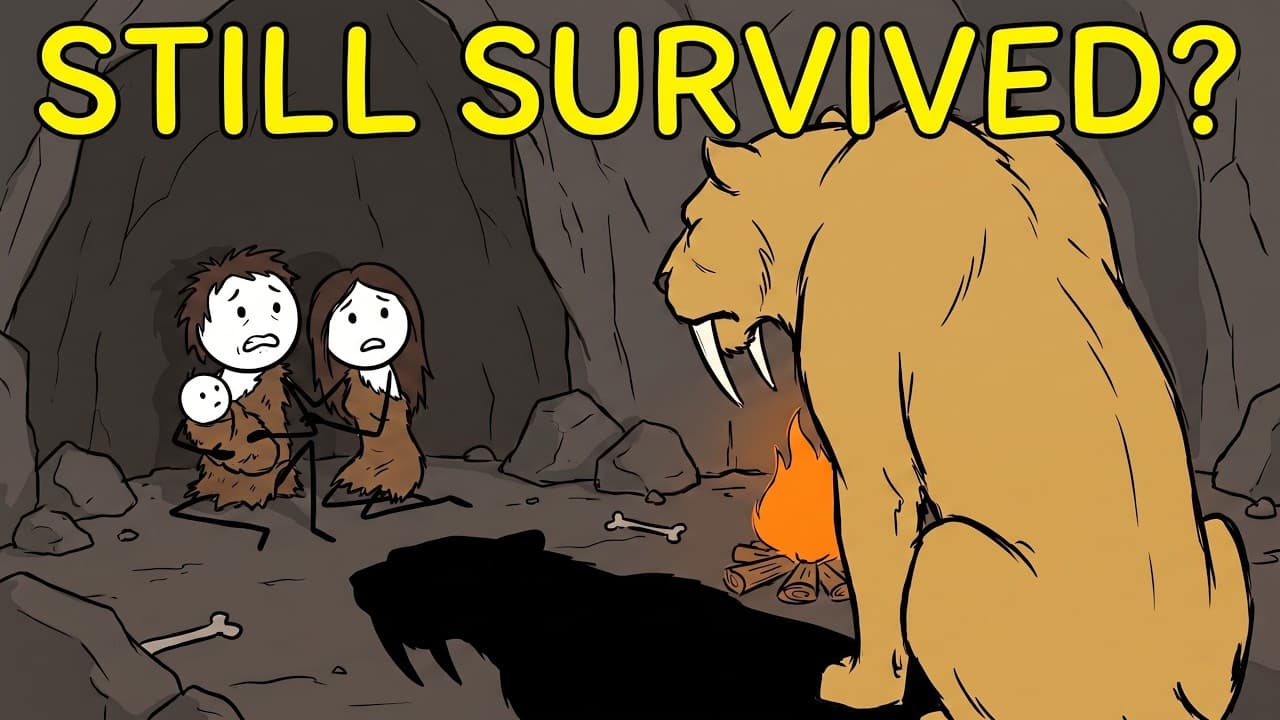
Early humans used group living, fire, and thrown weapons to beat predators. Fire kept danger at bay at night, while groups provided safety in numbers. Throwing weapons extended reach, changing how humans hunted and defended themselves, enabling distance control against dangerous animals.
Transcript
Last night, you walked through the dark without once wondering if something out there wanted to eat you. You locked the door, you switched off the light, and you fell asleep with your back to the window. And nothing about that felt brave. It just felt normal. Now, go back 2 million years. Your ancestor stands about 4t tall. He has no claws, no fang... Read More
Key Insights
- Humans benefited from group living because more eyes and louder voices improve danger detection.
- Fire provided a boundary and light, reducing ambush risk and enabling safer nights around the camp.
- Throwing abilities evolved from shoulder mechanics, enabling long distance defense and hunting.
- Early spears were designed for balance and distance, not just stabbing power.
- Leopards and other predators could drag prey into trees, creating a need for ground-based safety.
- Bone damage studies initially misattributed injuries to killers but later suggested leopards as culprits.
- Crucial fossil evidence links injuries to predators rather than other humans, reshaping hunting narratives.
- Cranial injuries and accidental damage in fossils inform the shift from isolation to communal survival strategies.
Install to Summarize YouTube Videos and Get Transcripts
Explore YouTube Video Summarizer or Get YouTube Transcript Extractor
Questions & Answers
Q: What is the main question about how early humans survived predators?
The central question is how our ancestors went from being potential prey to a species that could defend itself against many predators. The discussion traces from ancient hunter killer myths to evidence of leopard attacks, birds of prey, crocodiles, and the eventual development of social grouping, fire, and distance weapons that altered risk dynamics.
Q: How did early humans use fire to protect themselves at night?
Fire created a circle of light that kept predators at a distance and served as a visible boundary. It allowed safer sleeping, social interaction, and reduced ambush risk by making it harder for predators to approach unseen. Yet fire did not help when venturing outside the camp during the day.
Q: What evidence links early human bones to predator attacks rather than human conflict?
A skull with two small holes near the back matched to a leopard jaw and fangs fit the holes, suggesting a leopard grabbed the head. This finding, along with other marks on bones from crocodiles and birds, supports predator attacks as a significant threat rather than only human conflict.
Q: What role did group size play in early human safety?
Group size provided improved danger detection and deters predators through collective noise and presence. A troop of humans could drive predators away, while solitary individuals faced higher risk. This social defense contributed to the transition from tree sleeping to ground shelter with greater exposure.
Q: How did throwing weapons change predator interactions?
Throwing weapons allowed humans to strike predators from a distance, reducing the risk of close contact. The shoulder mechanism that stores energy enables fast projectiles, making it possible for multiple people to throw together and harass or injure predators before they could close in.
Q: What is the significance of the taung child and other skulls in the story?
The taung child skull, with injury patterns suggesting bird predation, helped reframe early human ancestry as potentially including interactions with birds of prey. This evidence contributed to the broader view that predators, not only humans, shaped survival strategies and the evolution of early hominins.
Q: Why are long distance weapons like spears important in human evolution?
Long distance weapons let humans harm prey from afar, changing the dynamic of risk. Spear construction preserved evidence that early Neanderthals and other groups used them, shifting the battlefield from hand to distance confrontations and enabling groups to protect themselves without direct contact with dangerous animals.
Q: How do scientists determine whether a fossil shows a hunter or the hunted?
Researchers analyze bone damage patterns, skull shapes, and contextual fossils to infer predator-prey interactions. By comparing with known damage from modern predators and cross-referencing with cave assemblages, they distinguish whether injuries were from hunts by other humans or from animals such as leopards, birds, or crocodiles.
Summary & Key Takeaways
-
In early human history predators dominated until social grouping improved safety, allowing groups to sleep near the ground and rely on shared vigilance.
-
Fire emerged as a portable defense, creating light and a visible boundary that deterred ambush predators at night.
-
Weapons and throwing arms evolved to strike from distance, shifting danger from claws to projectiles and enabling coordinated defense.
Read in Other Languages (beta)
Share This Summary 📚
Summarize YouTube Videos and Get Video Transcripts with 1-Click
Try YouTube Summary with ChatGPT & Claude or YouTube Transcript Generator
Explore More Summaries from Ink Explainer 📚





Summarize YouTube Videos and Get Video Transcripts with 1-Click
Try YouTube Summary with ChatGPT & Claude or YouTube Transcript Generator