How did ancient humans travel across oceans and lands?
TL;DR
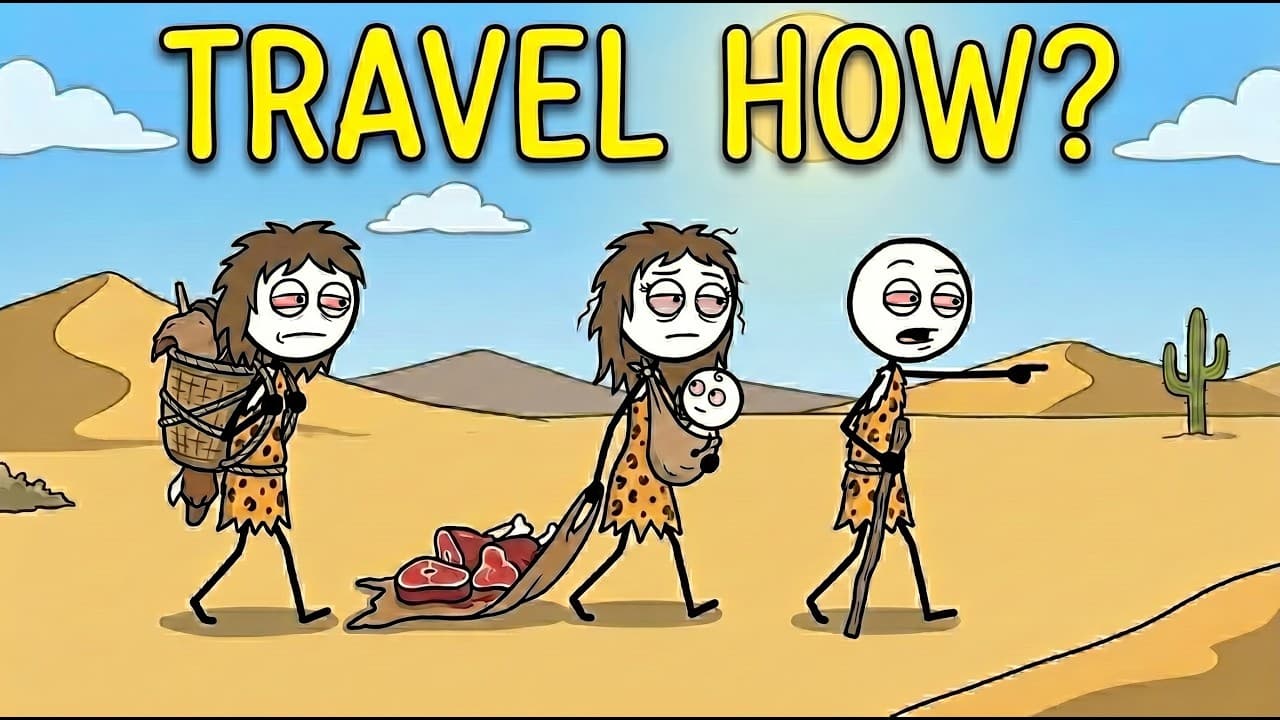
Humans moved mainly by walking for most of history, capable of long daily treks and gradual expansion. Then they learned to cross rivers and seas with simple floats, later dragging and carrying loads with devices like the travois, dogs, and horses. The wheel finally accelerated transport and trade, shrinking the world dramatically.
Transcript
You got in your car this morning, turned the key, pressed the pedal, and moved 40 miles an hour without using a single muscle. 100,000 years ago, that same trip would have taken two full days of walking, barefoot, through territory that could kill you. No road, no path, no sign telling you what's ahead. For almost all of human history, getting anyw... Read More
Key Insights
- Walking was the initial long distance transport method and remains the baseline capability of early humans.
- Crossing rivers and oceans emerged as a pivotal breakthrough that opened new regions and cultures to interaction.
- Drag and load carrying evolved from dragging hides to the travois, enabling one person to move heavier loads.
- Domestication of dogs enabled pulling sleds and increased mobility in harsh climates.
- Horses transformed mobility, reducing travel time and expanding the reachable world dramatically.
- The oldest wheel predates widespread use of wheels for transport, initially serving pottery before adaptation.
- Wheeled vehicles with lighter designs and roads enabled the rise of empires through improved trade and military logistics.
- The overall arc shows a cumulative build up of transport technology across thousands of years.
Install to Summarize YouTube Videos and Get Transcripts
Explore YouTube Video Summarizer or Get YouTube Transcript Extractor
Questions & Answers
Q: A real search query question about the video (e.g. 'How to...', 'What is...', 'Why does...', 'When should...'). Question 1
How did early humans move across continents before modern vehicles and why did different methods emerge at different times? The answer is that for 300,000 years movement depended on walking, which allowed steady travel and resource gathering. Rivers and seas eventually forced communities to develop crossings, boats, and then animal aided transport to extend reach.
Q: Question 2
What role did boats play in the initial expansion of humans from Africa and beyond? Boats appeared as a response to moving across water barriers, beginning with simple floating tools and progressing to more deliberate water crossings. This shift enabled populations to reach new regions that would be unreachable by walking alone.
Q: Question 3
How did humans first move heavy loads before the wheel altered transportation dynamics? Early methods included dragging hides and using the travois, a wooden frame that spreads weight. These techniques allowed a single person to move heavier loads than would be possible by carrying and laid groundwork for broader logistical systems.
Q: Question 4
When did domestication of animals begin to influence mobility, and what effects did it have? The domestication of dogs around 15,000 years ago introduced sled hauling, increasing mobility in arctic regions. Later the horse, first used around 5,500 years ago, dramatically expanded travel range and speed, enabling broader trade and faster communication.
Q: Question 5
What is the significance of the wheel in human transportation history according to the video? The wheel arrives after many other innovations and initially serves pottery. It evolves into a transportation tech around 2000 BC with the advent of the spoked wheel, which makes chariots possible and accelerates movement, trade, and empire building.
Q: Question 6
Why are roads and animal power described as foundational to empires? Roads and animal aided transport allowed reliable movement of armies and supplies across long distances, supporting the growth and maintenance of empires. The combination of wheels, roads, and animal strength created a connected network that reshaped civilizations.
Q: Question 7
How does the video portray the relationship between exploration and technological progress in transportation? It shows a progressive linkage where expanding exploration demanded better transport, which in turn spurred innovation and economic exchange. Each breakthrough built on prior methods, gradually shrinking distances and enabling global connectivity.
Q: Question 8
What overarching theme ties together the history of travel in the video? The theme is cumulative problem solving over millennia. Each invention solved a specific limitation — speed, distance, or load — and was built upon earlier discoveries, ultimately creating a connected world through walking, watercraft, animal power, and wheels.
Summary & Key Takeaways
-
Humans relied on walking for hundreds of thousands of years, using foot powered movement to span continents. Rivers and seas posed barriers that prompted innovators to develop crossings and boats. Animal power and the wheel then transformed movement, enabling rapid travel, trade, and the rise of empires.
-
The narrative traces a progression from barefoot mobility to water craft, animal labor, and wheeled transport, showing how each breakthrough built on the previous one. It emphasizes deliberate migration for trade and resource access, not random wandering, and highlights the social and technological shifts that followed.
-
By connecting land and sea transport advances, the video explains why civilizations could grow bigger and farther apart. It also notes that wheels started as pottery tools and only later became a key transportation technology with lighter, sprung wheels and roads enabling reliable movement.
Read in Other Languages (beta)
Share This Summary 📚
Summarize YouTube Videos and Get Video Transcripts with 1-Click
Try YouTube Summary with ChatGPT & Claude or YouTube Transcript Generator
Explore More Summaries from Ink Explainer 📚




Summarize YouTube Videos and Get Video Transcripts with 1-Click
Try YouTube Summary with ChatGPT & Claude or YouTube Transcript Generator