How Will Robo Taxis Challenge Uber by 2030
TL;DR
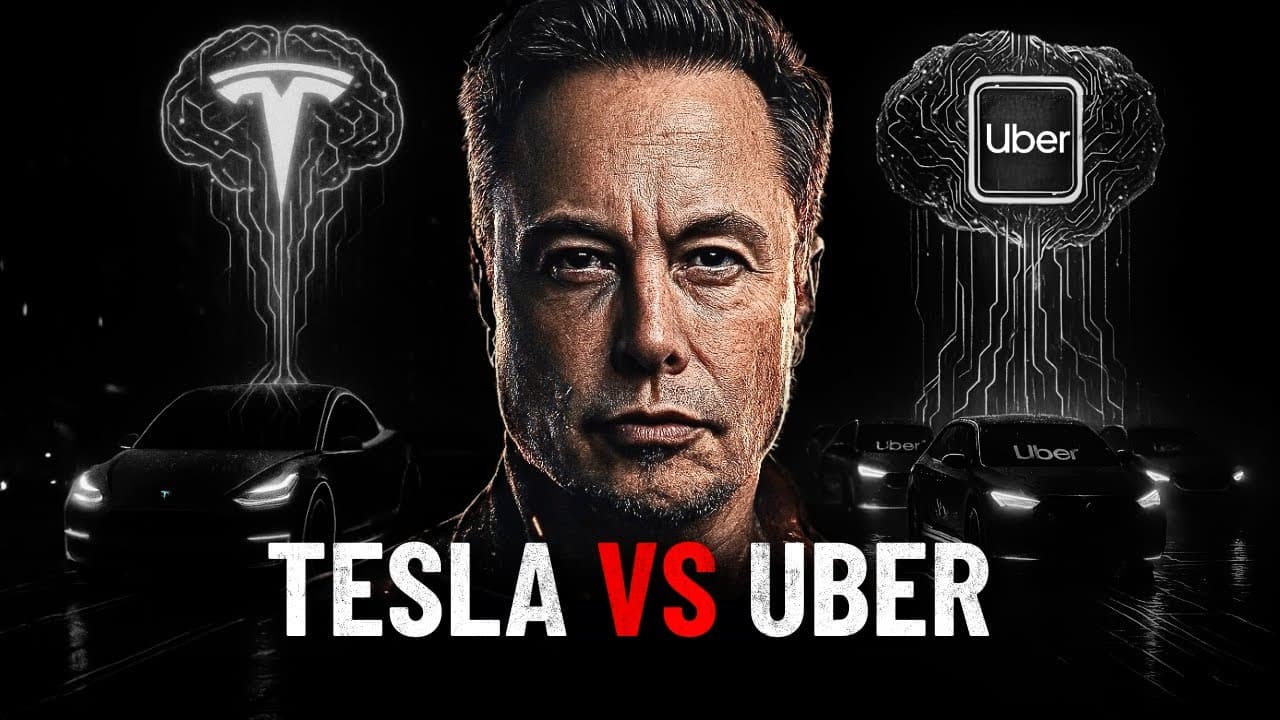
Robo taxis pose a existential threat to Uber by enabling ultra cheap rides through Tesla style autonomy. Uber responds by partnering with Nvidia to catch up on AI driven mobility. If Tesla achieves scale, Uber faces a potential decline in demand and value as autonomous fleets proliferate and private car ownership could diminish.
Transcript
At some point in the future, like maybe five or six years from now, I think we'll be able to treat achieve uh true autonomous driving. You've just mentioned something sort of inkling of a step towards full autonomy. Mhm. What would you say are the biggest technological roadblocks to full self-driving? Um, I think at Tesla we I feel like we're very ... Read More
Key Insights
- Robo taxi technology is presented as a path to dramatically reduce ride costs from current levels toward fractions of a dollar per mile.
- Tesla argues that a simplified sensor suite and end to end learning can achieve safe general autonomy, potentially outperforming legacy sensor heavy systems.
- Uber faces a pricing and structural challenge because driver costs currently occupy the largest share of fare revenue, making it vulnerable if autonomous fleets lower costs.
- Tesla claims economies of scale could push per mile costs down by a wide margin, threatening the profitability of traditional ride-hailing.
- Nvidia partnership is framed as Ubers response to Tesla by leveraging AI software and hardware expertise to accelerate autonomous capabilities.
- Black box problem in autonomous AI is highlighted as a potential regulatory hurdle since decision paths are not easily explainable.
- Auto industry disruption is framed as a shift from car ownership to on demand mobility services, potentially reducing private car sales.
- The narrative positions Uber and traditional automakers as facing a demand collapse if robo taxis dominate the market, reshaping transportation economics.
- More videos from this channel:
- More from this channel: Think School
Install to Summarize YouTube Videos and Get Transcripts
Explore YouTube Video Summarizer or Get YouTube Transcript Extractor
Questions & Answers
Q: What is the core threat posed by Tesla's robo taxi to Uber by 2030
The core threat is that Tesla claims economies of scale on robo taxis could reduce ride costs per mile to a fraction of current levels, potentially rendering Uber’s human driven model uncompetitive. If autonomous fleets proliferate, Uber could lose a large portion of its ride revenue as users shift to cheaper on demand mobility. This scenario would undermine Uber’s current business model and force strategic changes.
Q: Why is Uber partnering with Nvidia in this context
Uber partners with Nvidia to accelerate AI driven mobility capabilities, leveraging AI software and hardware to catch up with Tesla's general autonomy approach. The collaboration aims to deploy more capable autonomous systems quickly, enabling faster rollout of robo taxi style services without owning the entire vehicle fleet upfront, and to create scalable, AI driven ride solutions that compete on cost and reliability.
Q: What makes Tesla’s approach to self driving different according to the transcript
Tesla emphasizes a general autonomy approach that deletes conventional rules and relies on learning from billions of miles and human driving examples. Instead of a complex sensor suite, Tesla uses cameras with AI trained on vast data to predict driving actions, achieving lower sensor costs and potentially more adaptable performance in the real world.
Q: What economic impact could robo taxis have on private car ownership
If robo taxis cost significantly less per mile and scale, the economic incentive to own a private car drops, potentially reducing demand for new car sales. With autonomous fleets able to meet transportation needs more cheaply, individual car ownership may become less attractive, reshaping consumer buying patterns and the overall vehicle market.
Q: What is the black box problem mentioned in the transcript
The black box problem refers to autonomous AI decisions becoming opaque, where the exact reason for a given action cannot be easily explained. This creates regulatory and safety concerns because engineers cannot fully justify why the AI chose a specific maneuver, complicating liability and validation of autonomous systems.
Q: How does the transcript describe current ride costs and Uber’s share
The transcript states that today an Uber ride costs about $2.50 per mile in the US, with 70 to 75 percent of that going to the human driver and 25 to 30 percent to Uber. This cost structure makes Uber vulnerable if autonomous fleets can dramatically reduce per mile costs.
Q: What scenario could lead to a collapse in private car ownership
A scenario where one autonomous car can perform the work of multiple vehicles and provide rides at a fraction of current costs could reduce the economic justification for owning a private car. If robo taxis deliver convenient, cheap mobility at scale, private car ownership could decline as consumers opt for on demand transport instead.
Q: What strategic question does the video raise about Alphabet startups like Whimo
The video questions why Alphabet backed startups like Whimo are not deploying Tesla style general autonomy quickly enough to beat Tesla on rollout speed and efficiency. The implication is that incumbents or other tech firms may struggle to match Tesla’s integrated hardware, data advantages, and autonomous learning approach.
Summary & Key Takeaways
-
Tesla unveiled its robo taxi in 2025 and this shift could make Uber’s traditional ride model obsolete if scaled widely, drastically lowering per mile costs.
-
Uber counters with a Nvidia backed strategy to accelerate AI driven ride services, aiming to compete with Tesla without owning a large autonomous fleet.
-
The critical risk for Uber is the black box problem in AI driven driving, which could complicate regulation and safety as autonomous taxis expand.
Read in Other Languages (beta)
Share This Summary 📚
Summarize YouTube Videos and Get Video Transcripts with 1-Click
Try YouTube Summary with ChatGPT & Claude or YouTube Transcript Generator
Explore More Summaries from Think School 📚






Summarize YouTube Videos and Get Video Transcripts with 1-Click
Try YouTube Summary with ChatGPT & Claude or YouTube Transcript Generator