How to Build Resilience Through Controllable Stress
TL;DR
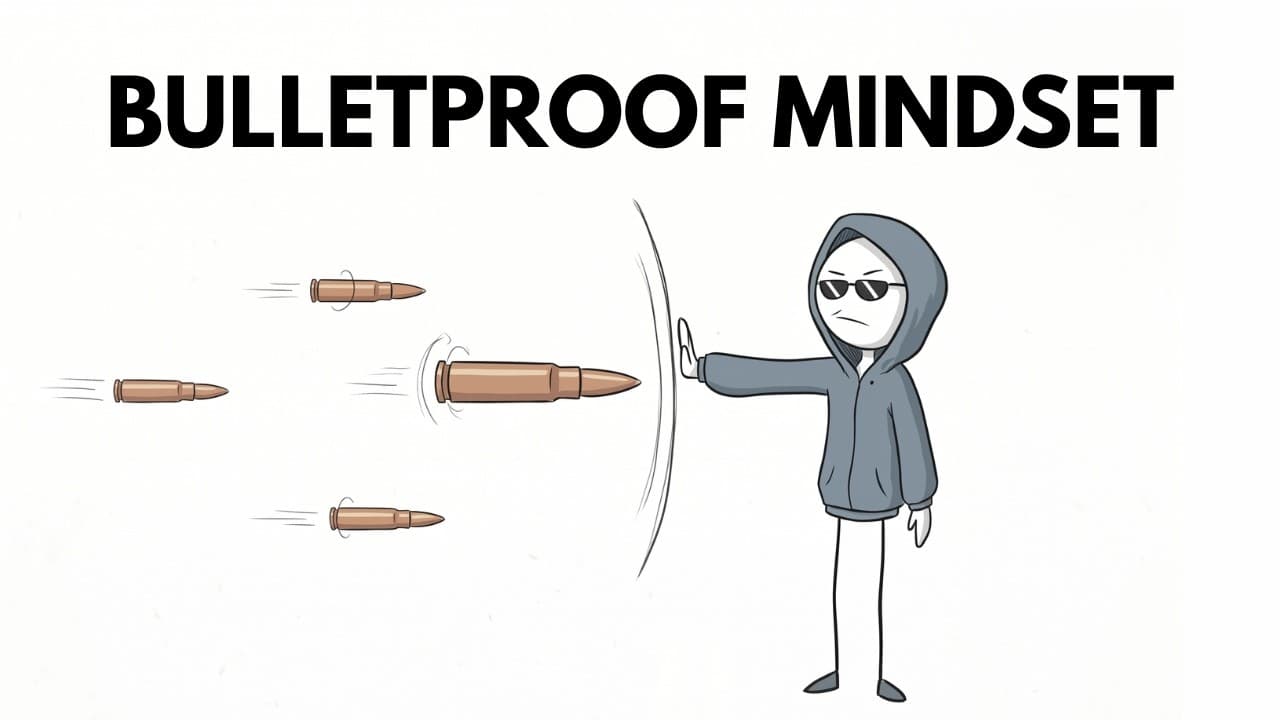
Resilience grows when you repeatedly act on difficult situations you can influence and see that your actions change outcomes. Shutdown after prolonged, uncontrollable stress is presented as an automatic brain response, not a character flaw. Recovery becomes harder when you avoid controllable challenges, wait for fairness, or turn a painful event into a permanent identity.
Transcript
Something happened to you. Maybe it was 6 months ago. Maybe it was just last night. A message that ended something. A door that closed quietly. A person who walked out. A business that died. A phone call that cut your life into a before and an after. And on the outside, you handled it. You said the right things. You told everyone you were fine. But... Read More
Key Insights
- Shutdown is described as an automatic response to prolonged pain that cannot be escaped, not evidence of weak character. The transcript says this response occurs through the dorsal raphe nucleus, which floods the system with serotonin and suppresses the urge to escape.
- Control is the capacity that must be learned through experience. According to the transcript, the ventromedial prefrontal cortex detects whether a person can influence events and, when control is detected, reaches down to interrupt the brain's shutdown response.
- Resilience is built through repeated encounters with controllable difficulty. Each experience of pushing against a challenge and seeing it move gives the brain evidence that personal action can change outcomes, providing the training data needed for a stronger control detector.
- Modern life can create stress without agency. Political news, online comments, wars, appearance judgments, and algorithms can affect a person emotionally while offering little or no direct control, reproducing the combination of pain and powerlessness associated with shutdown.
- Avoidance is reinforced because it produces immediate relief. Canceling meetings, postponing messages, abandoning courses, or evading difficult conversations can feel protective, yet the transcript argues that repeated avoidance teaches the brain to move away from hard things instead of changing them.
- The fairness contract keeps recovery dependent on another person's acknowledgment. Replaying an injustice, building a case, and waiting for reality to admit its mistake may preserve the feeling of being right, but it also gives the offending person control over the recovery timeline.
- Identity fusion turns a limited setback into an apparently impossible problem. Saying a business failed leaves room for action, while saying "I am a failure" treats the event as proof of an unchangeable identity, making recovery feel unavailable and encouraging shutdown.
- The difference between resilient and stuck people is presented as a trainable mental skill rather than innate toughness. The transcript compares shutdown to a tripped electrical breaker: the protective response is normal, but restoring power requires recognizing where personal control remains and acting on it.
Install to Summarize YouTube Videos and Get Transcripts
Explore YouTube Video Summarizer or Get YouTube Transcript Extractor
Questions & Answers
Q: How can you build psychological resilience?
Psychological resilience can be built by repeatedly facing difficult situations that are genuinely within your influence and taking actions that produce visible results. These experiences teach the brain that effort can change outcomes. The transcript compares this process to training a muscle: the control detector needs repeated practice pushing against difficulty and watching that difficulty move.
Q: What does learned helplessness mean in this account?
Learned helplessness originally described passivity that supposedly developed after repeated exposure to inescapable stress. The transcript says Martin Seligman and Steven Maier revisited that interpretation in 2016 and concluded that giving up itself was not learned. Instead, shutdown was automatic, while detecting and exercising control was the response that had to be learned through experience.
Q: Why do people shut down after prolonged stress?
People shut down because prolonged pain without an apparent escape can trigger an automatic brain response. The transcript attributes this response to the dorsal raphe nucleus, which floods the system with serotonin and suppresses the urge to escape. The reaction is presented as standard protective equipment rather than a deliberate choice, moral failure, or proof of personal weakness.
Q: What role does the ventromedial prefrontal cortex play in resilience?
The ventromedial prefrontal cortex is described as a control detector located behind the forehead. Its role is to determine whether a person has influence over what is happening. When it detects control, it reaches down and switches off the shutdown response. Strength therefore depends partly on learning, through repeated experience, that personal actions can affect outcomes.
Q: How can avoiding discomfort weaken resilience?
Avoiding discomfort can weaken resilience when the avoided situation is difficult but controllable. Canceling a meeting, withholding an important message, quitting a course, or postponing a hard conversation may create immediate relief. That relief reinforces avoidance, while the lost challenge removes an opportunity to learn that hard situations can be confronted and changed through deliberate action.
Q: What is the fairness contract in psychology?
The fairness contract is the pattern of refusing to move forward until an unfair event is acknowledged or corrected by someone else. A person may replay the event, build arguments, gather agreement, and wait for a verdict. Even when the grievance is valid, this pattern places the timing of recovery in another person's hands and makes being right more important than becoming free.
Q: How does identity fusion make setbacks harder to overcome?
Identity fusion occurs when a person treats a painful event as proof of who they fundamentally are. A failed business becomes "I am a failure," or rejection becomes "I am unlovable." The first formulation describes a specific event that can be addressed. The second creates an identity-level problem that feels permanent and impossible, so the brain sees no available path for effective action.
Q: Why can modern life make people feel powerless?
Modern life can combine frequent uncontrollable stress with fewer opportunities to master manageable difficulty. The transcript points to political news, online comments, distant wars, appearance judgments, and algorithms as stressors that individuals cannot directly influence. At the same time, convenience, scrolling, skipped workouts, and avoided conversations can remove the experiences that would teach the brain that effort changes outcomes.
Summary & Key Takeaways
-
The central claim is that helpless shutdown is an automatic response to prolonged, inescapable stress, while the sense of control must be learned. The dorsal raphe nucleus suppresses escape behavior, but the ventromedial prefrontal cortex can interrupt that response when it detects that personal action can influence the situation.
-
Modern life can weaken resilience by combining constant exposure to uncontrollable stress with easy avoidance of manageable discomfort. News, comments, algorithms, and distant events provide stress without agency, while convenience and avoidance remove opportunities to struggle, act, and succeed. Resilience develops through repeated experiences of effective control.
-
Three patterns reinforce shutdown: avoiding controllable difficulty while calling it peace, demanding acknowledgment of unfairness before moving forward, and treating setbacks as revelations about identity. Each pattern reduces perceived control. The proposed alternative is to face actionable problems, reclaim responsibility for recovery, and describe painful events without turning them into permanent self-definitions.
Read in Other Languages (beta)
Share This Summary 📚
Summarize YouTube Videos and Get Video Transcripts with 1-Click
Try YouTube Summary with ChatGPT & Claude or YouTube Transcript Generator
Explore More Summaries from PsychToons 📚

Summarize YouTube Videos and Get Video Transcripts with 1-Click
Try YouTube Summary with ChatGPT & Claude or YouTube Transcript Generator