How Do Geometric Derivative Formulas Work?
TL;DR
Derivatives can be computed by tracking how a function’s output responds to a tiny input change, then ignoring terms containing higher powers of that change because they vanish in the limiting process. Geometric area and volume models reveal why the derivatives of x squared and x cubed are 2x and 3x squared, and why the general power rule is n times x to the n minus 1.
Transcript
Now that we've seen what a derivative means and what it has to do with rates of change, our next step is to learn how to actually compute these guys. As in, if I give you some kind of function with an explicit formula, you'd want to be able to find what the formula for its derivative is. Maybe it's obvious, but I think it's worth stating explicitly... Read More
Key Insights
- A derivative is the ratio between a tiny output change and the tiny input change that caused it. This ratio can also be viewed as the tangent-line slope, but geometric models often reveal the exact derivative formula more clearly than a graph alone.
- The derivative of x squared is 2x because increasing a square’s side by dx adds two thin rectangles whose combined area is 2x times dx. The additional corner has area dx squared, which becomes negligible as dx approaches zero.
- Higher powers of dx are negligible in a derivative because the output change is divided by dx before dx approaches zero. Terms containing dx squared or dx cubed still retain a factor of dx afterward, so they do not survive the limiting process.
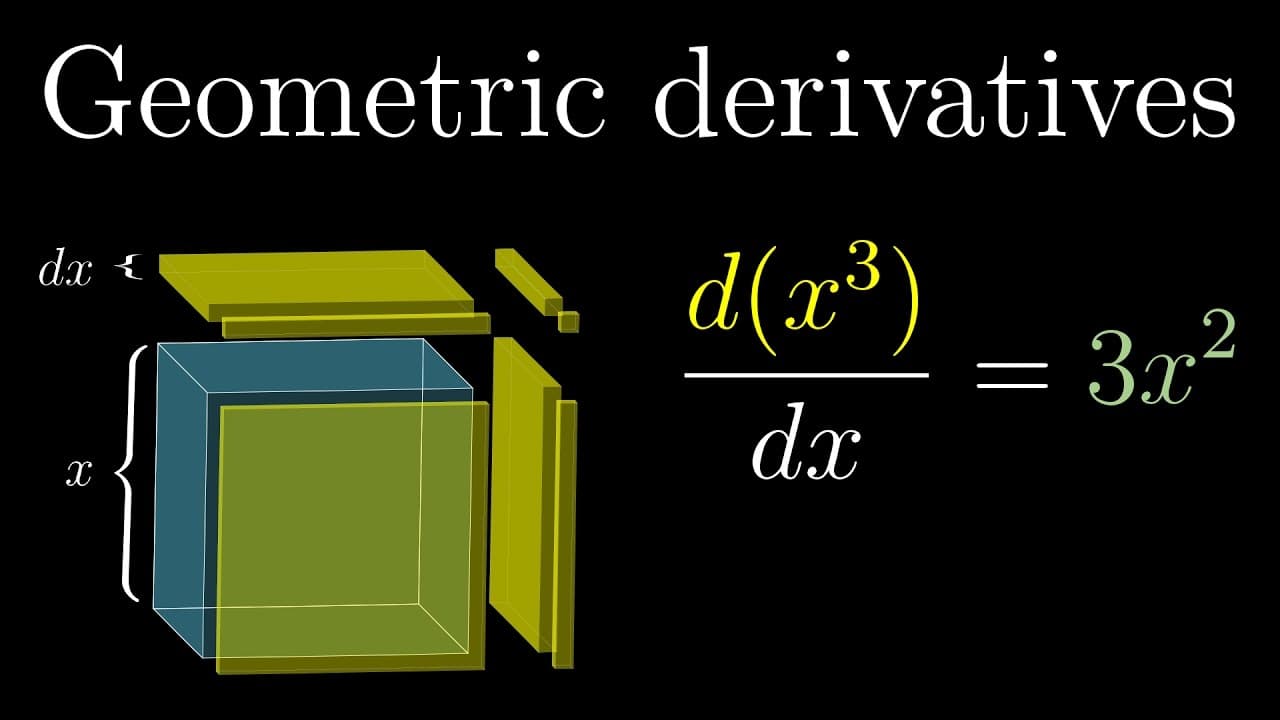
- The derivative of x cubed is 3x squared because almost all the new volume comes from three thin slabs. Each slab has face area x squared and thickness dx, giving a combined first-order volume change of 3x squared times dx.
- A function’s derivative determines its graph’s tangent slope at every input. For x cubed, the slope is 3x squared, so it is high for inputs on either side of the origin and equals zero at the origin.
- The power rule states that the derivative of x to the n is n times x to the n minus 1. Symbolically, the exponent moves in front as a coefficient, while the remaining power decreases by one.
- The coefficient n in the power rule comes from the n possible ways to select exactly one dx when multiplying n factors of x plus dx. Each choice produces the same first-order term, x to the n minus 1 times dx.
- The function 1 divided by x can be visualized as the height of a rectangle whose width is x and whose area remains one. Increasing the width by dx forces the height downward so that the lost area cancels the newly added area.
Install to Summarize YouTube Videos and Get Transcripts
Explore YouTube Video Summarizer or Get YouTube Transcript Extractor
Questions & Answers
Q: What does a derivative measure?
A derivative measures how much a function’s output changes per unit of a tiny change in its input. If the input increases from x to x plus dx and the corresponding output change is dF, the derivative is represented by dF divided by dx. Geometrically, this ratio is also the slope of the tangent line to the function’s graph at x.
Q: How does geometry show that the derivative of x squared is 2x?
Represent x squared as the area of a square with side length x. Increasing each side by dx creates two thin rectangles, each with area x times dx, plus a small corner square with area dx squared. The rectangles contribute 2x times dx, while the corner is negligible. Dividing the meaningful area change by dx gives the derivative 2x.
Q: Why can dx squared terms be ignored when computing derivatives?
Terms containing dx squared represent changes that are much smaller than terms containing only one factor of dx. The derivative calculation divides the total output change by dx and then considers what happens as dx approaches zero. A dx squared term becomes proportional to dx after division, so its contribution approaches zero and does not remain in the derivative.
Q: How does a cube explain the derivative of x cubed?
Represent x cubed as the volume of a cube with side length x. When the side grows by dx, the dominant new volume consists of three thin slabs, each with volume x squared times dx. Smaller pieces along the edges and corner contain dx squared or dx cubed. Ignoring those negligible pieces and dividing by dx gives 3x squared.
Q: What is the power rule for derivatives?
The power rule says that the derivative of x to the n is n times x to the n minus 1. Examples given include the derivative of x to the fourth being 4x cubed and the derivative of x to the fifth being 5x to the fourth. The rule captures a shared pattern across polynomial power terms.
Q: Why does the power rule produce the coefficient n?
Increasing x to x plus dx turns x to the n into a product of n identical factors of x plus dx. The first-order change terms are formed by selecting dx from exactly one factor and x from every other factor. There are n possible selections, producing n copies of x to the n minus 1 times dx.
Q: How is the derivative of x cubed reflected in its graph?
The derivative of x cubed is 3x squared, so this expression gives the tangent-line slope at every input x. The slope is high on the left side of the graph, falls to zero at the origin, and becomes high again toward the right. The graph suggests this behavior, while the cube model supplies the precise formula.
Q: How can 1 divided by x be understood geometrically?
The value 1 divided by x can be represented as the height of a rectangle whose width is x and whose total area is fixed at one. If the width grows, the height must shrink to preserve that area. Under a tiny width increase dx, the area added on one side must be canceled by area removed from the top.
Summary & Key Takeaways
-
A derivative measures the output change dF per tiny input change dx. For f(x) equals x squared, increasing a square’s side from x to x plus dx adds two thin rectangles with total area 2x times dx and a negligible corner of area dx squared, producing the derivative 2x.
-
For f(x) equals x cubed, increasing a cube’s side by dx adds three principal slabs. Each has volume x squared times dx, while the edge and corner pieces contain dx squared or dx cubed. Dividing the meaningful volume change by dx gives a derivative of 3x squared.
-
The same reasoning extends to x to the n. Expanding n factors of x plus dx produces n first-order terms, each equal to x to the n minus 1 times dx. Every remaining change term contains at least dx squared, so the derivative is n times x to the n minus 1.
Read in Other Languages (beta)
Share This Summary 📚
Summarize YouTube Videos and Get Video Transcripts with 1-Click
Try YouTube Summary with ChatGPT & Claude or YouTube Transcript Generator
Explore More Summaries from 3Blue1Brown 📚

Summarize YouTube Videos and Get Video Transcripts with 1-Click
Try YouTube Summary with ChatGPT & Claude or YouTube Transcript Generator