How Can AI Safely Run Science Experiments?
TL;DR
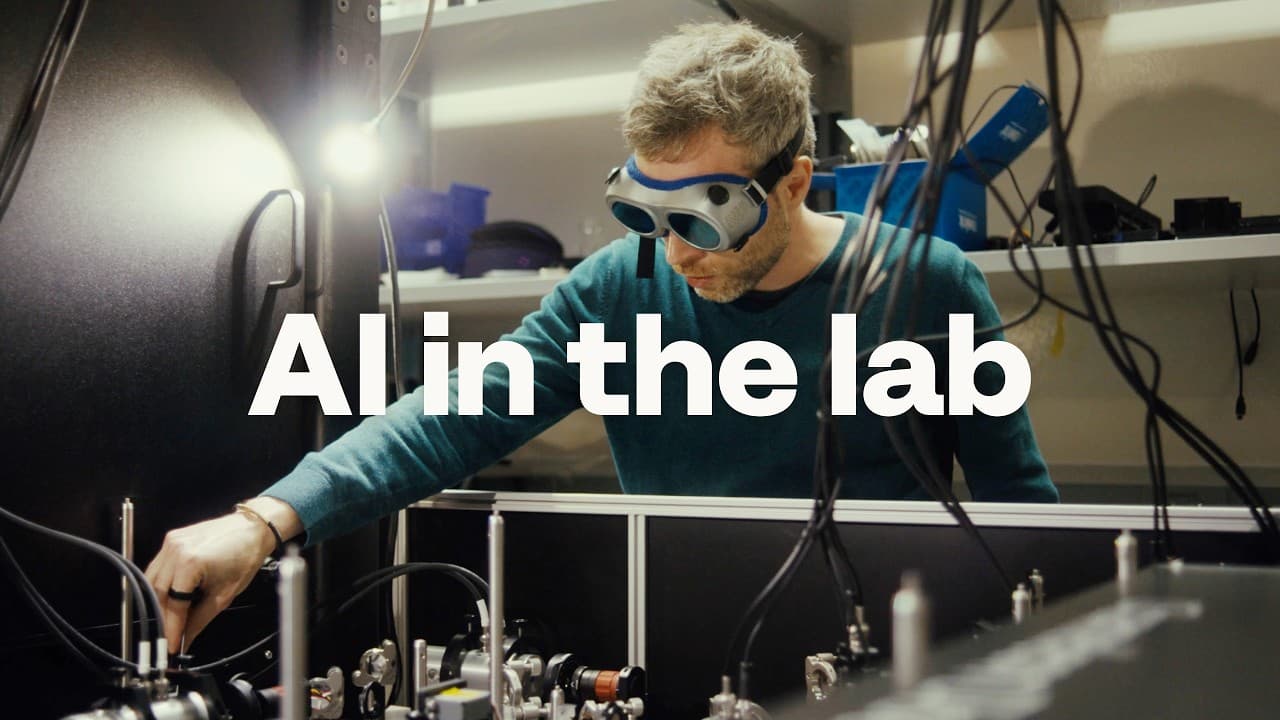
AI agents can operate scientific equipment through the Model Hardware Standard, which connects models with devices while enforcing safeguards such as permitted movement ranges. Early tests showed Claude controlling microscopes, programming an algae-tracking system, and adjusting laboratory procedures in response to data, potentially reducing setup work and accelerating experimental cycles.
Transcript
Scientists come up with theories about how the world works. But just coming up with a theory isn't good enough. And so we have to build experiments, physical measurement devices, to test our theories. That process of building the experiment takes maybe 80% of a scientist's time. They're building devices, they're setting things up, they're debugging... Read More
Key Insights
- Building experiments is a major scientific bottleneck, with device construction, setup, and hardware or software debugging described as consuming about 80% of a scientist's time, even though these activities are supporting tasks rather than the central scientific questions researchers want to investigate.
- The Model Hardware Standard is a general method for allowing AI agents to interact with physical equipment whose components otherwise use different languages, addressing the difficult integration work required to make scientific devices communicate and operate together seamlessly.
- Safety constraints can be enforced outside the AI model by defining permitted operating ranges in the hardware interface. When Claude was intentionally asked to move a robotic arm beyond its safe boundary, the Model Hardware Standard refused the movement.
- Claude can approach unfamiliar laboratory equipment iteratively, but human oversight remains necessary because the model can make mistakes. During microscope testing, scientists monitored its reasoning, provided help when needed, and observed its awareness that higher magnification could cause the instrument to crash into a sample.
- AI-generated laboratory software can be developed rapidly through interactive debugging. Claude wrote an initial algae-tracking script, then created a visible user interface after the researchers rejected an opaque background process, ultimately producing a system that successfully followed the moving organism for several minutes.
- Rapid prototyping can reduce the time researchers spend assembling experimental systems. One participant suggested that work requiring a PhD researcher to spend two years getting an experiment running might instead take two months, leaving more time for biological questions.
- Closed-loop experimentation works by having an AI execute procedures, take measurements, interpret the resulting data, and adjust operating parameters. In the pharmaceutical demonstration, Claude modified the procedure and produced a result with fewer bubbles, which supported more reliable liquid transfer.
- Faster experimental loops can increase the number of attempts researchers make while pursuing an answer. The participants identified possible applications in drug development, quantum computing, nuclear fusion, advanced manufacturing, and other fields where physical experiments require repeated setup, observation, and adjustment.
- More videos from this channel:
- More from this channel: Anthropic
Install to Summarize YouTube Videos and Get Transcripts
Explore YouTube Video Summarizer or Get YouTube Transcript Extractor
Questions & Answers
Q: What is the Model Hardware Standard?
The Model Hardware Standard is a general interface designed to let AI agents safely operate physical equipment used in scientific research and advanced manufacturing. It addresses the problem that laboratory devices often communicate through different languages. The standard also supports safeguards, such as defined movement boundaries that can reject commands directing equipment outside an allowed range.
Q: Why can setting up scientific experiments take so long?
Experimental setup can require scientists to build measurement devices, align components precisely, connect instruments, and debug both hardware and software. One researcher says these activities may consume about 80% of a scientist's time. Complex systems are especially difficult because individual devices can use different communication methods and must be coordinated without damaging equipment or valuable samples.
Q: How does the Model Hardware Standard improve laboratory safety?
The standard can enforce restrictions between an AI agent and the physical device. In the robotic-arm demonstration, the researchers first defined the arm's safe movement range, including how far it could extend beyond the table. When Claude was deliberately asked to move beyond that range, the Model Hardware Standard refused the unsafe motion instead of executing it.
Q: Can Claude operate a microscope without prior application training?
Claude was connected to a Leica microscope despite having seen nothing related to that particular application, according to the participants. It explored settings, worked toward obtaining a focused image, and showed awareness that switching to higher magnification could crash the microscope into the sample. Human assistance was still needed because the process was iterative and mistakes remained possible.
Q: How did Claude create a system for tracking algae?
The researchers asked Claude to write a program that could follow moving algae so a scientist would not need to watch continuously for hours. Its initial script was not sufficient, and the team requested a user interface so they could see what the system was doing. Claude revised the solution, and the resulting program tracked the algae for several minutes.
Q: How could AI reduce the time required for experimental setup?
AI can help connect instruments, write control software, build interfaces, debug failures, and revise procedures during rapid prototyping. A participant suggested that a PhD researcher who might otherwise spend two years getting an experimental system running could potentially finish that setup in two months, creating more time to focus on biological questions rather than infrastructure work.
Q: How can AI improve pharmaceutical experiments?
Claude can run a sequence of laboratory operations, read the resulting data, and modify parameters based on what it observes. In the pharmaceutical demonstration, bubbles were important because aspirating liquid from a well containing bubbles could produce an incorrect transfer amount. Claude adjusted the procedure and generated a result with bubbles in fewer wells than before.
Q: Why are closed-loop experiments valuable for drug discovery?
Closed-loop experiments connect execution, measurement, interpretation, and adjustment into a repeated process. Drug discovery can require testing thousands, hundreds of thousands, or millions of molecules to identify a useful candidate. If AI speeds up each experimental loop, researchers can make more attempts, respond to problems such as bubbles, and reach answers faster.
Summary & Key Takeaways
-
Scientists can spend about 80% of their time building experimental devices, configuring systems, and debugging hardware and software. The Model Hardware Standard was created to reduce this burden by giving AI agents a general interface for communicating with different physical instruments, allowing researchers to focus more directly on scientific questions.
-
Initial demonstrations tested the standard across neuroscience equipment, a robotic arm, and a Leica microscope. Claude moved hardware, respected defined safety boundaries, adjusted microscope settings, interpreted false-colored images, and created an interface and program that tracked moving algae after an initial script failed, demonstrating rapid, iterative experimental prototyping.
-
A pharmaceutical experiment extended the approach into drug discovery. Claude executed operations, read results, and changed parameters to reduce bubbles that could disrupt accurate liquid transfers. By shortening repeated cycles of execution, measurement, interpretation, and adjustment, AI-assisted equipment could help scientists test more possibilities and reach useful answers faster.
Read in Other Languages (beta)
Share This Summary 📚
Summarize YouTube Videos and Get Video Transcripts with 1-Click
Try YouTube Summary with ChatGPT & Claude or YouTube Transcript Generator
Explore More Summaries from Anthropic 📚

Summarize YouTube Videos and Get Video Transcripts with 1-Click
Try YouTube Summary with ChatGPT & Claude or YouTube Transcript Generator