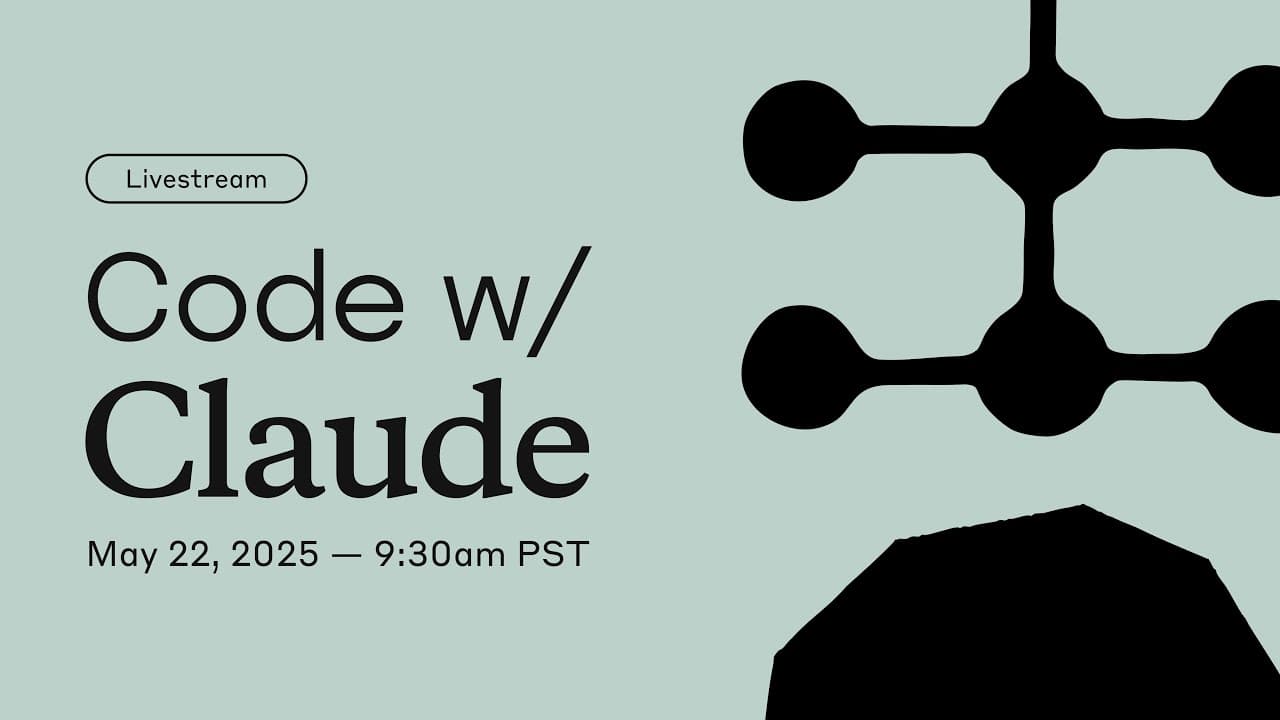
What Do Claude 4 Models Offer Developers? | Code with Claude Opening Keynote
TL;DR
Claude Opus 4 offers advanced support for complex coding and agentic workflows, while Claude Sonnet 4 balances intelligence and efficiency for everyday development and high-volume use. Both hybrid models provide near-instant responses or extended thinking, can use web search while reasoning, operate multiple tools in parallel, and retain knowledge across sessions through local files. Read on to compare their ideal use cases and agent capabilities.
Transcript
hey hey hey welcome hey hey hey hey hey hey hey hey hey heat heat happy birthday heat heat doo doo doo doo doo doo doo doo doo doo doo let me do it hey come on heat heat heat heat happy hey hey hey oh hey hey you are Read More
Key Insights
- Claude Opus 4 is designed for demanding coding and agentic tasks, including understanding codebases, planning additions, migrations, refactoring, and complex workflows where developers may have reached the limits of other models.
- Claude Sonnet 4 is positioned as an efficient model for everyday coding, application development, pair programming, high-volume workloads, and teams seeking a direct improvement from Sonnet 3.7 at the same cost.
- Both Claude 4 models are hybrid models that offer near-instant responses for routine requests and extended thinking when a task requires deeper reasoning, including uses beyond coding and mathematics.
- Claude 4 agents can use tools such as web search during their reasoning process, allowing tool-derived information to become part of how they work through a task rather than merely a separate final step.
- Claude 4 models can handle multiple tools in parallel, which supports workflows containing several simultaneous operations and aligns with Anthropic's broader goal of helping developers remove productivity bottlenecks.
- Claude 4 models can maintain memory across sessions when they have access to local files, enabling them to accumulate knowledge over time instead of beginning every interaction without retained working context.
- Claude Opus 4 can reportedly complete some tasks that take humans six or seven hours, based on experiences from customers who previewed the model before its public release.
- AI agents are presented as augmenting human creativity rather than replacing it, helping startups conduct parallel experiments, learn from users, build faster, and access strategic support before hiring specialized leaders.
Install to Summarize YouTube Videos and Get Transcripts
Explore YouTube Video Summarizer or Get YouTube Transcript Extractor
Questions & Answers
Q: What do Claude Opus 4 and Claude Sonnet 4 offer developers?
Claude Opus 4 is designed for complex coding and agentic work, including understanding codebases, planning additions, migrations, and refactoring. Claude Sonnet 4 balances intelligence and efficiency for everyday coding, application development, pair programming, and high-volume workloads.
Q: What is the difference between Claude Opus 4 and Claude Sonnet 4?
Opus 4 is positioned as Anthropic's most capable model for demanding coding and agentic workflows. Sonnet 4 is leaner and more narrowly focused, offering improved intelligence over Sonnet 3.7 at the same cost.
Q: How does extended thinking work in Claude 4?
Both Claude 4 models are hybrid systems that can give near-instant responses when extensive reasoning is unnecessary. They can switch to extended thinking for work that benefits from deeper analysis, including tasks beyond coding and mathematics.
Q: What coding tasks is Claude Opus 4 designed to handle?
Claude Opus 4 can understand codebases, plan additions, assist with migrations, and perform code refactoring. Preview customers reported that it could autonomously complete some tasks that take humans up to six or seven hours.
Q: When should developers use Claude Sonnet 4?
Claude Sonnet 4 is intended for everyday coding, application development, pair programming, and high-volume use cases where both efficiency and intelligence matter. It also addresses feedback about Sonnet 3.7's overeagerness and tendency to do more than requested.
Q: What tool-use capabilities do Claude 4 agents have?
Claude 4 agents can use tools such as web search during their reasoning process, incorporating retrieved information into how they work through a task. They can also operate multiple tools in parallel to support workflows with simultaneous operations.
Q: How can Claude 4 maintain knowledge across sessions?
Claude 4 can maintain knowledge across sessions when it has access to local files. Those files let the model preserve and accumulate working context over time instead of starting every interaction without retained knowledge.
Q: How can AI agents help startups build products faster?
AI agents can help startups run experiments in parallel, learn from users, and build products faster by reducing productivity bottlenecks. They can also provide strategic assistance resembling roles such as a chief financial officer or head of product before a startup is ready to hire those specialists.
Summary & Key Takeaways
-
Anthropic announced Claude Opus 4 and Claude Sonnet 4 at its first developer conference. Opus is positioned as the most capable model for complex coding and agentic work, while Sonnet offers a balance of intelligence and efficiency for everyday development, pair programming, application building, and high-volume use cases.
-
Both Claude 4 models are hybrid systems with near-instant and extended-thinking modes. Their agent capabilities include using web search during reasoning, operating multiple tools in parallel, and maintaining knowledge across sessions when local files are available. Anthropic presents these features as foundations for more capable and persistent AI workflows.
-
Anthropic frames AI agents as tools for augmenting human creativity and removing productivity bottlenecks. The keynote argues that startups can use agents to run experiments in parallel, learn from users, build products faster, and temporarily access strategic assistance resembling roles they may not yet be ready to fill permanently.
Read in Other Languages (beta)
Share This Summary 📚
Summarize YouTube Videos and Get Video Transcripts with 1-Click
Try YouTube Summary with ChatGPT & Claude or YouTube Transcript Generator
Explore More Summaries from Anthropic 📚
Summarize YouTube Videos and Get Video Transcripts with 1-Click
Try YouTube Summary with ChatGPT & Claude or YouTube Transcript Generator