How to Delegate Work Effectively Between Humans and AI
TL;DR
Effective AI delegation starts by defining the goal, required work, and criteria for success before choosing an AI system or assigning tasks. Combine problem awareness with practical knowledge of different platforms, then decide which activities to automate, perform collaboratively, reserve for human judgment, or entrust to AI agents acting on your behalf.
Transcript
In this video, we're going to take a closer look at the delegation competency. Remember that AI fluency is about working with AI in ways that are effective, efficient, ethical, and safe. Delegation is primarily focused on the first two of these. Helping you work effectively and efficiently with AI assistance. At its core, delegation is about decidi... Read More
Key Insights
- Delegation is the process of deciding what work must be completed, what a person should do, and what may be better suited to AI. Its primary contribution to AI fluency is helping people collaborate with AI more effectively and efficiently.
- Problem awareness is the ability to define goals clearly and understand the work required before involving AI. It includes identifying the desired creation or solution, the project vision, the criteria for success, and the forms of thinking needed to achieve the outcome.
- Domain expertise is the cornerstone of effective AI delegation because it enables people to direct work, judge results, and recognize when intervention is required. Advanced AI cannot compensate for an unclear goal or a weak understanding of the underlying problem.
- Project work can include simple but time-consuming activities, uncertain areas that benefit from a trusted thinking partner, areas of ignorance requiring more data, and decisions demanding critical judgment. Recognizing these differences helps determine an appropriate role for AI.
- Platform awareness is a working knowledge of available AI systems and their particular capabilities and limitations. Different systems may emphasize speed, depth, accuracy, or creativity, so effective delegation depends on matching a system to the intended kind of work.
- Hands-on experimentation is the recommended way to build platform awareness because the AI landscape changes quickly. Trying different systems regularly allows collaborators to develop practical, experience-based insights instead of searching for one supposedly perfect system.
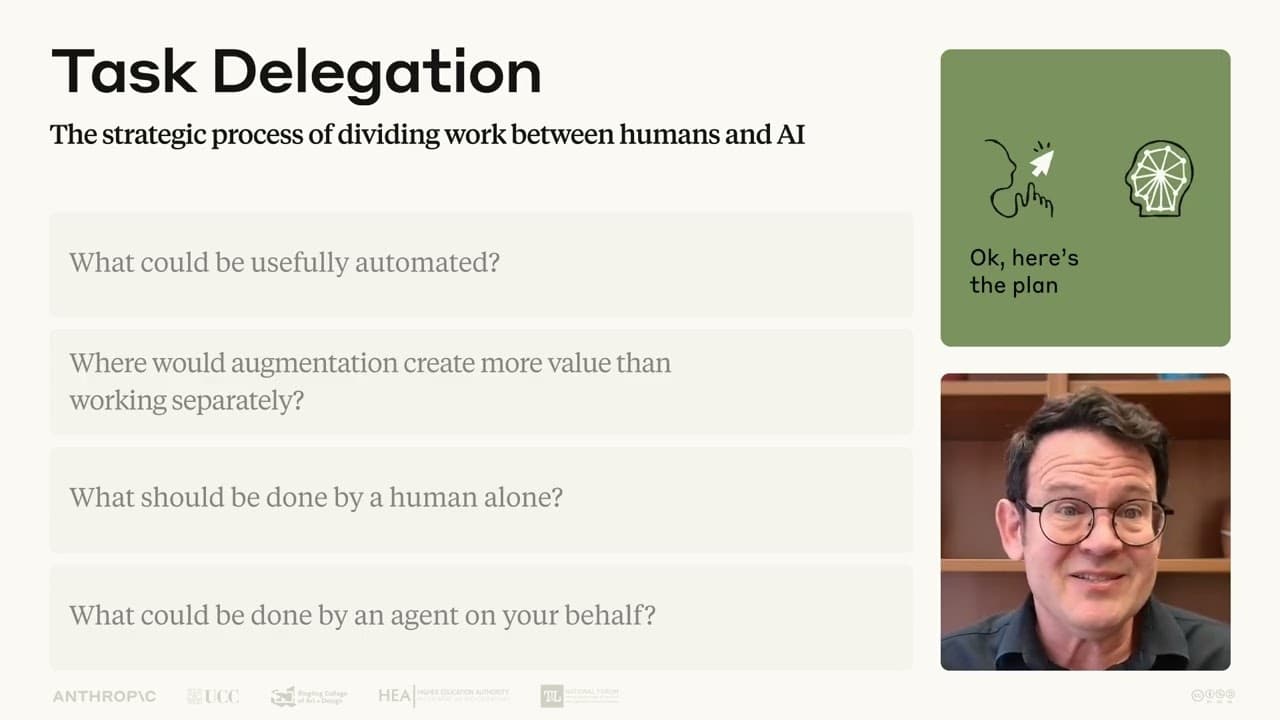
- Task delegation is the strategic division of work between humans and AI. Possible assignments include AI automation, human and AI augmentation, exclusively human execution for critical judgments, and agency in which AI systems handle routine interactions on a person's behalf.
- Effective AI collaboration is a deliberate distribution of responsibility, not the simple transfer of control to AI. Strong delegation uses problem awareness and platform awareness to leverage the distinct strengths of human and artificial intelligence throughout a workflow.
Install to Summarize YouTube Videos and Get Transcripts
Explore YouTube Video Summarizer or Get YouTube Transcript Extractor
Questions & Answers
Q: What is AI delegation?
AI delegation is the strategic process of deciding what work needs to be done and distributing its parts between humans and artificial intelligence. It involves determining what a person should complete, what AI can automate, where human and AI collaboration adds value, which judgments should remain human, and what routine interactions AI agents can handle on a person's behalf.
Q: How do you delegate work effectively to AI?
Effective delegation begins by defining the intended outcome, project goals, vision, success criteria, and required kinds of thinking. Next, assess the capabilities and limitations of available AI systems. Finally, divide the workflow into manageable parts and assign each part to automation, human and AI collaboration, exclusively human execution, or an AI agent acting on your behalf.
Q: Why is problem awareness important for AI delegation?
Problem awareness provides the foundation needed to use AI purposefully. Without a clear understanding of the goal and the work involved, a person may struggle to guide an AI assistant, evaluate its output, or recognize when human intervention is necessary. Clear goals also reveal which activities are routine, uncertain, data-dependent, or reliant on critical judgment.
Q: What is platform awareness in AI fluency?
Platform awareness is a working knowledge of available AI systems and their specific capabilities and limitations. It includes investigating which models fit a particular kind of work and recognizing that systems can prioritize qualities such as speed, depth, accuracy, or creativity differently. This knowledge supports better matching between a task and the AI assistance selected for it.
Q: How can someone develop platform awareness?
Platform awareness is best developed through frequent hands-on experimentation with different AI systems. Because the AI landscape changes quickly and systems offer different strengths and limitations, direct experience helps a person form practical insights about which options suit particular tasks. The goal is not to find one perfect system, but to understand several available choices.
Q: Which tasks should remain exclusively human?
Tasks involving critical judgment may need to remain exclusively human rather than being delegated. The appropriate boundary depends on the project, domain, goals, and work involved. A person with strong problem awareness can identify these areas, evaluate AI outputs, and determine when intervention is necessary instead of automatically transferring every part of a workflow to an AI system.
Q: What is the difference between automation, augmentation, and agency?
Automation assigns suitable work to AI for completion, while augmentation combines human and AI contributions where collaboration creates more value than either working alone or fully automating the activity. Agency allows AI agents to handle routine interactions on a person's behalf. These approaches sit alongside tasks reserved exclusively for human execution, especially where critical judgment is required.
Q: What are the three elements of effective AI delegation?
The three elements are problem awareness, platform awareness, and task delegation. Problem awareness means understanding the goal and problem to be solved. Platform awareness means knowing the capabilities and limitations of available AI systems. Task delegation uses both forms of awareness to divide work strategically between human execution, AI automation, collaboration, and AI agents.
Summary & Key Takeaways
-
Delegation is the competency of deciding what work must be done, what humans should perform, and what AI may handle more effectively or efficiently. It requires breaking complex projects into manageable parts and selecting among automation, augmentation, agency, and exclusively human execution according to the demands of each task.
-
Problem awareness comes before AI involvement. A person must clarify the intended outcome, project vision, success criteria, and kinds of thinking required. Domain expertise makes it possible to guide AI productively, evaluate its output, recognize uncertainty or ignorance, and identify situations where human intervention or critical judgment remains necessary.
-
Platform awareness means developing practical knowledge of available AI systems, including their different strengths and limitations. Combined with clear problem awareness, it supports strategic task delegation. The resulting workflow assigns routine, collaborative, automated, agentic, and judgment-intensive activities according to the distinct capabilities of humans and artificial intelligence.
Read in Other Languages (beta)
Share This Summary 📚
Summarize YouTube Videos and Get Video Transcripts with 1-Click
Try YouTube Summary with ChatGPT & Claude or YouTube Transcript Generator
Explore More Summaries from Anthropic 📚




Summarize YouTube Videos and Get Video Transcripts with 1-Click
Try YouTube Summary with ChatGPT & Claude or YouTube Transcript Generator