How to apply the 4 Ds of AI fluency in collaboration
TL;DR
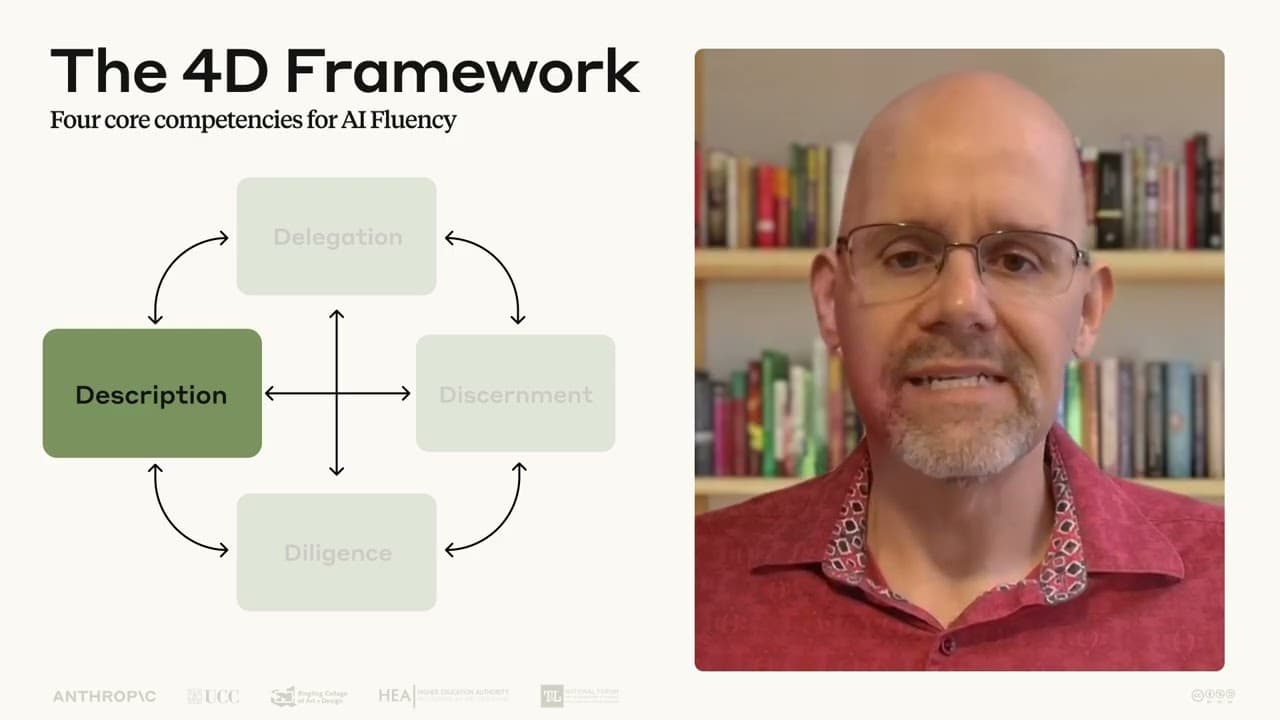
The four Ds are delegation, description, discernment, and diligence, and they guide how to work with AI. Start by defining your goal and what tasks to delegate, then describe outputs clearly, assess AI results for accuracy and alignment, and finally ensure responsible use and accountability throughout the process. This framework helps you collaborate with AI effectively and safely.
Transcript
Hi, my name is Rick Dacon from the Ringling College of Art and Design. Now that we've explored what AI fluency means and the different ways we interact with AI, let's dive into the core competencies that help us navigate AI collaboration effectively, efficiently, ethically, and safely. No matter how you're working with AI, whether through automatio... Read More
Key Insights
- The four Ds are the core competencies for AI collaboration, focusing on delegation, description, discernment, and diligence.
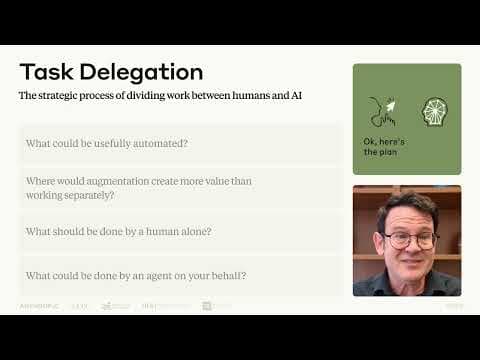
- Delegation requires a clear goal, task division, and an understanding of AI strengths and limits to optimize workflow.
- Description means precise, context rich communication with AI, including desired output format and style.
- Discernment involves evaluating AI outputs for accuracy, relevance, and alignment with goals and values.
- Diligence emphasizes responsible AI use, such as fairness, data protection, transparency, and accountability.
- These competencies are designed to be tool agnostic and adapt to evolving AI technologies.
- Effective AI collaboration relies on iterative cycles of description and discernment to refine results.
- The framework helps users move beyond simply using AI to using AI wisely in professional and educational contexts.
- More videos from this channel:
- More from this channel: Anthropic
Install to Summarize YouTube Videos and Get Transcripts
Explore YouTube Video Summarizer or Get YouTube Transcript Extractor
Questions & Answers
Q: What are the four Ds of AI fluency and why do they matter?
The four Ds of AI fluency are delegation, description, discernment, and diligence. They matter because they provide a structured approach to working with AI that emphasizes clear goals, precise communication with the AI, critical evaluation of outputs, and responsible handling of information. This framework helps users maximize AI benefits while minimizing risks and inefficiencies by guiding how to plan, prompt, assess, and govern AI assisted work.
Q: How does delegation influence AI driven projects?
Delegation influences AI driven projects by making a plan for which tasks to handle with AI and which to keep for human effort. It requires understanding the goal, breaking down the work, and assigning responsibilities to balance efficiency with quality. This ensures AI is used where it adds value and humans retain oversight on critical decisions and final conclusions.
Q: What does effective description look like when working with AI?
Effective description involves detailing the goal, target audience, style, and constraints, not just a vague request. It includes specifying the output format, required steps, and context the AI needs to perform well. This creates a context rich conversation where the AI can align its suggestions with the user’s vision and standards.
Q: What role does discernment play in evaluating AI outputs?
Discernment plays the role of evaluating accuracy, logic, and alignment with brand values and objectives. It requires the user to apply domain expertise, check sources, question assumptions, and decide whether to refine, discard, or further develop the AI produced content. This helps ensure the final result is useful and trustworthy.
Q: Why is diligence important in AI collaboration?
Diligence is important because it covers responsible practices, including fairness, data protection, transparency about AI involvement, and accountability for the final work. It ensures that AI assistance is used ethically, with proper safeguards, and that users can justify and defend the outcomes if challenged.
Q: How can you apply the 4 Ds in a simple project workflow?
In a simple project, start with delegation by outlining the goal and assigning tasks between you and the AI. Use description to craft precise prompts and define the desired output. Apply discernment to assess AI results for accuracy and relevance, refining prompts as needed. End with diligence by checking for biases, data handling compliance, and documenting AI involvement.
Q: Can the 4 Ds be used with any AI tool or just specific ones?
The 4 Ds are designed to be tool agnostic, focusing on process and thinking skills rather than tool specifics. They work with any AI tool by guiding how to define goals, describe tasks, evaluate outputs, and ensure responsible use. As tools evolve, the 4 Ds provide a stable framework for ongoing AI collaboration.
Q: How do the 4 Ds support ethical and safe AI use?
The 4 Ds support ethical and safe AI use by embedding responsibility into every step: delegation clarifies what AI should and should not do, description ensures transparent and precise requests, discernment reinforces critical evaluation of AI outputs, and diligence enforces accountability, fairness, data protection, and clear communication about AI involvement.
Summary & Key Takeaways
-
The four Ds provide a stable, goals driven approach to AI collaboration, ensuring tasks are allocated thoughtfully and strategically. Delegation clarifies roles and responsibilities while maintaining human oversight for critical analysis.
-
Description emphasizes precise, context rich prompts and ongoing dialogue to set expectations, format, and approach for AI outputs, improving relevance and quality.
-
Diligence centers on ethics, fairness, data protection, and transparency, making responsible AI use a habitual part of every project.
Read in Other Languages (beta)
Share This Summary 📚
Summarize YouTube Videos and Get Video Transcripts with 1-Click
Try YouTube Summary with ChatGPT & Claude or YouTube Transcript Generator
Explore More Summaries from Anthropic 📚


Summarize YouTube Videos and Get Video Transcripts with 1-Click
Try YouTube Summary with ChatGPT & Claude or YouTube Transcript Generator