How AI Agents Learn to Plan by Playing Pokemon
TL;DR
Claude Plays Pokemon demonstrates how an AI agent can act through a sequence of actions in a contained game environment. The system uses a Game Boy Pokemon Red setup where Claude presses buttons and receives screenshots as feedback, while maintaining a memory of past actions to guide future decisions. This setup illustrates practical agent behavior and long term memory in action.
Transcript
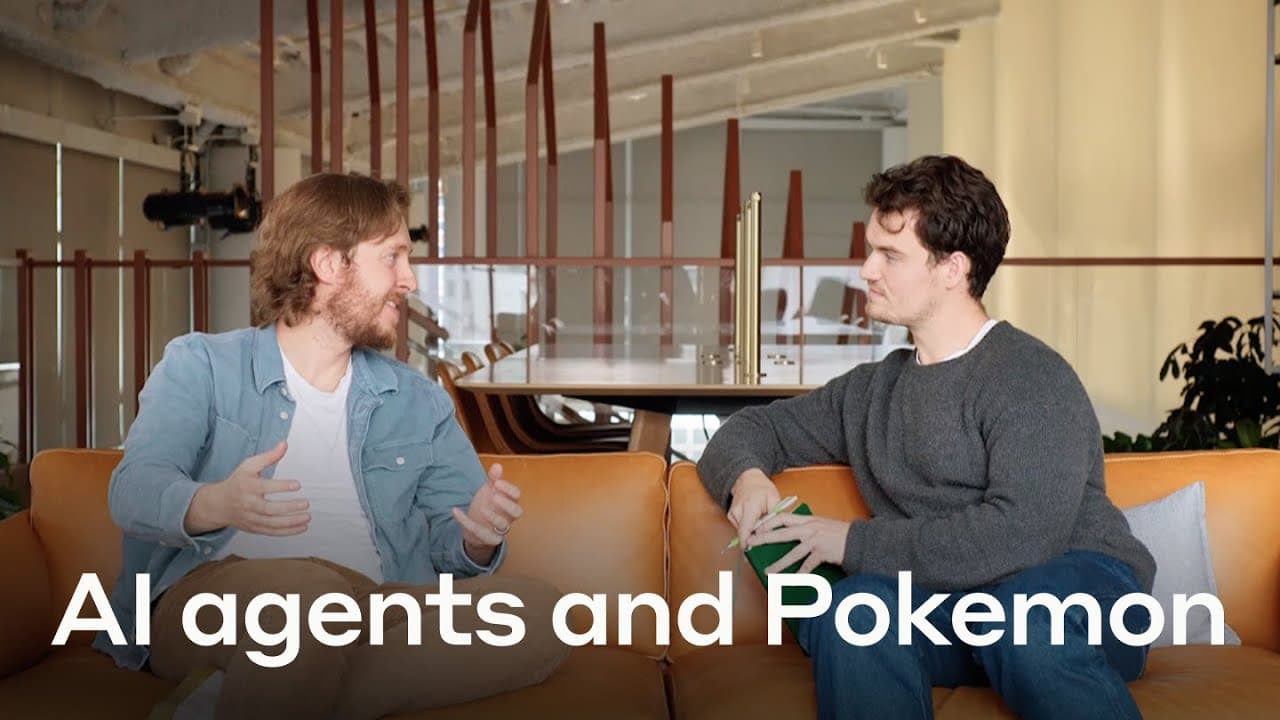
- The AI world has talked so much about agents in the last year, but for a lot of the world I think like, it's pretty hard to really understand what that means. And I think the example of Pokemon where it's like, oh, it's like not just a chatbot where I type in a chat and I get a response back, but like it's like doing this on its own and seeing an... Read More
Key Insights
- Claude acts through a minimal action set by pressing buttons and receiving screen updates.
- A feedback loop using screenshots lets Claude observe game state after each action.
- Memory is externalized via a knowledge base to extend long term reasoning beyond context limits.
- Long term memory helps Claude remember goals and past actions across sessions.
- Summarization is used to compress history when context length is reached.
- Pokemon is chosen because its turn based, self contained, and task oriented nature suits agents.
- The experiments evolve from simple button presses to more structured agent behavior.
- The project demonstrates practical considerations for AI planning in real world tasks.
- More videos from this channel:
- More from this channel: Anthropic
Install to Summarize YouTube Videos and Get Transcripts
Explore YouTube Video Summarizer or Get YouTube Transcript Extractor
Questions & Answers
Q: What is Claude Plays Pokemon and how does it relate to AI agents
Claude Plays Pokemon is an experiment that hooks Claude to a Game Boy Pokemon Red game to let it try to play the game. The setup uses a simple tool set that includes button presses and screen feedback so the agent can act across many steps without human prompts. It demonstrates how agents can operate in a sequential task with feedback.
Q: How does Claude control the Pokemon game during play
Claude controls the game by issuing button press actions such as A, B, up, down, left, and right. Each decision is translated into a corresponding emulator input, and after each action a screenshot is returned to Claude so it can decide the next move based on the new game state.
Q: What is the purpose of the long term memory in Claude Plays Pokemon
The long term memory or knowledge base stores past actions, goals, and milestones so Claude can remember what it has done and what it aims to achieve over time. This memory is essential because the model’s context window is limited and would otherwise lose track of progress across many actions.
Q: Why was Pokemon chosen as the testing environment for AI agents
Pokemon was chosen because it is turn based, non synchronous, and provides clear feedback through game progression. It allows the model to take actions over time and observe results without high frame rate constraints, making it an accessible and effective setting to study agent behavior and planning.
Q: How does Claude handle context length limitations
When the context length is reached, Claude summarizes prior actions to a concise form and stores them in memory. This process helps keep the essential information while freeing up capacity for new actions, ensuring the agent can continue operating over extended play sessions.
Q: What role do screenshots play in Claude Plays Pokemon
Screenshots provide the visible state of the game after each action, serving as the only perceptual input for Claude to interpret. This visual feedback is crucial for deciding the next button press and pacing the agent’s actions in the turn based game.
Q: How does Claude adapt its behavior across model versions
The project notes evolution across different model versions, indicating progress in the agent’s ability to plan and act over time. Improvements likely reflect refinements in how Claude processes state, memory, and decision making, enabling more sustained and coherent gameplay.
Q: What practical lessons about building AI agents are highlighted
The discussion highlights practical lessons such as the need for effective memory systems, deliberate tool design for action selection, managing context length, and using contained environments like games to study planning. These insights inform how to design agents capable of long term, goal oriented tasks.
Summary & Key Takeaways
-
Claude Plays Pokemon shows an AI agent acting without human prompts and using a memory system to track past actions over time, enabling long sequential tasks. The Pokemon environment provides clear feedback through gym progression and battles to measure progress. The project blends model control with a game loop to demonstrate planning.
-
The implementation uses button controls to interact with the emulator and screenshots as input, while a memory knowledge base stores goals and past moves. When memory fills up, the system summarizes to stay within context limits, preserving direction and intent.
-
The discussion highlights the design choices that make Pokemon a suitable test bed, including turn based play, contained environment, and measurable progress indicators like gym badges. It also touches on limitations and lessons applicable to broader agent development.
Read in Other Languages (beta)
Share This Summary 📚
Summarize YouTube Videos and Get Video Transcripts with 1-Click
Try YouTube Summary with ChatGPT & Claude or YouTube Transcript Generator
Explore More Summaries from Anthropic 📚

Summarize YouTube Videos and Get Video Transcripts with 1-Click
Try YouTube Summary with ChatGPT & Claude or YouTube Transcript Generator