What Is Claude Code on the Web and When to Use Haiku 4.5
TL;DR
Claude Code on the web lets you delegate coding tasks from a browser or mobile app by connecting GitHub, picking a repo, and describing the work. Tasks run in parallel on cloud infrastructure. Haiku 4.5 is best for implementation, while Sonnet 4.5 handles planning and problem decomposition.
Transcript
Clot code is now available on the web. So instead of loading up your terminal or having to open up your IDE anytime you want to make a change, you can now delegate coding tasks directly from your browser or the cloud mobile app. You simply connect your GitHub account, you select your repo, describe what you need done, and Claude handles the rest, a... Read More
Key Insights
- Claude Code on the web lets developers delegate coding tasks from a browser or the Claude mobile app, without opening a terminal or IDE. You connect GitHub, select a repo, describe the task, and Claude runs it on cloud infrastructure.
- Claude Code on the web can run multiple tasks in parallel across different repositories. This suits bug backlogs, routine fixes, or new feature ideas, since several sessions can be spun up and handled at the same time.
- Each web task runs in its own isolated sandbox with full git access. Users can watch progress in real time while Claude works, and then review a summary of the changes it made across files.
- Claude Haiku 4.5 gives similar coding performance to Sonnet 4, which was state-of-the-art five months earlier, at one third of the cost and more than twice the speed. It even surpasses Sonnet 4 at certain tasks like computer use.
- Haiku 4.5 scores 73.3% on SWE-bench Verified and 41% on Terminal Bench. It reaches 90% of Sonnet 4.5's performance in agentic coding evaluations, making it a strong option for fast, low-cost coding work.
- A popular multi-agent pattern is to have Sonnet 4.5 handle high-level problem decomposition and planning, while Haiku 4.5 implements and writes the code. This approach is common for large-scale refactors and tackling technical debt.
- Haiku 4.5 is priced at $1 per million input tokens and $5 per million output tokens, and it is available wherever Claude is available.
- The Open in CLI button moves a web session into your local terminal with all context and progress preserved. You paste the provided command, then see the messages and changed files, and continue where you left off.
Install to Summarize YouTube Videos and Get Transcripts
Explore YouTube Video Summarizer or Get YouTube Transcript Extractor
Questions & Answers
Q: What is Claude Code on the web?
Claude Code on the web lets you delegate coding tasks directly from your browser or the Claude mobile app instead of opening a terminal or IDE. You connect your GitHub account, select a repository, describe what you need, and Claude handles the work on cloud infrastructure.
Q: How do you start a task in Claude Code on the web?
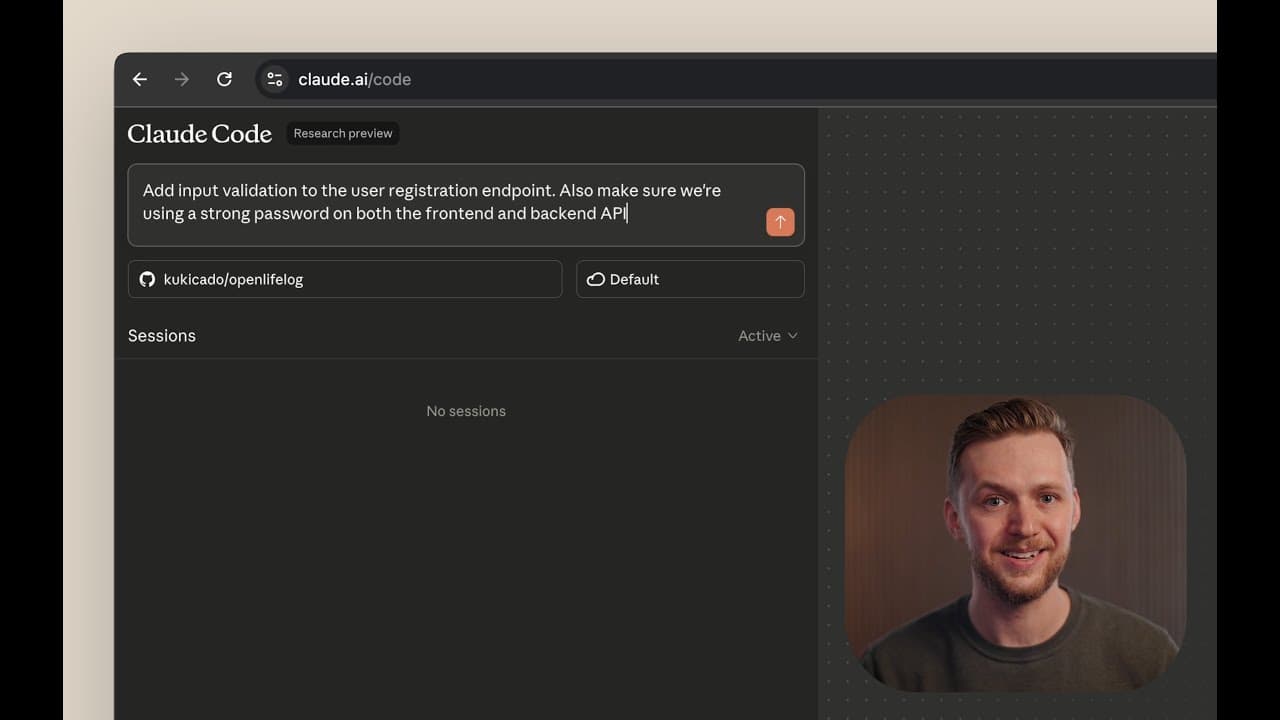
Open Claude Code on the web, select a repository, and enter a prompt. In the demo, the prompt asked to add input validation to the user registration endpoint and enforce strong passwords on both the front end and backend API. Claude then works in its own isolated sandbox with full git access, and you can watch progress in real time.
Q: Can Claude Code on the web run several tasks at once?
Yes. You can run multiple tasks in parallel across different repositories. This is useful for a bug backlog, routine fixes, or a new feature idea, because you can spin up one or several sessions and let Claude handle them simultaneously rather than waiting for each to finish before starting the next.
Q: When should developers use Claude Haiku 4.5?
The pattern seen from the community is that Sonnet 4.5 does the high-level problem decomposition and planning, and Haiku 4.5 is then used to implement and write the code. This multi-agent approach is becoming popular for large-scale refactors and for tackling technical debt, where fast and low-cost implementation matters.
Q: How does Haiku 4.5 compare with Sonnet 4 and Sonnet 4.5?
Haiku 4.5 gives similar coding performance to Sonnet 4 at one third of the cost and more than twice the speed, and it surpasses Sonnet 4 at certain tasks like computer use. It achieves 90% of Sonnet 4.5's performance in agentic coding evaluations, with 73.3% on SWE-bench Verified and 41% on Terminal Bench.
Q: How much does Claude Haiku 4.5 cost?
Haiku 4.5 costs $1 per million input tokens and $5 per million output tokens. It is available wherever you get your Claude. Compared with Sonnet 4, which was state-of-the-art five months earlier, it delivers similar coding performance at one third of the cost and more than twice the speed.
Q: How do you move a web session into your local environment?
Use the Open in CLI button. Click it, open your terminal, and paste the command it gives you. You then work in your local development environment with all of the context and progress from the web preserved, including the messages and changed files, which you can inspect in VS Code and continue from there.
Q: What does the multi-question feature in Claude Code do?
When you give Claude Code a broad prompt, such as adding caching to an application, it asks follow-up questions to implement it correctly. These cover the caching level, such as database query or API response caching, your goals, the target area, and the technology, such as Redis, in-memory, or Postgres. You then submit your answers and it implements.
Summary & Key Takeaways
-
Claude Code is now available on the web, so developers can delegate coding tasks from a browser or the Claude mobile app. After connecting GitHub and selecting a repo, a prompt starts a session in an isolated cloud sandbox with full git access, and multiple tasks can run in parallel.
-
Claude Haiku 4.5 was launched shortly after Sonnet 4.5. It matches the coding performance of Sonnet 4 at one third of the cost and over twice the speed, with 73.3% on SWE-bench Verified. The recommended pattern is Sonnet 4.5 for planning and Haiku 4.5 for implementation.
-
The Open in CLI button carries a web session into the local terminal with context and file changes preserved. A new multi-question feature also makes Claude Code ask follow-up questions for broad prompts, such as caching level, goals, target area, and technology, before implementing. Web access is for Pro and Max users.
Read in Other Languages (beta)
Share This Summary 📚
Summarize YouTube Videos and Get Video Transcripts with 1-Click
Try YouTube Summary with ChatGPT & Claude or YouTube Transcript Generator
Explore More Summaries from Anthropic 📚






Summarize YouTube Videos and Get Video Transcripts with 1-Click
Try YouTube Summary with ChatGPT & Claude or YouTube Transcript Generator