Why Is AI Fluency Essential for Working With AI?
TL;DR
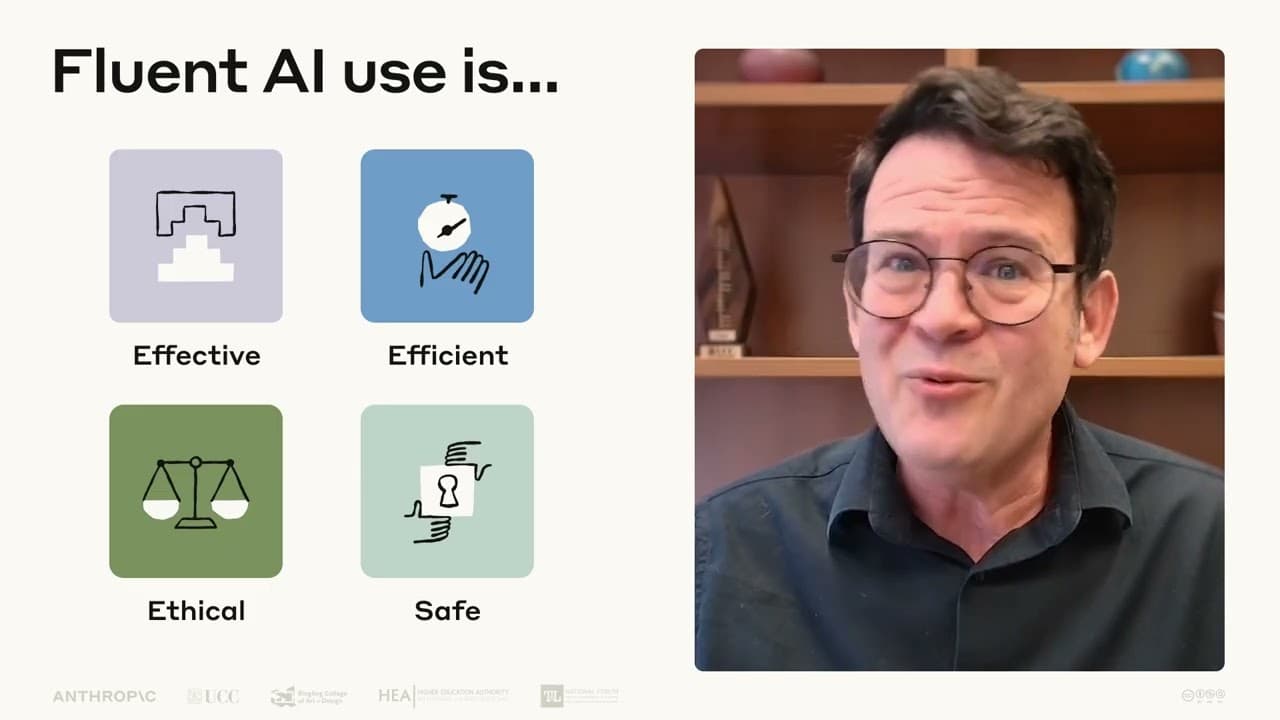
AI fluency is the ability to interact with AI effectively, efficiently, ethically, and safely. It requires adaptable skills, knowledge, insights, and values rather than technical expertise or memorized prompt tricks, helping people choose among automation, augmentation, and agency while protecting privacy and security.
Transcript
let's begin our exploration of the AI fluency framework that is central to our learning over the rest of this course what does it really mean to be fluent with AI why does it matter we're living in a fascinating moment of technological change one that brings both excitement and uncertainty ai is reshaping how we communicate create learn and solve p... Read More
Key Insights
- AI fluency is the ability to interact with AI systems effectively, efficiently, ethically, and safely. It aims to maximize useful results without wasting time or energy, while protecting the privacy and security of both the user and other people.
- Access to AI is not the same as fluency with AI. Unexpected outputs, difficulty expressing a need, frustration during an interaction, and uncertainty about information protection all reveal gaps between possessing an AI system and using it thoughtfully.
- AI fluency is a collection of practical skills, knowledge, insights, and values that reinforce one another. It is designed to adapt as technology changes, unlike technical expertise alone or a memorized list of prompts for currently popular tasks.
- Automation is a mode in which AI completes a specific task from the user's instructions. It works well when the desired outcome is clear, such as summarizing a document, drafting an email, creating an image, or planning a trip itinerary.
- Augmentation is a collaborative mode in which AI supports a person's creativity, thinking, and problem-solving. It is especially useful when solutions are not straightforward and the user needs room to explore, experiment, exchange ideas, and refine unfinished work.
- Agency is a mode in which AI works independently on a person's behalf. Instead of prescribing every action, the user establishes knowledge and behavior patterns, acting more like a director who sets a vision than a script writer who specifies exact directions.
- Automation, augmentation, and agency are not inherently ranked from best to worst. Each serves different purposes, excels in different situations, and may be used alongside the others within a single project, depending on the work and desired outcome.
- AI can function as a tool, a medium, a partner, or a co-creator, sometimes simultaneously. This expanded role changes how people participate in creative and problem-solving work, creating new human roles and a need for four key areas of competence.
Install to Summarize YouTube Videos and Get Transcripts
Explore YouTube Video Summarizer or Get YouTube Transcript Extractor
Questions & Answers
Q: What is AI fluency?
AI fluency is the capacity to interact with AI systems in ways that are effective, efficient, ethical, and safe. It consists of practical skills, knowledge, insights, and values that reinforce one another and adapt as technology changes. Its goal is to maximize the value of AI interactions without wasting time or energy, while acting honestly and responsibly and protecting privacy and security.
Q: Why do people need AI fluency?
People need AI fluency because access to powerful AI systems does not automatically provide the ability to use them well or responsibly. Users can encounter unexpected responses, struggle to communicate what they need, feel frustrated when interactions fail, or worry about whether shared information is protected. Fluency addresses these gaps while supporting communication, creation, learning, research, decision-making, and problem-solving.
Q: How is AI fluency different from prompt engineering?
AI fluency extends beyond learning prompt tricks or memorizing a list of useful prompts for a currently popular task. It brings together practical skills, knowledge, insights, and values that can adapt as AI technology evolves. Prompting may help direct an AI system, but fluency also covers choosing an engagement mode, collaborating thoughtfully, working efficiently, behaving ethically, and protecting privacy and security.
Q: What is automation when working with AI?
Automation is an engagement mode in which an AI assistant completes a specific task according to the user's instructions. Examples include summarizing a document, drafting an email, creating an image, and planning a trip itinerary. The user defines what must be done, and the AI executes it. This mode works well when the user already has a clear outcome in mind.
Q: What is augmentation when working with AI?
Augmentation is an engagement mode in which a person and an AI assistant collaborate to complete work. The AI becomes a creative, thinking, or problem-solving partner instead of merely executing a task. A user might exchange ideas about a fictional character, examine an application architecture problem, or formulate thoughts on a research topic. It works best when exploration and experimentation are needed.
Q: What is AI agency and how does it work?
Agency is an engagement mode in which AI works independently on a user's behalf. The user establishes the AI's relevant knowledge and behavior patterns rather than defining every specific action. Examples include categorizing incoming emails, beginning drafts of urgent responses, creating a changing interactive website experience, or powering an interactive game character. The user acts like a director who sets the vision.
Q: When should automation, augmentation, or agency be used?
Automation is appropriate when the intended outcome is clear and the AI can execute a defined task. Augmentation is better suited to unclear or complex work that benefits from conversation, creative exploration, and experimentation. Agency fits situations where AI should operate independently under established knowledge and behavior patterns. None is inherently better, and all three can be combined within one project.
Q: How does AI change human creative and problem-solving roles?
AI can act not only as a tool, but also as a medium, partner, or co-creator, sometimes filling several of these roles at once. Augmentation allows it to help people improve their own thinking and creativity, while agency allows it to act within a broader vision. These expanded possibilities give people new roles and create a need to develop the competencies described by the AI fluency framework.
Summary & Key Takeaways
-
Access to powerful AI systems does not automatically produce useful or responsible results. Unexpected responses, unclear instructions, frustration, and concerns about protected information reveal the gap between basic access and genuine fluency. Closing that gap requires practical capabilities that remain valuable as AI technology continues to evolve.
-
AI fluency combines practical skills, knowledge, insights, and values that reinforce one another. Its purpose is to maximize the value of AI interactions without wasting time or energy, while maintaining honesty, responsibility, privacy, and security. It extends beyond technical expertise and temporary collections of popular prompts.
-
People engage with AI through automation, augmentation, and agency. Automation executes clearly defined tasks, augmentation supports collaborative exploration, and agency operates independently within established knowledge and behavior patterns. These modes serve different purposes, can appear within one project, and require four key areas of competence introduced by the AI fluency framework.
Read in Other Languages (beta)
Share This Summary 📚
Summarize YouTube Videos and Get Video Transcripts with 1-Click
Try YouTube Summary with ChatGPT & Claude or YouTube Transcript Generator
Explore More Summaries from Anthropic 📚





Summarize YouTube Videos and Get Video Transcripts with 1-Click
Try YouTube Summary with ChatGPT & Claude or YouTube Transcript Generator