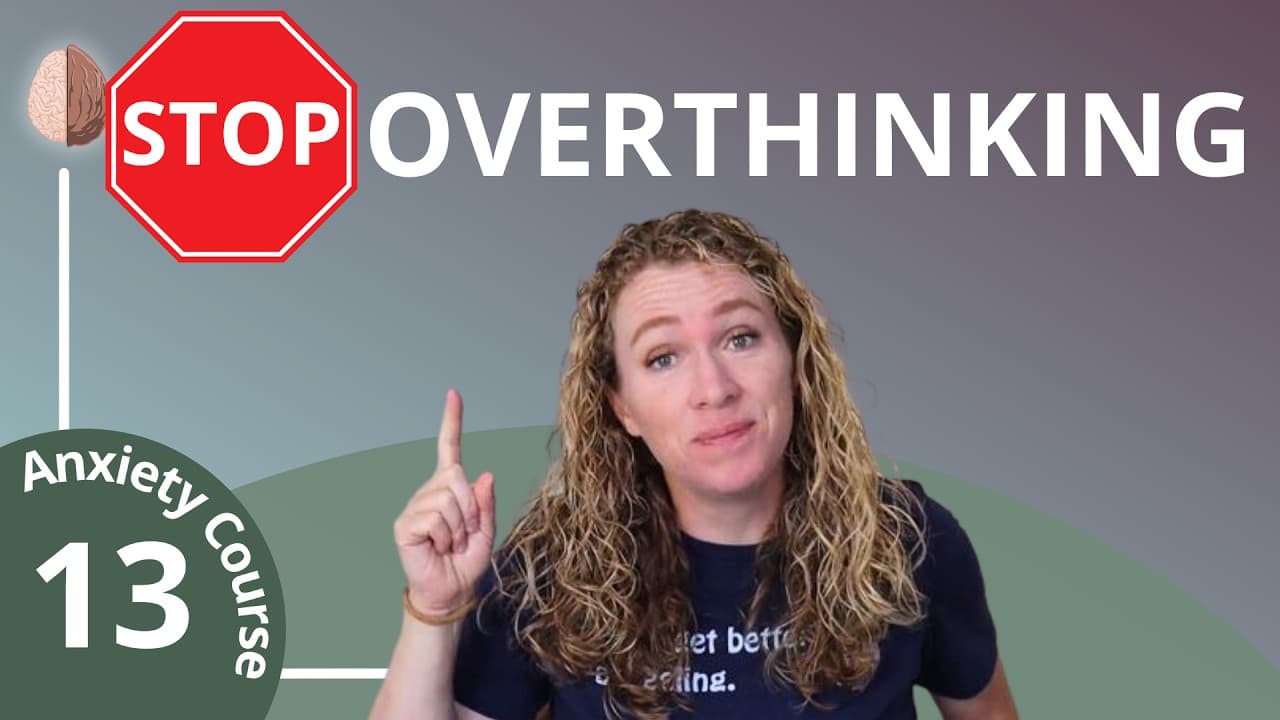
How to stop overthinking with cognitive defusion?
TL;DR
Cognitive diffusion teaches you to observe thoughts without getting entangled. By labeling thoughts as thinking and shifting to the observer self, you reduce their power and regain focus on your values. This approach breaks the cycle of rumination and helps you act despite anxious thoughts.
Transcript
hey Emma why you pulling that rope have you ever tried pushing one all right guys so sorry for the bad joke but thank you for letting me reminisce on my days as a camp counselor for a second um and this rope has something to teach us about our anxiety and our anxious thoughts now I once had a client who was a ballerina and she was a really good... Read More
Key Insights
- Cognition can be diffused by labeling thoughts as thinking, which creates distance between the thinker and the thought.
- The observer self is a distinct vantage point that allows you to notice thoughts and sensations without being swept up by them.
- Paying attention to what you value rather than what you fear reduces the impact of intrusive thoughts.
- The brain pays more attention to what you focus on, so dampening the attention to negative thoughts lowers their frequency.
- Humor and experiential exercises can diffuse distressing thoughts and make them less threatening.
- Written lists of thoughts viewed as stories help separate identity from mental content.
- Metaphors like a chess board or sports announcer illustrate how to remain present during mental activity.
- Practicing diffusion regularly builds resilience and better emotional regulation over time.
- More videos from this channel:
- More from this channel: Therapy in a Nutshell
Install to Summarize YouTube Videos and Get Transcripts
Explore YouTube Video Summarizer or Get YouTube Transcript Extractor
Questions & Answers
Q: What is cognitive diffusion and how does it help with overthinking
Cognitive diffusion is an ACT skill where you stop believing your thoughts and instead observe them as mental events. It helps with overthinking by reducing the automatic acceptance of anxious content, lowering its emotional charge, and creating space to act according to your values rather than being ruled by fear or rumination. The practice involves noticing thoughts without judgment, labeling them as thinking, and learning to watch them pass like clouds in the sky.
Q: How can labeling thoughts change your mental state
Labeling thoughts as thinking shifts your perspective from being fused with the content to observing it. This reduces the power of negative spirals by giving you a separate vantage point, the observer self. When you label, you create distance, which allows you to choose a response aligned with your goals instead of reacting automatically to distressing mental content.
Q: What is the observer self and why is it useful
The observer self is a perspective that sits outside your immediate thought stream and bodily sensations. It is useful because it lets you witness thoughts and feelings without identifying with them, decreasing their ability to derail your behavior. Regular engagement with the observer self fosters calm, clarity, and better alignment with values during stressful moments.
Q: What role do metaphors play in cognitive diffusion
Metaphors like the chess board or a sports announcer help you see thoughts as separate from action. They illustrate that you are the board or the player, not just a single piece or commentary. This mental reframing reduces attachment to thoughts, promoting present-moment focus and effective responding rather than rumination.
Q: How does attention influence the persistence of negative thoughts
Attention amplifies what you focus on. If you fixate on a negative thought, your brain treats it as highly important and searches for it more. Conversely, diffusing attention away from the thought reduces its salience, making it easier to stop rumination and shift toward constructive actions and values.
Q: What practical steps can someone take right after this video to diffuse thoughts
Practically, you can practice the observer self exercise by closing your eyes, labeling thoughts as thinking, and noting bodily sensations. Then shift perspective to observe thoughts as if watching a movie, while the audience remains constant. Writing thoughts down as stories or in a humorous voice can also diminish their grip and increase psychological distance.
Q: Why is trying to force positive thinking counterproductive
Trying to force positive thinking often backfires by increasing resistance and making the unwanted thoughts louder. Cognitive diffusion suggests letting thoughts be what they are, not judging them, and redirecting attention toward actions that are consistent with your values. This reduces the cycle of struggle and improves emotional regulation.
Q: How can diffusion support long term anxiety management
Diffusion supports long term management by training you to respond rather than react to thoughts. Regular practice strengthens the observer self, reduces reactivity, and helps maintain focus on meaningful goals. Over time, this cultivates resilience, clearer thinking, and a steadier emotional baseline during stressful situations.
Summary & Key Takeaways
-
Cognitive diffusion reframes thoughts as events to observe rather than truths to believe, reducing emotional intensity and freeing mental space for values and action.
-
The observer self exercise invites a one minute practice of labeling thoughts and sensing bodily cues to create distance from inner dialogue.
-
Using metaphors like the chessboard or a cinema helps externalize thoughts, making it easier to return to action rather than fixation.
Read in Other Languages (beta)
Share This Summary 📚
Summarize YouTube Videos and Get Video Transcripts with 1-Click
Try YouTube Summary with ChatGPT & Claude or YouTube Transcript Generator
Explore More Summaries from Therapy in a Nutshell 📚






Summarize YouTube Videos and Get Video Transcripts with 1-Click
Try YouTube Summary with ChatGPT & Claude or YouTube Transcript Generator