How to Scale Facebook Ads With Avatar Targeting
TL;DR
Diagnose Facebook ad performance with incremental attribution, then identify proxy metrics that reveal which creative angles attract likely buyers. In this account, expanding proven ads into avatar-specific problem-and-solution concepts increased purchases by 83% while spend rose by less than 1%, and reduced cost per purchase by about 45% across the measured period.
Transcript
I was able to increase this brand's purchases by 83% while increasing spend by less than 1%. I did this all in just 3 weeks [music] and in this video, I'm going to show you how I diagnose exactly what goes on in ad accounts every single day, how you could find solutions and in this case, I'm going to show you the exact solution that we implemented ... Read More
Key Insights
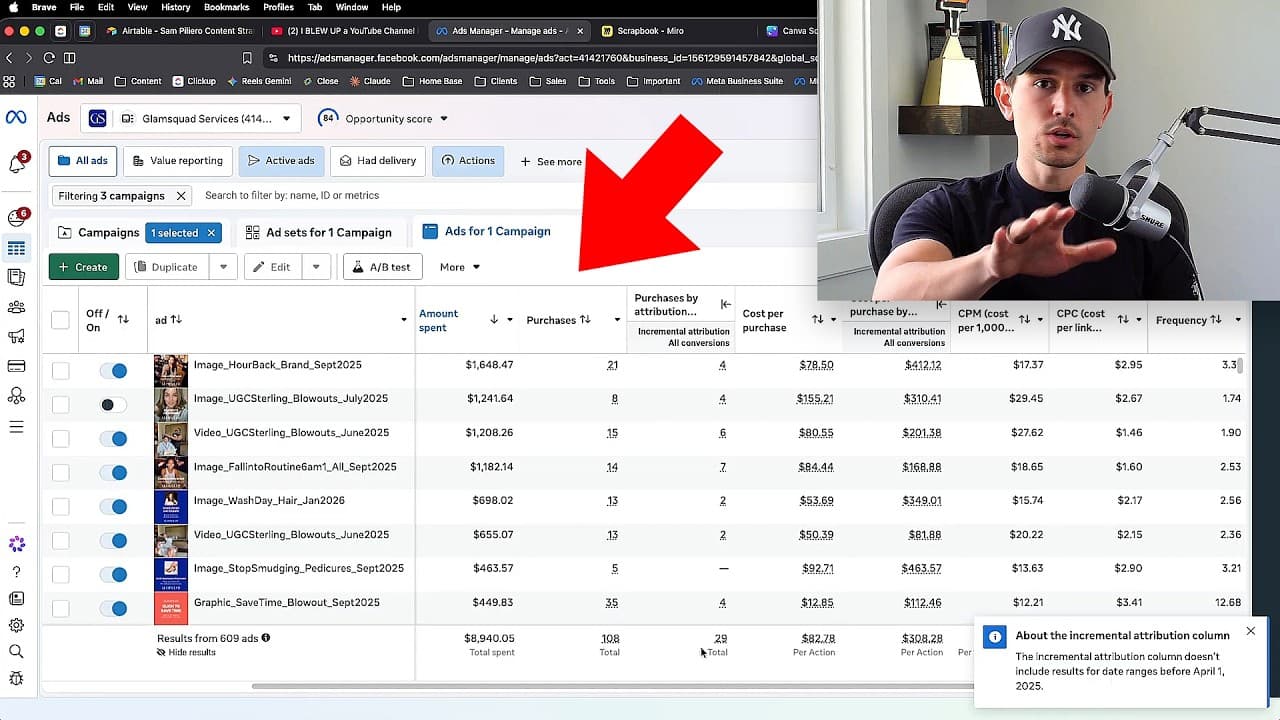
- Incremental attribution measures conversions that happened because of Facebook, rather than every conversion credited to an ad near the end of the customer journey. Applying it to the prospecting campaign reduced the displayed purchases from 108 to 29, exposing a roughly 75% gap.
- New-customer acquisition is the central objective of the account diagnosis because business growth depends on generating net new purchases. The analysis therefore concentrated on prospecting and retargeting campaigns aimed at new customers, rather than relying on continued purchases from existing customers.
- Post shares are a proxy metric when people who share an advertisement are more likely to purchase later. For this beauty brand, frequent sharing provided a useful signal because the product and its creative were naturally shareable, even when the ads appeared weak by purchase metrics.
- A proxy metric is most useful when it remains close to the final purchase event. Stable relationships between behaviors, such as adding to a cart and subsequently purchasing, can help advertisers diagnose performance when direct incremental purchase data is limited or shows a concerning decline.
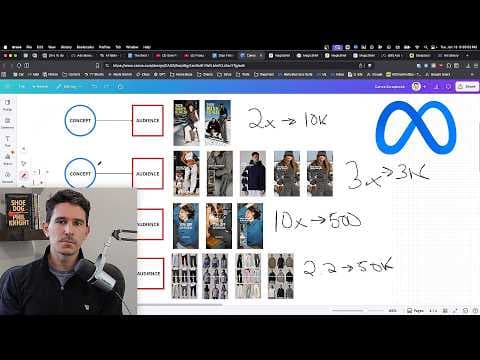
- Avatar-based creative works by matching a specific customer type with a relevant marketing angle, format, and concept. Under the strategy described, the creative effectively defines its audience by presenting a problem and solution that resonates with a particular group of prospective customers.
- Creative depth is the practice of producing multiple ads around an angle already supported by performance signals. Instead of distributing effort broadly across unrelated messages, the team duplicated its strongest advertisements and adapted them more precisely to the avatars associated with those successful concepts.
- Problem-and-solution positioning gives each advertisement a clear reason for a specific customer to consider the product. The cited examples separate hair concerns, digestive concerns, weight concerns, and competitor comparisons into distinct angles, allowing one product to address different customer motivations through specialized creative.
- The avatar-and-angle strategy increased total purchases by 83% while spending rose by less than 1% during three evergreen weeks in April. Prospecting purchases increased by 98% and retargeting purchases by 97%, while cost per purchase declined by 49% in each campaign.
- More videos from this channel:
- More from this channel: Sam Piliero
Install to Summarize YouTube Videos and Get Transcripts
Explore YouTube Video Summarizer or Get YouTube Transcript Extractor
Questions & Answers
Q: How can incremental attribution improve Facebook ad analysis?
Incremental attribution helps distinguish purchases caused by Facebook advertising from conversions that merely receive credit near the end of a customer journey. In the analyzed prospecting campaign, switching to incremental attribution changed the reported result from 108 purchases to 29, a roughly 75% reduction. That discrepancy showed that standard purchase reporting could overstate the campaign's contribution and prompted a deeper investigation into creative performance.
Q: What results did the Facebook ad strategy produce in three weeks?
The changes increased the brand's total purchases by 83% while spending rose by less than 1% during three evergreen weeks in April. Overall cost per purchase fell by about 45%. Within the campaigns focused on new customers, prospecting purchases increased by 98% and retargeting purchases increased by 97%, while cost per purchase declined by 49% in each campaign.
Q: What is a proxy metric in Facebook advertising?
A proxy metric is an observable action that has a dependable relationship with a later purchase. The transcript gives post sharing as one example when people who share an ad are more likely to buy later, and adding to cart as another when purchases follow at a stable rate. A useful proxy should remain as close to the purchase event as possible.
Q: Why were post shares important in this ad account?
Post shares were important because they offered a signal about which creatives connected with specific people, even though the advertisements performed poorly by other measures. The account recorded 36 shares at $331 per share, which was described as reasonable for the brand. Because the beauty product was particularly shareable, high-sharing ads helped reveal promising avatars and angles for further creative development.
Q: How does avatar-based Facebook ad targeting work?
Avatar-based targeting starts with a clearly defined customer type, then places that avatar within a creative format or template to form a concept. The concept uses an angle tied to a particular problem or desire. In the approach described, Facebook's system can infer the relevant audience from the creative itself, which is why the presenter says that creative functions as targeting.
Q: How should advertisers expand a successful creative angle?
Advertisers should identify their strongest ads and produce additional variations that serve the same specific avatar and angle. The team duplicated the best ads and developed more creative around the proven concepts instead of spreading effort broadly across unrelated messages. This increased depth gave Facebook clearer signals about the intended customer and helped lower the brand's cost per purchase.
Q: Why should Facebook ads use problem-and-solution positioning?
Problem-and-solution positioning makes the advertisement relevant to a defined customer by naming a concern and presenting the product as its answer. The transcript illustrates this with separate creative angles for hair thickness, digestive regularity, weight concerns, and competitor comparisons. Although the same product appears in each case, each angle naturally appeals to a different customer avatar and motivation.
Q: How can advertisers diagnose weak prospecting performance?
Advertisers can begin at the campaign level, review every ad, and customize reporting columns to include incremental attribution. If incremental purchases fall sharply compared with standard attribution, they can inspect supporting behaviors that may predict purchases. In this case, post shares exposed which ads appealed to particular avatars, and those findings guided the creation of deeper, more targeted problem-and-solution concepts.
Summary & Key Takeaways
-
The account diagnosis began with the prospecting campaign and incremental attribution, which reduced the reported purchase count from 108 to 29. That roughly 75% drop suggested many attributed purchases were not caused incrementally by Facebook, creating a need to identify creative signals connected more closely to genuine new-customer acquisition.
-
Post shares emerged as a useful proxy metric because the beauty brand produced shareable content, and ads received 36 shares at $331 per share despite weak purchase performance. The strategy used high-sharing ads to identify promising customer avatars and angles, rather than treating conventional attribution totals as sufficient evidence of effectiveness.
-
The team duplicated its strongest ads and developed greater creative depth around each proven avatar, angle, problem, and solution. Over the following three weeks, purchases increased by 83% with less than a 1% spending increase. Prospecting and retargeting purchases rose by 98% and 97%, while their respective costs per purchase fell by 49%.
Read in Other Languages (beta)
Share This Summary 📚
Summarize YouTube Videos and Get Video Transcripts with 1-Click
Try YouTube Summary with ChatGPT & Claude or YouTube Transcript Generator
Explore More Summaries from Sam Piliero 📚




Summarize YouTube Videos and Get Video Transcripts with 1-Click
Try YouTube Summary with ChatGPT & Claude or YouTube Transcript Generator