How to Build a Facebook Ad Creative Flywheel
TL;DR
Build a repeatable creative flywheel by sourcing proven concepts from appropriately sized competitors, testing each batch in a new prospecting CBO ad set, and forcing initial delivery with a temporary minimum spend equal to the target cost per acquisition. After seven days, remove the minimum, analyze incremental return on ad spend, and develop iterations and variations from the strongest high-spend concepts.
Transcript
In this video, I'll be breaking down the single best creative ad strategy for 2026 [music] so that you can make killer high-erforming ad creatives in Facebook ads. This is the exact creative strategy that we're deploying over our 100 plus brands at the Moonlighters and the same exact creative strategy that I've shared within my school community [mu... Read More
Key Insights
- A creative flywheel is a repeatable system for sourcing, testing, analyzing, and expanding advertising ideas. Its purpose is to improve the likelihood of finding winners instead of producing large volumes of ads with a low win rate.
- Competitor advertising is the primary source of new concepts in this strategy. The Facebook Ads Library provides a free research method, while MagicBrief offers a paid view that can consolidate active ads, reveal long-running creative, and make imagery easier to review or download.
- Relevant competitors are brands operating somewhat above your current scale. The suggested comparison for a brand generating $1 million in revenue is a brand generating $10 million, rather than a category giant such as Nike or a smaller company without meaningful sales.
- Ad longevity is a practical signal for identifying promising concepts. The strategy prioritizes creative that has run for a long period or received substantial spending, while ads marked with a low impression count are treated as less likely to be strong performers.
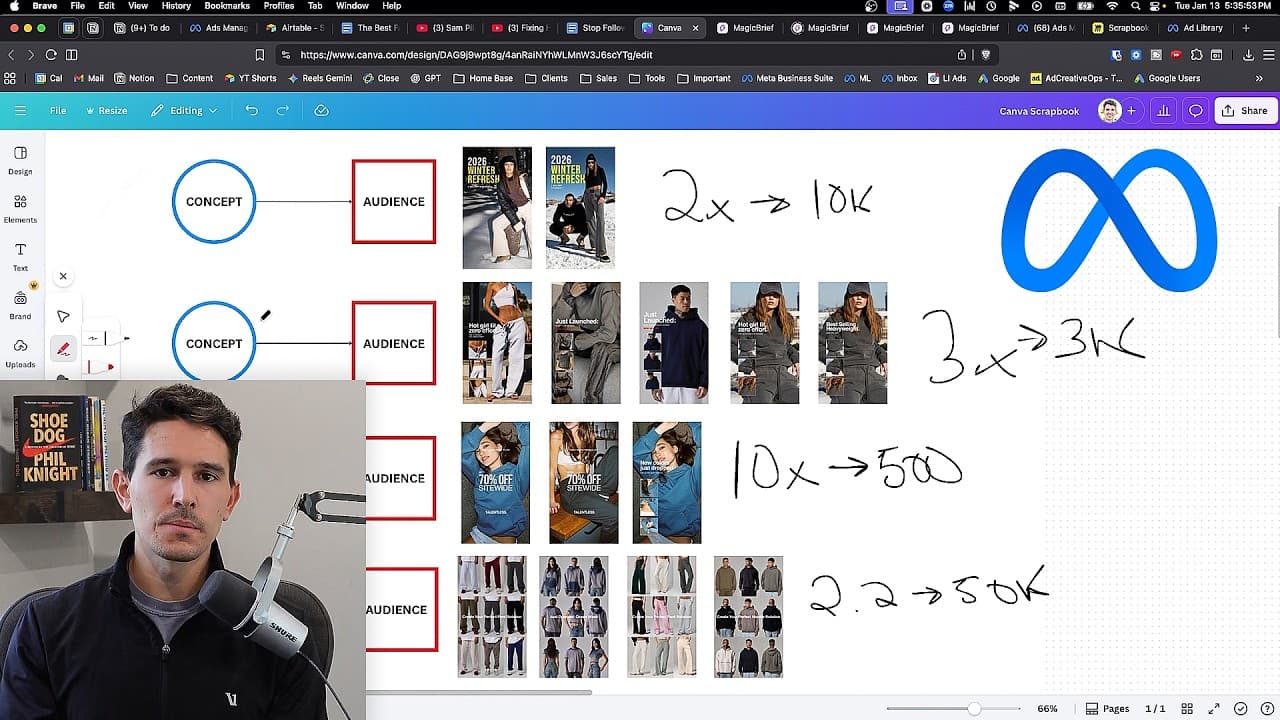
- Concepts, iterations, and variations serve different roles in the creative system. Instead of merely duplicating an existing top performer, the process introduces new concepts and then expands successful ideas into many product-specific executions, formats, iterations, and variations.
- A prospecting CBO campaign creates competition among new and existing ads. Each new creative batch receives a separate ad set, with four to eight creatives described as the typical sweet spot, although a batch may contain between one and 15 creatives.
- An ad set minimum accelerates the initial test by forcing delivery. The recommended average daily minimum equals one times the target cost per acquisition, so a $50 acquisition target produces a $50 minimum, which should remain active for no longer than seven days.
- Incremental return on ad spend guides the analysis after testing. Ads are sorted from highest to lowest spend, then evaluated for outsized results at meaningful scale and performance above the brand's threshold, with additional grouping by product or category when necessary.
- More videos from this channel:
- More from this channel: Sam Piliero
Install to Summarize YouTube Videos and Get Transcripts
Explore YouTube Video Summarizer or Get YouTube Transcript Extractor
Questions & Answers
Q: How do you build a Facebook ad creative flywheel?
Start by collecting proven concepts from relevant competitors, recreate those ideas for your own products, and launch each new batch in a separate ad set within a prospecting CBO campaign. Apply a temporary daily minimum equal to the target cost per acquisition, review it within seven days, remove the minimum, and analyze high-spend ads using incremental attribution. Successful concepts then produce further iterations and variations.
Q: How can you research competitor Facebook ads for free?
Use the Facebook Ads Library, select all ads, and search each relevant competitor individually. Review the competitor's page and inspect its available ads, including ads from other pages the company may use. Look for creative that has remained active for a long time, and be cautious about ads displaying low impression counts because they may not represent strong performance.
Q: Which competitors should a small brand study for ad ideas?
Study competitors that are one or two steps above your current business rather than the largest companies in the category. The example given is that a brand producing $1 million in revenue could examine a brand producing $10 million. This balance provides ideas from businesses with demonstrated sales while avoiding comparisons with giants such as Nike whose scale may be unrealistic.
Q: How can ad longevity help identify winning creative concepts?
A long-running ad can serve as a useful indicator that a brand continues to value the concept. The process therefore looks for ads that have been active longest or appear to have received the most spending. One Lululemon carousel had run for 469 days after launching in October 2024, making it a candidate for adaptation rather than direct duplication.
Q: How many creatives should be placed in a new Facebook ad set?
Each batch of new creative should enter a new ad set within the prospecting CBO campaign. The batch may contain as few as one or two creatives or as many as 10 to 15, but four to eight creatives is presented as the general sweet spot. The guidance is to keep the structure simple and consistently create a fresh ad set for each launch.
Q: How should an ad set spending minimum be calculated?
Set the average daily minimum to one times the target cost per acquisition. If the target cost per acquisition is $50, the ad set minimum should also be $50. Change the setting from a percentage to a dollar value under ad set spending limits. This forced spending is intended to generate adequate testing data faster than passive delivery would.
Q: When should a Facebook ad set minimum be removed?
Return to the ad set within seven days, since the minimum should never remain active for longer than that period. If an ad is weak, removing the minimum allows its spending to decline. If it is a winner, it may continue spending above the threshold even after removal. A calendar invitation or alarm can prevent the temporary setting from being forgotten.
Q: How should Facebook ad creative performance be analyzed?
Open the prospecting campaign, choose the column settings, compare attribution settings, and select incremental attribution. Sort all ads from highest to lowest spend, then look for high-spending ads producing outsized results above the brand's required return threshold. The analysis can cover all ads together, but product and category groupings may reveal important differences that an account-wide view hides.
Summary & Key Takeaways
-
The proposed creative flywheel begins with competitor research. Use the Facebook Ads Library for free or MagicBrief as a paid option, prioritize ads that have remained active longest, and collect videos, static images, GIFs, and carousels. Study competitors one or two steps above your brand rather than category giants with incomparable resources.
-
Turn each promising competitor pattern into an original concept suited to your products, then create multiple iterations from it. Launch every batch of new ads in its own ad set inside a prospecting CBO campaign, generally grouping four to eight creatives together. This structure lets new work compete against previously successful ads.
-
Give each new ad set an average daily minimum equal to one times the target cost per acquisition, then revisit it within seven days. Remove the minimum and analyze results using incremental attribution, sorting ads from highest to lowest spend. Prioritize high-spending ads whose incremental return exceeds the brand's required threshold.
Read in Other Languages (beta)
Share This Summary 📚
Summarize YouTube Videos and Get Video Transcripts with 1-Click
Try YouTube Summary with ChatGPT & Claude or YouTube Transcript Generator
Explore More Summaries from Sam Piliero 📚





Summarize YouTube Videos and Get Video Transcripts with 1-Click
Try YouTube Summary with ChatGPT & Claude or YouTube Transcript Generator