How to Build Winning AI Ads with Better Context
TL;DR
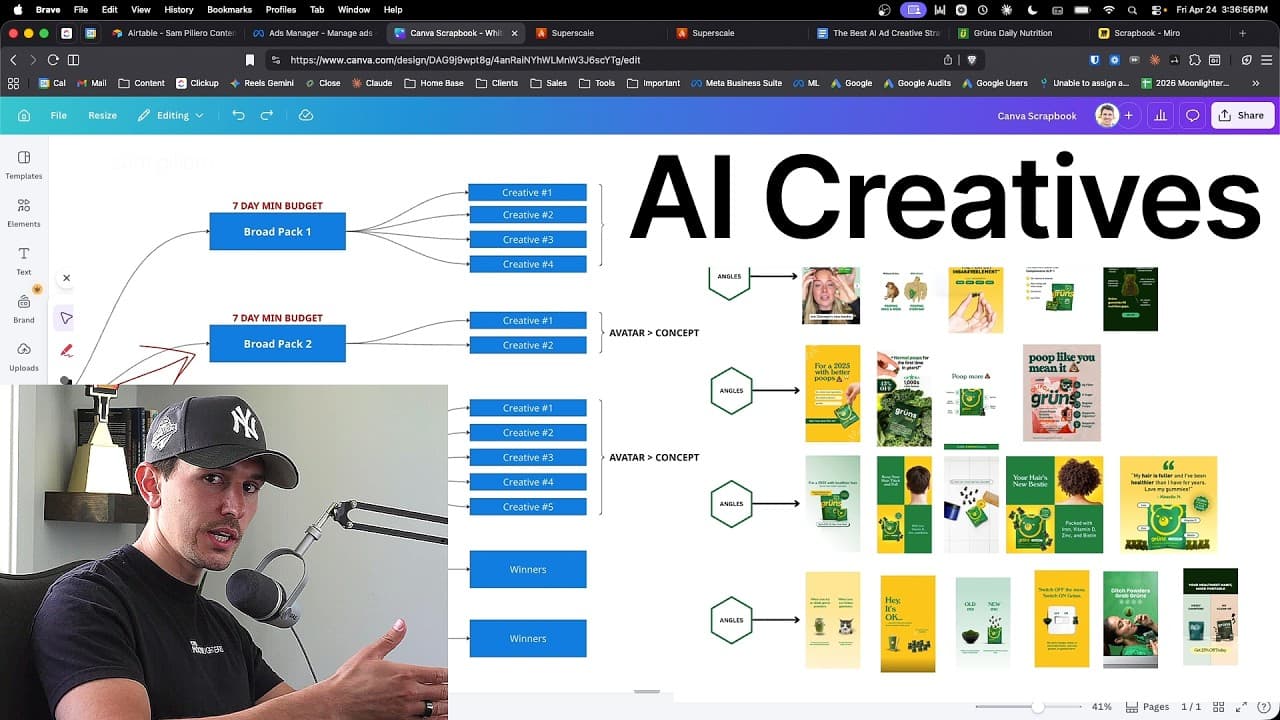
Use AI to accelerate a researched creative strategy, not to generate large batches of ads without direction. Start with a defined customer avatar, proven concept, brand context, competitor research, and performance data, then use AI to produce and iterate relevant creative angles. The goal is a smaller set of stronger ads, not maximum output volume.
Transcript
Most brands are using AI to create ads completely wrong. They'll fire up an AI tool to generate 50 ads in an afternoon. They roll them all into their ad account and wonder why nothing is working. The volume is there, but the quality isn't. And I get it because AI tools are everywhere right now and they make it seem stupidly easy to create content. ... Read More
Key Insights
- AI is most effective as an accelerant layered onto a creative strategy, rather than as a standalone system for generating dozens of ads. Producing 50 ads in an afternoon creates volume, but it does not ensure the research, relevance, or quality required for winning creative.
- Creative targeting works by connecting customer avatars with concepts that match their likely audiences. In the framework presented, avatars help platforms find audiences, while combining an avatar with a creative template produces an ad concept that can be researched, generated, tested, and iterated.
- Brand context improves AI outputs by defining products, branding guidelines, approved language, prohibited language, required elements, and creative boundaries. SuperScale creates this context from a website URL and expands it over time, allowing later generations to become more relevant to the selected product.
- Competitive research gives AI evidence for choosing creative angles instead of forcing it to invent ideas without direction. The demonstrated process examines the brand's image ads, the broader supplement-gummy niche, comparable brands, and ads that have run longest or received impressions in the Facebook Ads Library.
- First-party performance data makes creative research more useful because it can connect ads with business outcomes. When a Meta account is connected, the system can evaluate metrics selected by the advertiser, including conversions, purchases, cost per result, and return on ad spend.
- AI-generated concepts still require human judgment because many polished-looking outputs may be ineffective. The presenter does not expect every result to succeed and would skip or regenerate a weak kitchen-lifestyle concept, while retaining stronger executions based on proven formats, claims, or customer avatars.
- Winning-ad iteration works by adapting validated concepts into new executions rather than repeatedly starting from scratch. Examples include a clear ingredient comparison, an iPhone Notes-style testimonial, supplement-shelf replacement messaging, travel positioning, GLP-1 positioning, and an avatar-specific digestive-health angle.
- Reusable prompts and structured workflows help creative teams stay aligned. The expert library includes prompts for tasks such as winning-ad iteration, while skills support top-of-funnel creative testing and weekly creative briefs. The platform also provides format resizing, generated characters, and access to Sora and Seedance.
- More videos from this channel:
- More from this channel: Sam Piliero
Install to Summarize YouTube Videos and Get Transcripts
Explore YouTube Video Summarizer or Get YouTube Transcript Extractor
Questions & Answers
Q: How should brands use AI to create better ads?
Brands should use AI to accelerate a creative strategy that already defines the customer avatar, audience, concept, angle, and brand rules. Instead of generating 50 unrelated ads and uploading all of them, they should provide substantial context, research proven creative, generate a focused set of concepts, review the results, and iterate only the strongest candidates.
Q: Why does generating many AI ads often fail?
Generating many AI ads often fails because production volume is not the same as creative quality. AI can quickly produce material that appears polished, but many outputs may be strategically weak or perform poorly. Without brand context, customer avatars, proven concepts, competitive research, and human review, a large batch can become undifferentiated creative that does not improve the ad account.
Q: What does creative is your targeting mean for Facebook ads?
Creative is your targeting means that the ad's avatar and concept help the platform find the appropriate audience. The older approach began with an audience and built ads specifically for it. The newer approach starts with a customer avatar, pairs that avatar with a suitable template, and turns the combination into an ad concept that matches likely buyers.
Q: How does SuperScale create brand context for AI ads?
SuperScale starts with the brand's website URL and analyzes the site to build a contextual brand book. The resulting context can include products, branding guidelines, language the brand should or should not use, required elements, and prohibited treatments. The context grows as the platform is used, and advertisers can select an individual product to make generation more relevant.
Q: How can competitor research improve AI ad concepts?
Competitor research gives the generation process examples of formats and angles already appearing in the relevant market. In the demonstration, the system reviews the brand's own image ads, searches the supplement and gummy category, identifies comparable brands, and examines competitors' longest-running or high-impression ads. It then converts those findings into distinct angles and organized ad concepts.
Q: Why should a Meta ad account be connected to an AI creative tool?
Connecting a Meta ad account allows the creative tool to evaluate ads using the brand's actual performance data rather than relying only on Facebook Ads Library indicators such as impressions or how long an ad has run. The system can examine advertiser-selected outcomes, including conversions, purchases, cost per result, and return on ad spend, to identify proven creative more precisely.
Q: How should marketers evaluate AI-generated ad concepts?
Marketers should treat every generated concept as a candidate that requires judgment, not as finished creative guaranteed to work. They should compare each output with proven formats, brand rules, customer avatars, and account evidence. Strong concepts can move into testing or further iteration, while weak executions should be skipped, regenerated, or revised instead of being launched merely because AI produced them.
Q: What AI ad formats and workflows were demonstrated?
The demonstration produced nine concepts, including an ingredient comparison, travel and GLP-1 positioning, a kitchen-lifestyle image, a clinically studied angle, an iPhone Notes-style testimonial, supplement-shelf replacement messaging, and a digestive-health angle. It also showed automatic resizing from 4x5 to 9x16, winning-ad iteration prompts, top-of-funnel testing skills, weekly briefs, generated characters, and video creation through Sora and Seedance.
Summary & Key Takeaways
-
High-volume AI generation does not automatically produce winning ads. The recommended approach treats AI as an accelerant for an existing creative strategy. Brands should first understand their avatars, audiences, templates, concepts, and proven angles, then supply that context to AI so its outputs are strategically relevant rather than merely fast to produce.
-
The demonstrated workflow begins with a website URL, from which SuperScale builds brand guidelines and identifies individual products. It then researches the brand's ads, its niche, comparable competitors, and long-running or high-impression Facebook ads. That research is converted into angles and nine ad concepts organized by concept and creative direction.
-
Quality control remains essential after generation because many AI outputs can still be weak. The presenter considers roughly half of the demonstrated concepts strong, while skipping or regenerating weaker options. Built-in prompts, winning-ad iterations, creative-testing skills, weekly briefs, format resizing, and video-character libraries can help teams create and refine ads consistently.
Read in Other Languages (beta)
Share This Summary 📚
Summarize YouTube Videos and Get Video Transcripts with 1-Click
Try YouTube Summary with ChatGPT & Claude or YouTube Transcript Generator
Explore More Summaries from Sam Piliero 📚




Summarize YouTube Videos and Get Video Transcripts with 1-Click
Try YouTube Summary with ChatGPT & Claude or YouTube Transcript Generator