How to Turn Emotional Fragments Into Beautiful Writing
TL;DR
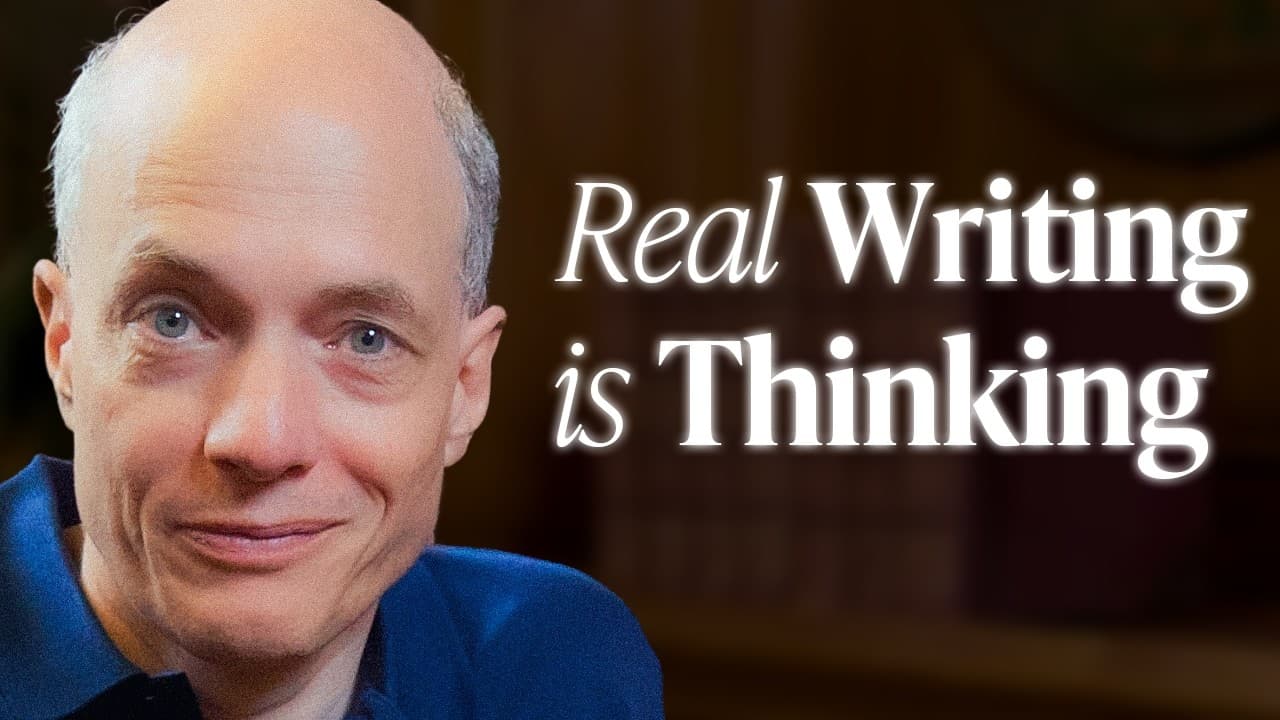
Beautiful writing begins by naming painful or pleasurable feelings precisely enough to make them understandable. Instead of forcing a complete book from the outset, collect sentences, images, and emotional fragments, then patiently discover how they connect. Faithful observation of your own mind can transform private experience into work that resonates with strangers.
Transcript
you've written so so many books and then also with the school of life I mean gez almost 10 million YouTube subscribers and as I was thinking about what is it that you're doing what is it that gives you joy as a writer for yourself but also kind of a sense of relief for us as the viewer on a school of life video or as a reader it's this joy of captu... Read More
Key Insights
- Writing is a way to control experience by putting language around it. Naming pain can reduce its emotional force, while describing beauty can preserve an experience that would otherwise be fleeting. This process makes writing broadly therapeutic and helps explain why people keep journals.
- Personal pain can become meaningful material when it is observed accurately. De Botton wrote about love to understand sensations that had been painful and mysterious, then found that readers recognized themselves in observations drawn only from his own experience.
- The mind is an extensive library of sensations and potential evidence. Rather than relying exclusively on established authorities, writers can examine their own thoughts and feelings as a source of data, provided they record what they discover with care and honesty.
- A feeling must become sufficiently understood before it can become coherent prose. Writers need to identify its nature and present it from the perspective of a stranger who has not experienced it, which requires patience while the emotional material develops.
- Pleasurable memories can become sources of pain after a relationship ends. The mind may return not to arguments or disappointments, but to meals, holidays, walks, and other beautiful moments whose loss reveals the emotional cost attached to former happiness.
- Writing often develops from fragments into a complete structure. A sentence, image, scene, or incomplete thought can be preserved before its purpose is clear, then joined with related pieces as the writer gradually discovers where it belongs.
- The archaeology metaphor describes how writers reconstruct larger works from scattered pieces. A fragment suggests that other pieces exist nearby, but locating and arranging them takes time, uncertainty, and repeated attempts to find a plausible pattern.
- A book is an artificial container rather than the natural unit of thought. People ordinarily think in sentences, images, and fragments, which may eventually form a book. Short forms such as aphorisms and maxims can also capture psychological truths without becoming conventional narratives.
- More videos from this channel:
- More from this channel: David Perell
Install to Summarize YouTube Videos and Get Transcripts
Explore YouTube Video Summarizer or Get YouTube Transcript Extractor
Questions & Answers
Q: How can writing help process difficult emotions?
Writing can process difficult emotions by turning feelings that seem larger than the writer into defined ideas. Once an emotion has words and a recognizable shape, it can be considered almost as an object separate from the person experiencing it. De Botton describes this transformation as a source of relief because naming pain can lessen its power and make it more comprehensible.
Q: Why should writers use personal experience as material?
Personal experience gives writers access to a detailed collection of sensations, thoughts, and emotional patterns. De Botton treats his own mind as an empirical source rather than beginning with claims about other people. When self-observation is faithful, private insights may echo in readers who recognize similar experiences, even though the writer did not research those readers directly.
Q: When is an emotion ready to become prose?
An emotion is ready to become prose when the writer understands it well enough to give it coherence and introduce it to someone unfamiliar with the experience. Some feelings remain tangled for a time and cannot yet be named or located within the writer's broader understanding. Patience allows fragments to develop until their meaning and relationship become clear.
Q: Why do beautiful memories become painful after loss?
Beautiful memories become painful after loss because they represent something valuable that is no longer available. When a relationship breaks down, a person may dwell less on arguments than on a wonderful meal, holiday, or walk. The pleasure stored in those memories gains a new emotional cost, since mourning arises from losing what once felt good and hopeful.
Q: How should a writer begin a book without a complete plan?
A writer can begin by collecting a compelling fragment, such as an image, sentence, scene, or thought, without demanding a complete plot or structure. De Botton compares this process to archaeology: finding one piece suggests that related pieces may exist. Continued observation and assembly can gradually reveal a pattern that was invisible at the beginning.
Q: What does emotional archaeology mean in writing?
Emotional archaeology means uncovering scattered pieces of inner experience and reconstructing them into an intelligible form. The writer starts with partial evidence, searches for connected memories or ideas, and experiments with possible arrangements. Like fragments of a broken pot, the pieces do not immediately disclose the whole, so their recovery and organization require time and patience.
Q: Why are fragments useful to writers?
Fragments are useful because human thought naturally appears as sentences, images, brief scenes, and incomplete ideas rather than fully formed books. Preserving these pieces gives the writer material that can later connect. A powerful scene may eventually act like a magnet, drawing in related elements from elsewhere and providing the center around which a larger work develops.
Q: How can private observations connect with readers?
Private observations can connect with readers when the writer records personal experience precisely and faithfully. De Botton found that readers recognized themselves in his writing about love, although he had been tracking his own emotions rather than studying theirs. The connection emerges because apparently private sensations can have parallels in other lives, allowing careful self-examination to produce broader resonance.
Summary & Key Takeaways
-
Writing can provide emotional relief by converting overwhelming feelings into ideas that can be examined. Alain de Botton focuses particularly on pain and beauty, using words to lessen painful experiences and preserve pleasurable ones. His first book about love grew from an effort to understand emotions that felt painful and mysterious.
-
Personal experience can serve as a rich source of material when it is observed faithfully. De Botton argues that people contain an extensive library of sensations, yet education often directs attention toward established thinkers instead of encouraging self-examination. Accurately recording private experience can unexpectedly create recognition and connection in other readers.
-
Books often begin as disconnected fragments rather than complete plans. De Botton compares writing to archaeology: a writer discovers pieces, searches for related material, and gradually assembles a plausible pattern. An image or scene can eventually become a magnet that attracts other ideas, even when its larger meaning is initially unclear.
Read in Other Languages (beta)
Share This Summary 📚
Summarize YouTube Videos and Get Video Transcripts with 1-Click
Try YouTube Summary with ChatGPT & Claude or YouTube Transcript Generator
Explore More Summaries from David Perell 📚



Summarize YouTube Videos and Get Video Transcripts with 1-Click
Try YouTube Summary with ChatGPT & Claude or YouTube Transcript Generator