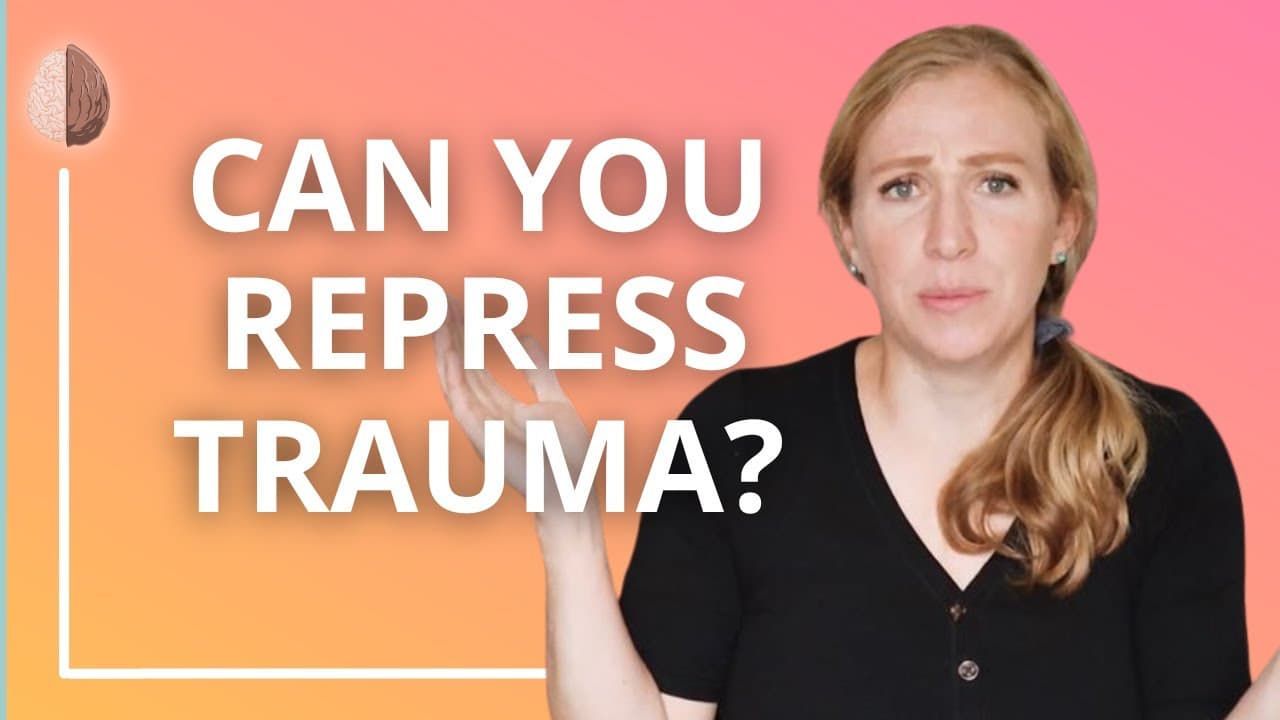
Can Trauma Cause Repressed Memories or Dissociative Amnesia? PTSD and the Memory Wars
TL;DR
Trauma can sometimes be forgotten and remembered later, but a recovered memory is not necessarily accurate because memory is reconstructive and vulnerable to suggestion. Most people have no memories from before age three, so childhood gaps alone do not prove abuse. Safe therapy avoids hypnosis, leading questions, and pressure to recover memories while focusing on present safety and coping skills. Read on to understand dissociation, false memories, and responsible treatment.
Transcript
I had a ton of comments on my last video about how trauma messes with your memories, and a lot of the comments went like this, you know: "How do you heal from trauma that you can't remember?" and "I can't remember large parts of my childhood. Does that mean I was abused?" and "I grew up with a narcissistic parent and can't remember large parts ... Read More
Key Insights
- Memory is a reconstructive process rather than an exact recording of past events. Recollections are often assembled from memory fragments, beliefs, emotions, intuitions, and guesses, creating narratives that may feel plausible and convincing without being completely accurate.
- Memories can be altered, implanted, or created through suggestion. Laboratory experiments and the experience of repressed-memory therapy in the 1990s showed that people can strongly believe events occurred even when those recollections were shaped by repeated prompting or a clinician’s expectations.
- Forgotten trauma is possible, according to the research and clinical experience presented. The transcript describes adults with verified histories of childhood sexual abuse who later did not recall the documented abuse, although the existence of forgetting does not establish that every recovered memory is accurate.
- Dissociation is one hypothesis for disrupted trauma memory. When escape feels impossible, a person may freeze, become numb, or detach mentally and emotionally, and the survival-focused brain may encode the experience in a fragmented, sensory, confused, or incomplete form.
- State-dependent retrieval is a proposed explanation for some returning memories. A later event that recreates feelings or cues associated with an earlier trauma, such as witnessing another car crash, may make previously inaccessible material easier to retrieve.
- Repression remains a difficult hypothesis to test scientifically. The proposed idea is that an overwhelming memory may become inaccessible while a person remains unsafe or lacks support, then return after greater safety, maturity, coping skills, or emotional capacity develops.
- Missing childhood memories are not proof that abuse occurred. Most people lack memories from before age three, and ordinary gaps can have multiple explanations, so social media lists that treat particular symptoms or memory gaps as evidence of hidden trauma may cause harm.
- Safe trauma therapy is present-focused and non-directive. A therapist should not use hypnosis, leading questions, symptom-based assumptions, or pressure to recover memories, confront someone, press charges, or end relationships, but should support informed choices and teach regulation and safety skills.
Install to Summarize YouTube Videos and Get Transcripts
Explore YouTube Video Summarizer or Get YouTube Transcript Extractor
Questions & Answers
Q: Can traumatic experiences be forgotten and remembered later?
Yes, the research and clinical experience presented indicate that traumatic experiences can sometimes be forgotten and later remembered. However, remembering something later does not prove that every detail is accurate because recollections can combine genuine fragments with beliefs, feelings, intuitions, guesses, and later information.
Q: Does not remembering large parts of childhood mean abuse occurred?
No, missing childhood memories alone do not establish that abuse occurred. Most people have no memories from before age three, and memory gaps can have explanations other than hidden trauma, so they should not be treated as proof of a specific event.
Q: How can dissociation affect memories of trauma?
When danger feels overwhelming and escape seems impossible, a person may freeze, become numb or confused, or detach mentally and emotionally. Because the brain prioritizes immediate survival, the experience may be encoded as fragmented sensory material with substantial gaps rather than as an orderly narrative.
Q: Why can recovered memories be inaccurate?
Memory is reconstructed rather than replayed like a permanent video recording. Each recollection can be shaped by emotions, biases, beliefs, suggestions, and information received later, so someone may sincerely believe a memory that was distorted or unintentionally created.
Q: How did repressed-memory therapy create false memories?
In the 1990s, some clinicians repeatedly prompted clients to uncover forgotten events and used hypnosis to explore memory gaps. The resulting memories often followed the clinician's suggested theme, including sexual abuse, alien abduction, or Satanic ritual abuse, causing substantial harm and opposition to memory-recovery therapy.
Q: What evidence suggests that verified trauma can be forgotten?
The discussion cites a study described by Bessel van der Kolk in The Body Keeps the Score in which abuse had been established, verified, and written down. When survivors were interviewed years later, some no longer remembered the documented abuse.
Q: Should hypnosis be used to recover forgotten trauma memories?
The guidance presented advises against using hypnosis or other suggestive methods to push clients toward forgotten trauma memories. Because suggestion can create convincing recollections that match a clinician's expectations, therapy should focus instead on current safety, coping skills, emotions, and personal choice.
Q: What should a therapist do when a client reports uncertain memories?
A therapist should offer a safe, nonjudgmental space without declaring uncertain memories true or false. Questions should be non-leading, and treatment should help the client manage present thoughts, feelings, sensations, interpretations, and distress while preserving the client's control over personal decisions.
Summary & Key Takeaways
-
Memory does not operate like a permanent video recording. It reconstructs the past from fragments, beliefs, emotions, intuitions, and guesses, so recollections can change whenever they are retrieved and stored again. People may sincerely believe inaccurate or created memories, especially when suggestions are repeatedly introduced by a clinician or another influential source.
-
Traumatic events can sometimes be forgotten, and dissociation offers one possible explanation. During overwhelming danger, the nervous system may shift from fight or flight into freezing, numbness, confusion, or detachment. Because the brain prioritizes survival under stress, traumatic experiences may be stored as fragmented sensory material with gaps rather than orderly narratives.
-
The safest response to uncertain memories is education, caution, and present-focused support. Missing memories do not establish that trauma occurred, while uncertainty also should not be used to deny someone’s experience. Therapists should provide a nonjudgmental space, avoid directing conclusions or decisions, and teach skills that restore safety and personal choice.
Read in Other Languages (beta)
Share This Summary 📚
Summarize YouTube Videos and Get Video Transcripts with 1-Click
Try YouTube Summary with ChatGPT & Claude or YouTube Transcript Generator
Explore More Summaries from Therapy in a Nutshell 📚




Summarize YouTube Videos and Get Video Transcripts with 1-Click
Try YouTube Summary with ChatGPT & Claude or YouTube Transcript Generator