How Do Neurons Generate Electrical Signals?
TL;DR
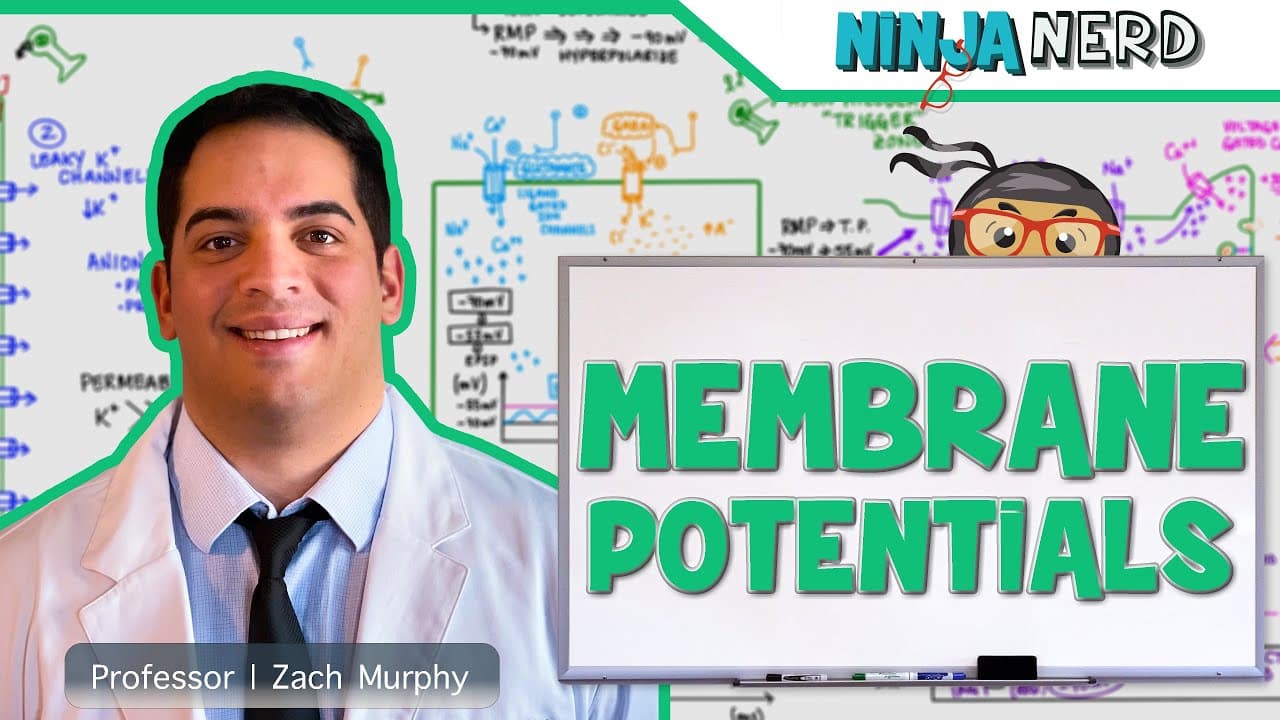
Neurons generate electrical signals through resting membrane potentials, graded potentials, and action potentials. Resting membrane potential is established by sodium-potassium ATPase pumps and ion channels. Graded potentials occur as localized changes in membrane voltage, which can integrate to trigger action potentials. Action potentials involve rapid depolarization and repolarization, crucial for neural signaling.
Transcript
what's up ninja nerds in this video today we're going to talk about resting membrane potentials graded potentials and action potentials of neurons guys before you guys watch this video please hit that like button hit that subscribe button comment down in the comment section and all of the information for all our social media platforms instagram fac... Read More
Key Insights
- Resting membrane potential is the voltage difference across a neuron's membrane when the cell is at rest, typically around -70 millivolts.
- Sodium-potassium ATPase pumps play a critical role in maintaining resting membrane potential by pumping sodium out and potassium into the cell.
- Graded potentials are localized changes in membrane voltage that can be depolarizing or hyperpolarizing, depending on the stimulus.
- Temporal summation involves one presynaptic neuron repeatedly stimulating a postsynaptic neuron to reach threshold potential.
- Spatial summation occurs when multiple presynaptic neurons simultaneously stimulate a postsynaptic neuron, leading to threshold potential.
- Action potentials are all-or-none events triggered when the membrane potential reaches a threshold, resulting in rapid depolarization and repolarization.
- Voltage-gated sodium channels open at threshold potential, allowing sodium ions to rush in and depolarize the cell.
- Refractory periods ensure unidirectional propagation of action potentials and prevent immediate re-stimulation of neurons.
Install to Summarize YouTube Videos and Get Transcripts
Explore YouTube Video Summarizer or Get YouTube Transcript Extractor
Questions & Answers
Q: How do sodium-potassium ATPase pumps maintain resting membrane potential?
Sodium-potassium ATPase pumps maintain resting membrane potential by actively transporting three sodium ions out of the neuron and two potassium ions into the neuron. This creates a concentration gradient, with more sodium outside and more potassium inside, contributing to a negative charge inside the cell relative to the outside, typically around -70 millivolts.
Q: What are graded potentials and how do they differ from action potentials?
Graded potentials are small, localized changes in membrane potential that occur in response to stimuli. Unlike action potentials, which are all-or-none events, graded potentials vary in amplitude based on stimulus strength. They can be depolarizing or hyperpolarizing and can summate to reach the threshold needed to trigger an action potential.
Q: What is the role of voltage-gated sodium channels in action potentials?
Voltage-gated sodium channels play a crucial role in action potentials by opening when the membrane potential reaches the threshold. This allows sodium ions to rush into the neuron, causing rapid depolarization. Once the membrane potential reaches around +30 millivolts, the inactivation gates close, stopping sodium influx and initiating repolarization.
Q: How do refractory periods affect action potential propagation?
Refractory periods ensure that action potentials propagate unidirectionally along an axon. During the absolute refractory period, no new action potential can be initiated regardless of stimulus strength. The relative refractory period follows, where a stronger-than-normal stimulus is needed to trigger another action potential, allowing the neuron to reset and preventing backward propagation.
Q: What is temporal summation in the context of graded potentials?
Temporal summation occurs when a single presynaptic neuron releases neurotransmitters in rapid succession, causing multiple graded potentials to add together on a postsynaptic neuron. This can increase the membrane potential to reach the threshold, triggering an action potential. It is essential for integrating signals over time to generate a response.
Q: What is spatial summation and how does it contribute to action potentials?
Spatial summation involves multiple presynaptic neurons simultaneously releasing neurotransmitters onto a single postsynaptic neuron. The combined effect of these graded potentials can raise the membrane potential to the threshold level, initiating an action potential. Spatial summation allows integration of signals from different sources, enhancing neural processing.
Q: Why is the resting membrane potential typically around -70 millivolts?
The resting membrane potential is around -70 millivolts due to the differential distribution of ions across the neuron's membrane, primarily maintained by sodium-potassium ATPase pumps and leaky potassium channels. These mechanisms create a negative charge inside the cell relative to the outside, essential for maintaining readiness for neural signaling.
Q: How do voltage-gated potassium channels contribute to repolarization?
Voltage-gated potassium channels contribute to repolarization by opening in response to depolarization, allowing potassium ions to exit the neuron. This outflow of positive ions restores the negative membrane potential, bringing the cell back towards resting potential. The slow closure of these channels can lead to hyperpolarization before stabilizing at resting potential.
Summary & Key Takeaways
-
Resting membrane potential is maintained by sodium-potassium ATPase pumps and ion channels, creating a voltage difference across the neuron's membrane. This potential is vital for neural signaling.
-
Graded potentials are small, localized changes in membrane voltage that occur in response to stimuli. They can summate to reach threshold potential, triggering an action potential.
-
Action potentials involve rapid depolarization and repolarization phases, facilitated by voltage-gated sodium and potassium channels, essential for transmitting signals along neurons.
Read in Other Languages (beta)
Share This Summary 📚
Summarize YouTube Videos and Get Video Transcripts with 1-Click
Try YouTube Summary with ChatGPT & Claude or YouTube Transcript Generator
Explore More Summaries from Ninja Nerd 📚





Summarize YouTube Videos and Get Video Transcripts with 1-Click
Try YouTube Summary with ChatGPT & Claude or YouTube Transcript Generator