How Big Is the Universe Compared to Earth?
TL;DR
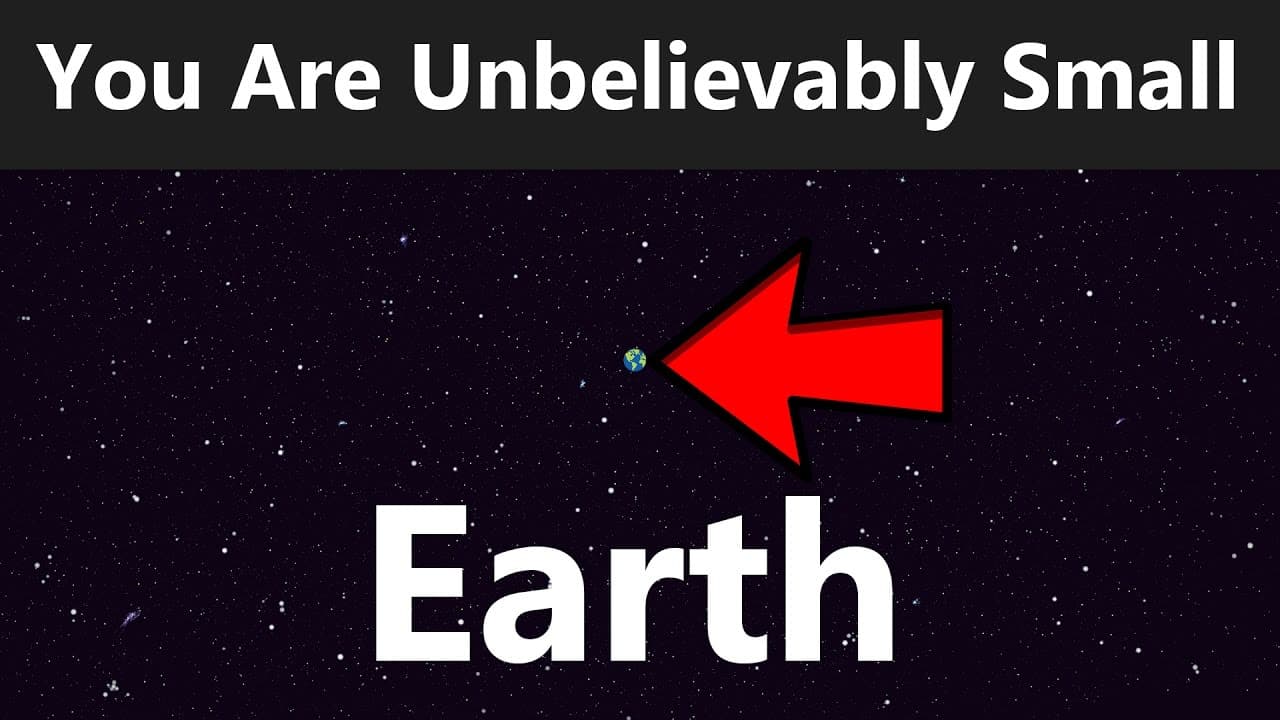
Earth appears tiny when viewed against cosmic scales, beginning with the Moon and extending to distant galaxies and the observable universe. The video outlines the vast distances involved, the limitations of communication across space, and the idea that the observable universe is just a fraction of what might exist beyond. It ends with the notion that there is much more to discover together.
Transcript
You live here on this planet somewhere and everything that you've ever known is located right here, but just how small exactly is Earth when compared to the scale of the entire universe? Let's start by zooming out to where we can see our nearest cosmic neighbor, The Moon. You may think that the moon is very close to Earth since it dominates our nig... Read More
Key Insights
- Earth is a small part of the Moon Earth distance but still far beyond immediate scale.
- The Moon is farther away than common intuition suggests and distance is described in kilometers.
- Mars is much further than the Moon and communication delays accumulate with distance.
- Voyager 1 is a far object that is still within our solar system conceptually but extremely distant.
- Light speed defines how long it takes for messages to travel between planets and probes.
- The observable universe is vast and contains billions of galaxies and stars within its reach.
- The local group is a tiny portion of the larger Laniakea Supercluster in the cosmic map.
- Cosmic inflation implies the full universe could be vastly larger than what we can observe.
- More videos from this channel:
- More from this channel: RealLifeLore
Install to Summarize YouTube Videos and Get Transcripts
Explore YouTube Video Summarizer or Get YouTube Transcript Extractor
Questions & Answers
Q: What is the Moon relative to Earth and why does its distance matter for scale?
The Moon is described as far away enough to make the distance mathematically non trivial when comparing with Earth, illustrating how perspective changes with scale. This helps viewers grasp that even nearby celestial bodies can seem close while still being massively distant in everyday terms, shaping our sense of size in the cosmos.
Q: How does the video explain the speed of light in relation to interplanetary communication?
The video uses light speed as a benchmark to explain transmission delays across space. It notes that messages take measurable time to travel between Earth and other worlds, highlighting that even with fast signals, real time communication becomes impractical over interplanetary distances, emphasizing the isolation of distant habitats.
Q: Why is Voyager 1 used as a reference point in the scale of the universe?
Voyager 1 is used as a reference to demonstrate how far human-made objects can travel, illustrating humanitys reach into space. Its continued voyage, described in the video, helps convey the idea that even at impressive speeds, the distances to stars and galaxies remain unimaginably vast.
Q: What does the concept of light years help illustrate in this video?
Light years provide a unit to express the distance light travels in a year, allowing the video to compare distances between stars like Proxima Centauri and our solar system. This helps viewers understand how vast space is in terms of time rather than just physical length.
Q: How is the Milky Way characterized in the video in terms of scale?
The Milky Way is presented as a huge structure containing over a hundred billion stars and planets, with Earth occupying a tiny spot. The visualization underscores that even a massive galaxy is just a single part of a much larger cosmic landscape.
Q: What is the local group and how does it fit into larger cosmic structures?
The local group is described as a collection of galaxies that sits within larger clusters and superclusters. This framing shows that galaxies are not isolated but part of nested structures spanning vast distances, with the Virgo Supercluster and the Laniakea Supercluster representing progressively larger scales.
Q: How does the video explain the observable universe versus what lies beyond it?
The observable universe represents what we can detect given the finite speed of light and the age of the universe. The video notes that areas beyond this observable shell may exist and could be vastly different in size and content, suggesting there is more to space than we can currently perceive.
Q: What is the central philosophical takeaway about our place in the universe?
The video emphasizes that humans are incredibly small within the cosmic scale, yet this size does not diminish the value of exploration. It invites curiosity about the unknown and posits that shared discovery can expand our understanding of reality, leaving room for future revelations beyond current knowledge.
Summary & Key Takeaways
-
Summary point 1 A broad view shows how small Earth is when compared with the Moon, Mars, and Voyager 1 on its long journey.
-
Summary point 2 The video explains light speed delays and what they mean for communication across vast distances.
-
Summary point 3 The final message emphasizes the enormity of the observable universe and the possibility that more lies beyond what we can see.
Read in Other Languages (beta)
Share This Summary 📚
Summarize YouTube Videos and Get Video Transcripts with 1-Click
Try YouTube Summary with ChatGPT & Claude or YouTube Transcript Generator
Explore More Summaries from RealLifeLore 📚



Summarize YouTube Videos and Get Video Transcripts with 1-Click
Try YouTube Summary with ChatGPT & Claude or YouTube Transcript Generator