What explains Laos and Cambodia’s low population density
TL;DR
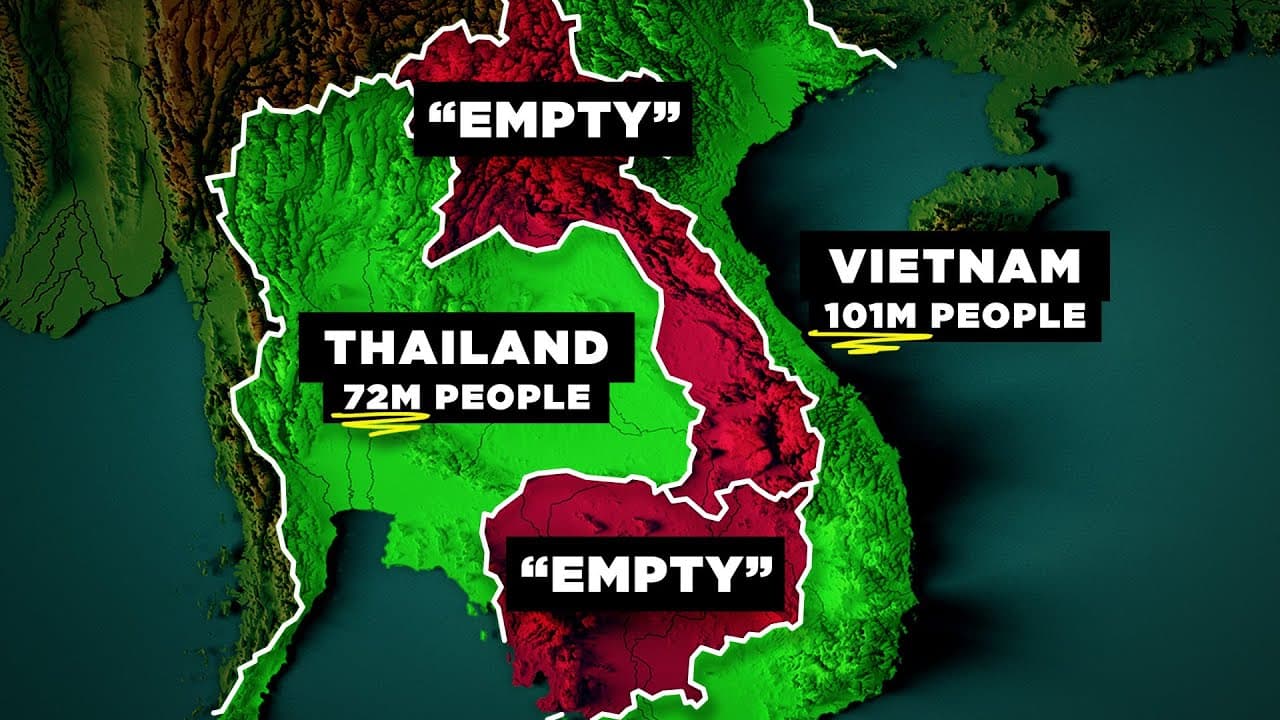
Laos and Cambodia are emptier than neighbors due to geography, history, and trade access. Laos is highly mountainous, forested, and landlocked with limited arable land and few rivers usable for sea trade, while Cambodia sits in a flat, fertile delta region but still has low density because of historical and regional factors. Vietnam and Thailand enjoy better agriculture and trade routes.
Transcript
Southeast Asia is a big place. It's often geographically divided between maritime Southeast Asia and mainland Southeast Asia. And something weird is happening in mainland Southeast Asia when you pay closer attention to it on a population density map. There's a sort of population void that's going on in the center of Southeast Asia that roughly line... Read More
Key Insights
- Laos has the lowest population density in mainland Southeast Asia due to mountains, jungles, and limited arable land.
- Cambodia is not as handicapped by geography as Laos yet still has a much lower density than Vietnam because of historical factors.
- Vietnam’s two major river deltas make it a highly productive agricultural region with dense population near the deltas.
- The Mekong Delta and Red River Delta together account for a large share of Vietnam’s rice production and population concentration.
- Laos is landlocked and surrounded by mountains, which hampers trade and economic development.
- Cone Falls blocks navigation on the Mekong, isolating Laos from sea trade and contributing to economic isolation.
- Cambodia’s lack of mountains and access to the sea does not fully translate into high population density due to past conflicts and demographic shifts.
- Trade access and proximity to China influence density differences among Southeast Asian neighbors.
Install to Summarize YouTube Videos and Get Transcripts
Explore YouTube Video Summarizer or Get YouTube Transcript Extractor
Questions & Answers
Q: A real search query question about the video (e.g. 'How to...', 'What is...', 'Why does...'). Question 1
Why are Laos and Cambodia so sparsely populated compared with Vietnam and Thailand? The core explanation combines geography and history. Laos is highly mountainous and densely forested, with very limited arable land and no sea access due to being landlocked and a major river navigation barrier like Cone Falls. Cambodia has favorable geography but suffered long historical conflicts which kept its population density lower than Vietnam, which benefits from two major productive river deltas enabling intensive farming and a high population concentration near the deltas.
Q: Question 2
What role do river deltas play in Vietnam’s population density and agricultural output? The Red River Delta and the Mekong Delta are among the world’s most productive river deltas. They supply nutrient-rich sediment annually and support multiple rice crops yearly. This fertility supports a large population living in the delta regions, which drives Vietnam’s high population density relative to its neighbors.
Q: Question 3
How does being landlocked affect Laos's economy and population distribution? Being landlocked limits Laos’s direct access to sea trade, reducing economic opportunities. Its borders are also heavily mountainous, restricting overland trade routes. These factors collectively dampen development potential, contributing to lower GDP per capita and a slower population growth in dense urban centers compared with Vietnam and Thailand.
Q: Question 4
Why does Cone Falls influence Laos’s trade and population patterns? Cone Falls is described as the widest waterfall in the world, effectively blocking navigation on the Mekong toward the sea. This barrier prevents Laos from using the river for maritime trade and connectivity with the wider world, reinforcing isolation and limiting economic opportunities that could attract more people.
Q: Question 5
What historical factors affected Cambodia’s population density compared with Vietnam? Cambodia’s history includes a long period of dominance by the Camar Empire and later conflict as Vietnamese and Thai powers battled across its plains. This political instability and warfare disrupted demographic growth and settlement patterns, resulting in a lower population density than Vietnam despite similar arable potential.
Q: Question 6
How do arable land percentages compare among Laos, Cambodia, and Vietnam? Laos has very little arable land relative to its size, contributing to its low density. Cambodia has more arable land and is less mountainous, yet its density remains lower than Vietnam’s due to limitations in economic development and historical factors that have shaped settlement patterns.
Q: Question 7
What makes Vietnam a population anchor in mainland Southeast Asia? Vietnam combines easy coastal access, proximity to major Chinese population centers, and highly productive deltas that enable multiple crop cycles yearly. This combination supports dense settlement around the deltas and strong agricultural output, making it more populous than its neighbors.
Q: Question 8
Why is Vietnam able to harvest a large share of its rice production from the Mekong and Red River deltas? The Mekong Delta deposits large volumes of nutrient-rich sediment annually and sustains warm, humid conditions with abundant rainfall. These factors allow three rice crops per year in some areas, making the delta a critical agricultural engine and population magnet for the country.
Summary & Key Takeaways
-
Laos is geographically mountainous and heavily forested, reducing habitable and arable land.
-
Cambodia, though flat with fertile land, has a lower population density than neighboring Vietnam due to historical factors.
-
Vietnam benefits from productive river deltas and easier trade, driving higher population concentration around key agricultural zones.
Read in Other Languages (beta)
Share This Summary 📚
Summarize YouTube Videos and Get Video Transcripts with 1-Click
Try YouTube Summary with ChatGPT & Claude or YouTube Transcript Generator
Explore More Summaries from RealLifeLore 📚



Summarize YouTube Videos and Get Video Transcripts with 1-Click
Try YouTube Summary with ChatGPT & Claude or YouTube Transcript Generator