Why Is a Full-Scale Invasion of the US So Hard?
TL;DR
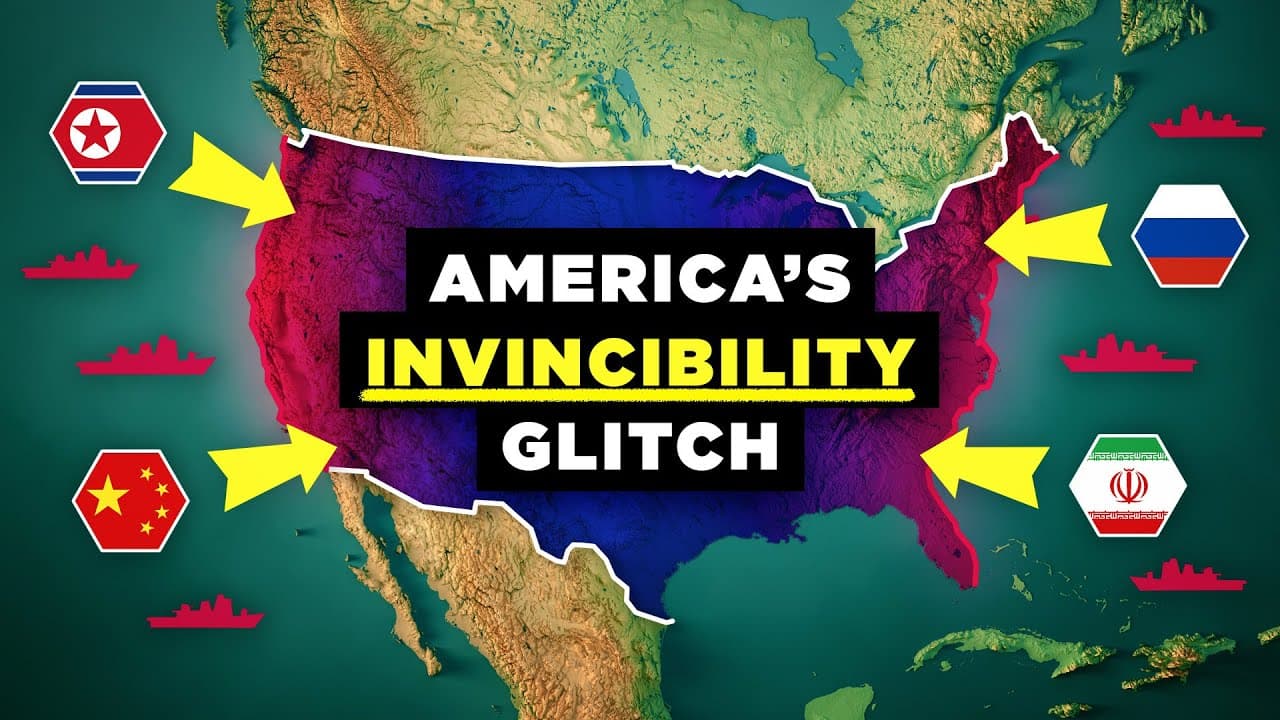
A full-scale invasion of the United States would be stopped first by the near impossibility of neutralizing its entire nuclear triad before retaliation. Hundreds of inland missile silos, strategic submarines hidden across the oceans, and nuclear-capable bombers at dispersed overseas bases give the country multiple, geographically separated ways to strike virtually anywhere in the world.
Transcript
the fantasy of a hostile foreign Nation launching a full-scale invasion of the United States has been a common Trope and fiction now for decades and while the idea of a foreign power invading the United States has been around since the nation's founding the modern fictional trend of depicting a foreign invasion of the country sort of dates back to ... Read More
Key Insights
- Foreign invasion stories are a recurring fictional trope, appearing in Red Dawn, Call of Duty, Homefront, and the Fallout series. These stories depict Soviet, Russian, North Korean, Chinese, or allied forces successfully attacking or occupying parts of the United States despite the immense logistical barriers involved.
- Geography is a major American defense because two vast oceans separate the United States from its principal rivals. The transcript contrasts this position with Russia's invasion of neighboring Ukraine, arguing that attacking a larger country across the world would be far more difficult than crossing a shared land border.
- The nuclear triad is a three-part strategy composed of land-based, sea-based, and air-based nuclear weapons. Its components are scattered across the United States, the world's oceans, Europe, and the Indian Ocean, making complete elimination before an American response logistically implausible.
- The land-based deterrent includes around 450 ICBM silo locations distributed across Montana, North Dakota, Wyoming, Nebraska, and Colorado. Around 400 silos contain missiles, while approximately 50 are left as decoys intended to complicate a first strike and consume an attacker's time and weapons.
- Nuclear command continuity is supported by fixed and airborne systems. If contact between ground launch-control centers and remote missile facilities is lost during an attack, specially designed E-6B aircraft can assume command and control from the air while maintaining contact with the president.
- The submarine deterrent includes 14 Ohio-class strategic submarines based near Seattle and Jacksonville. A rotating patrol and maintenance cycle keeps around eight submarines at sea on an average day, hidden at secret locations and carrying roughly 20 Trident II D5 ballistic missiles apiece.
- Strategic submarines are difficult to neutralize because their nuclear reactors permit operations without routine refueling and their patrol locations are closely guarded secrets. An attacker would have to locate and eliminate every deployed submarine across the world's oceans before any could launch its missiles.
- The air-based component extends American nuclear reach through bombs stored at several overseas bases. The transcript identifies six bases in Europe and describes Diego Garcia in the Indian Ocean as another likely storage location, allowing strategic bombers to threaten areas beyond the stated reach of land-based ICBMs.
Install to Summarize YouTube Videos and Get Transcripts
Explore YouTube Video Summarizer or Get YouTube Transcript Extractor
Questions & Answers
Q: Why would invading the United States be so difficult?
Invading the United States would require an enemy to cross vast oceans, establish and sustain a beachhead against a powerful military, and prevent nuclear retaliation. The central problem is that American nuclear forces are divided among hardened inland silos, submarines hidden in the world's oceans, and bombers operating from dispersed overseas bases. Neutralizing every component before any response would require extraordinary worldwide coordination.
Q: What is the United States nuclear triad?
The United States nuclear triad is a defense strategy built around three separate categories of nuclear delivery systems: land-based intercontinental ballistic missiles, submarine-launched ballistic missiles, and aircraft carrying nuclear bombs. Because these forces operate from hardened inland sites, secret ocean patrol areas, and dispersed air bases, an attacker could not eliminate the American deterrent by striking only one location or one type of weapon.
Q: How do American ICBM silos complicate an invasion?
Around 450 ICBM silo locations are scattered across Montana, North Dakota, Wyoming, Nebraska, and Colorado, deep inside the continental United States and thousands of miles from a potential landing site. Around 400 contain missiles, while approximately 50 serve as decoys. Their dispersion, hardening, and inland position would force an attacker to identify and neutralize hundreds of separate targets before retaliation could begin.
Q: How could the United States launch ICBMs if ground command centers were disabled?
The president and secretary of defense normally maintain reliable, nearly immediate contact with ICBM launch crews through ground-based command infrastructure. If an attack severed contact between launch-control centers and remote missile facilities, specially designed E-6B airborne launch-control aircraft could assume command and control of the missiles. An enemy would therefore need to disable the fixed command sites and eliminate the relevant aircraft as well.
Q: Why are Ohio-class submarines important to nuclear deterrence?
Ohio-class strategic submarines provide a concealed, mobile means of nuclear retaliation. The United States maintains 14 of them, with eight home-ported in Bangor, Washington, and six in Kings Bay, Georgia. Their nuclear reactors support extended operations, and the patrol cycle keeps around eight submarines at sea at any given time, where their exact locations remain closely guarded secrets.
Q: How heavily armed are deployed American strategic submarines?
Each deployed strategic submarine can carry around 20 Trident II D5 ballistic missiles equipped with multiple independently targeted nuclear warheads. The transcript estimates the missiles' range at around 12,000 kilometers or more and says they can strike intended targets within about 100 meters. With around eight submarines commonly on patrol, the submerged force represents a widely dispersed retaliatory capability.
Q: How does the air-based nuclear force expand American reach?
The air-based component uses strategic bombers that can be armed with nuclear bombs stored at overseas military bases. The transcript identifies six bases in Europe, located in Belgium, the Netherlands, Germany, Italy, and Turkey, and describes Diego Garcia in the Indian Ocean as another likely storage site. These positions enable bombers to reach places outside the stated range of American land-based ICBMs.
Q: Could an attacker prevent retaliation by destroying one part of the nuclear triad?
Destroying one part of the nuclear triad would not remove the other two. Even if an enemy neutralized the inland missile silos, it would still need to find deployed submarines at unknown locations across the oceans and disable nuclear-capable aircraft and storage sites dispersed overseas. The entire design preserves multiple independent methods of retaliation, so a successful disarming attack would have to be nearly simultaneous and global.
Summary & Key Takeaways
-
Fiction frequently portrays foreign forces invading the United States, from the Soviet-led attack in Red Dawn to Russian or North Korean occupations in video games. Such scenarios overlook the enormous difficulty of reaching and conquering a large country separated from major rivals by two oceans and protected by a powerful military.
-
The first decisive obstacle is the United States nuclear triad. Its land component includes around 450 silo locations across five Great Plains states, with around 400 containing intercontinental ballistic missiles. Dispersed command centers and E-6B airborne control aircraft are intended to preserve launch capability even if fixed command facilities lose contact.
-
The sea and air components make complete disarmament still harder. Around eight Ohio-class strategic submarines are normally patrolling at secret locations, while nuclear bombs and strategic bombers are dispersed across several overseas bases. An attacker would need worldwide coordination to eliminate all three components before an overwhelming retaliatory strike could occur.
Read in Other Languages (beta)
Share This Summary 📚
Summarize YouTube Videos and Get Video Transcripts with 1-Click
Try YouTube Summary with ChatGPT & Claude or YouTube Transcript Generator
Explore More Summaries from RealLifeLore 📚

Summarize YouTube Videos and Get Video Transcripts with 1-Click
Try YouTube Summary with ChatGPT & Claude or YouTube Transcript Generator