Why Are the Fergana Valley Borders So Complex?
TL;DR
The Fergana Valley’s tangled borders arose when Soviet authorities replaced inherited Central Asian administrative divisions with republics intended to reflect ethnographic and demographic data. Because the valley’s population had long been multilingual, mobile, and deeply intermingled, the resulting boundaries divided communities and created enclaves, narrow corridors, disputed territory, isolation, and recurring conflict among Uzbekistan, Kyrgyzstan, and Tajikistan.
Transcript
This is Central Asia. And this region here that I'm highlighting is known as the Forgana Valley. Home to about 17 million people. It's by far the most densely populated part of Central Asia and encompasses about 1 in five people across the whole region. And the borders across it are potentially the most janky borders that you can find anywhere in t... Read More
Key Insights
- The Fergana Valley is Central Asia’s most densely populated area, containing about 17 million people and roughly one fifth of the region’s population. Its valuable farmland, concentrated settlement, and division among Uzbekistan, Kyrgyzstan, and Tajikistan make every unusual boundary politically and practically significant.
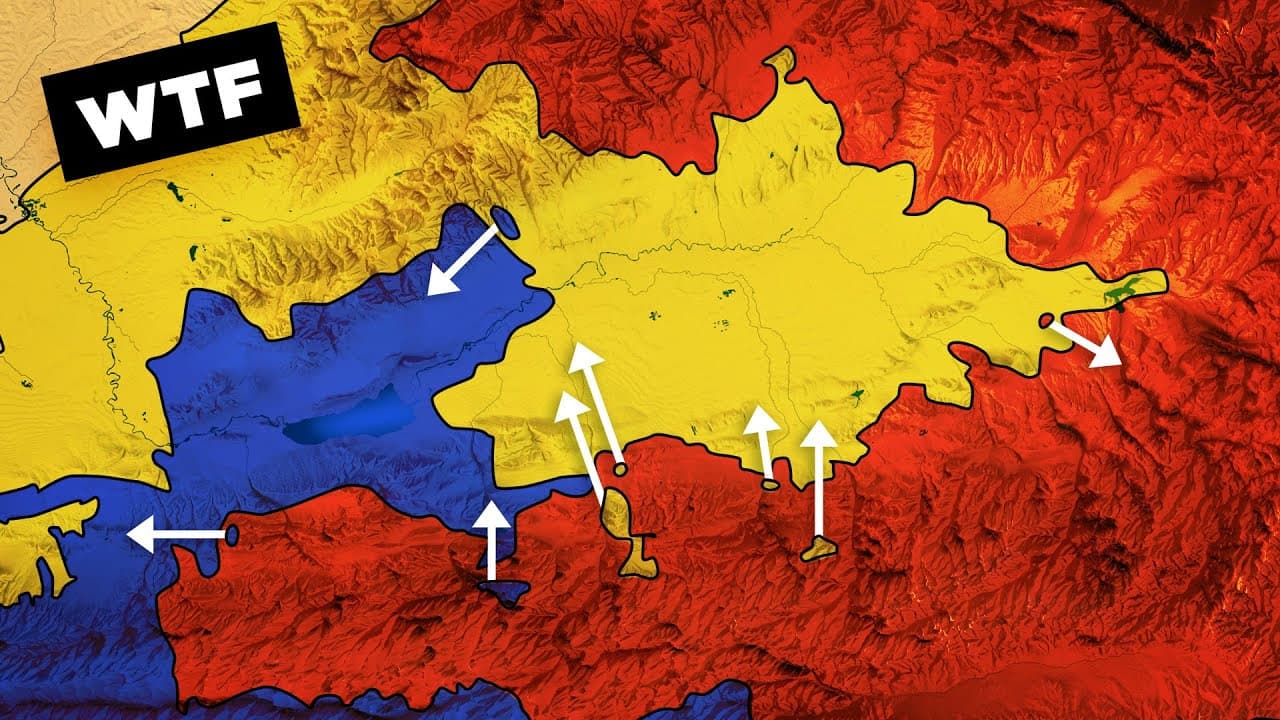
- The valley’s political geography is defined by zigzagging borders, narrow territorial connections, branching corridors, and isolated enclaves. One Uzbek peninsula near Namangan connects to the rest of Uzbekistan through a neck only 360 meters wide, illustrating how formally continuous territory can remain physically vulnerable.
- Eight pieces of territory were completely isolated from their national mainlands within the border arrangement described. Six lay inside Kyrgyzstan’s Batken region, including four belonging to Uzbekistan and two belonging to Tajikistan, while additional Kyrgyz and Tajik enclaves were surrounded by Uzbekistan.
- Vorukh is a densely populated Tajik enclave surrounded by Kyrgyzstan and home to around 45,000 people. Tajikistan historically claimed a narrow connecting corridor across internationally recognized Kyrgyz territory, while Kyrgyzstan rejected that claim, contributing to repeated modern conflicts and prolonged isolation for residents.
- Sokh District is an Uzbek enclave surrounded by Kyrgyzstan and home to around 80,000 people. Nearly all its residents are described as ethnic Tajiks, meaning that their ethnicity differs from both the country governing the enclave and the country geographically surrounding it.
- The Fergana Valley is a fertile oasis about the size of New Jersey, surrounded by mountain ranges except toward the west. Two rivers supplied by glacial runoff and snowmelt support its agriculture, helping explain why the valley has attracted settlement, trade, and competing powers for thousands of years.
- Pre-Russian identities in the valley did not correspond neatly to modern national categories. Residents were often multilingual and ancestrally intermingled, while identity commonly centered on sedentary or nomadic lifestyles, tribes, clans, and religion rather than a clearly bounded understanding of ethnicity or nationalism.
- Soviet border planning sought to replace inherited colonial divisions with administrative units considered more rational and scientific. Officials relied largely on ethnographic and demographic data while pursuing a Marxist-Leninist vision of a union of national republics, but the valley’s intermingled population made clean territorial separation inherently difficult.
Install to Summarize YouTube Videos and Get Transcripts
Explore YouTube Video Summarizer or Get YouTube Transcript Extractor
Questions & Answers
Q: Why are the Fergana Valley borders so complicated?
The borders are complicated because Soviet authorities sought to replace Central Asia’s inherited administrative divisions with republics based largely on ethnographic and demographic data. The Fergana Valley, however, contained multilingual, highly intermingled sedentary and nomadic populations without clear territorial separation. Dividing that population among Uzbekistan, Kyrgyzstan, and Tajikistan produced winding boundaries, narrow connections, enclaves, and communities separated from their national mainlands.
Q: Where is the Fergana Valley and why is it important?
The Fergana Valley lies in Central Asia and is divided among Uzbekistan, Kyrgyzstan, and Tajikistan. It is a green agricultural oasis about the size of New Jersey, surrounded by mountains except toward the west and supplied by rivers originating from glacial runoff and snowmelt. About 17 million people live there, making it Central Asia’s most densely populated area and home to roughly one fifth of the region’s population.
Q: How many enclaves and exclaves are in the Fergana Valley border system?
The border system described contained eight territories completely isolated from their respective national mainlands and surrounded by neighboring countries. Six were located inside Kyrgyzstan’s southwestern Batken region, with four belonging to Uzbekistan and two to Tajikistan. The account also identifies a Kyrgyz enclave around Barak and a long, narrow Tajik enclave with a small village, both surrounded by Uzbekistan.
Q: Why is Vorukh disputed between Tajikistan and Kyrgyzstan?
Vorukh is a densely populated Tajik enclave surrounded by Kyrgyzstan and home to around 45,000 people. Tajikistan historically rejected the idea that it should be isolated, claiming a narrow corridor connecting it to the Tajik mainland across internationally recognized Kyrgyz territory. Kyrgyzstan fiercely rejected that claim. The disagreement, together with residents’ isolation and marginalization, contributed to multiple modern conflicts between the countries.
Q: What makes Uzbekistan’s Sokh District unusual?
Sokh District is a large Uzbek enclave entirely surrounded by Kyrgyzstan and home to around 80,000 people. Its demographic composition adds another layer of complexity because nearly all those residents are described as ethnic Tajiks. They therefore belong politically to Uzbekistan while living inside Kyrgyzstan, yet their ethnicity corresponds to neither the governing country’s majority nor the surrounding country’s population.
Q: What were identities like in the Fergana Valley before Russian rule?
Before Russian and Soviet rule, the valley had no clear modern system of ethnicity or nationalism. Many inhabitants were multilingual and had intermingled ancestries. Sedentary Persian-speaking and Turkic-speaking agricultural communities were collectively called Sarts, while nomadic Turko-Mongol groups lived around the edges and mountains. Identity often centered on lifestyle, tribe, clan, or religion, which was Islam in most, but not all, cases.
Q: How did the Russian Empire govern Central Asia after conquering it?
After conquering Central Asia between the 1850s and 1870s, the Russian Empire divided much of the territory into two large colonial administrative regions: the Governorate of the Steppe and the Governorate of Turkestan. The Khanate of Khiva and Emirate of Bukhara remained theoretically independent protectorates with internal autonomy, although Russia controlled their foreign and military policies. Tsarist authorities generally permitted substantial local autonomy until the First World War.
Q: How did the Basmachi movement affect the Fergana Valley?
The Basmachi movement began after the Tsarist regime extended military conscription to Muslim inhabitants in 1916, triggering revolt in Central Asia. After the Bolsheviks seized power, the Red Army fought the movement in the Fergana Valley. A massacre at Kokand in early 1918 reportedly killed as many as 25,000 inhabitants, intensifying support for resistance. More than six years of war followed before the revolt was largely suppressed by 1923.
Summary & Key Takeaways
-
The Fergana Valley is a densely populated agricultural oasis divided among Uzbekistan, Kyrgyzstan, and Tajikistan. Its borders include narrow connections, winding territorial arms, and eight enclaves or exclaves. These arrangements separate communities from their national mainlands and make travel, administration, resource access, and relations between neighboring countries unusually difficult.
-
The valley’s population developed through centuries of trade, migration, conquest, settlement, and cultural exchange along the Silk Road. Before Russian rule, identities were often connected more closely to livelihood, tribe, clan, or religion than modern nationality. Multilingual sedentary and nomadic communities lived together without clear scientific boundaries separating distinct ethnic populations.
-
After conquering Central Asia, the Russian Empire governed it through large colonial administrative regions and autonomous protectorates. War, conscription, revolt, revolution, and Bolshevik expansion then transformed the region. Soviet authorities considered the inherited divisions irrational and sought new republics based largely on ethnographic and demographic information, producing borders with enduring practical consequences.
Read in Other Languages (beta)
Share This Summary 📚
Summarize YouTube Videos and Get Video Transcripts with 1-Click
Try YouTube Summary with ChatGPT & Claude or YouTube Transcript Generator
Explore More Summaries from RealLifeLore 📚


Summarize YouTube Videos and Get Video Transcripts with 1-Click
Try YouTube Summary with ChatGPT & Claude or YouTube Transcript Generator