How Big Do Tsunamis Get and Megatsunamis Explained
TL;DR
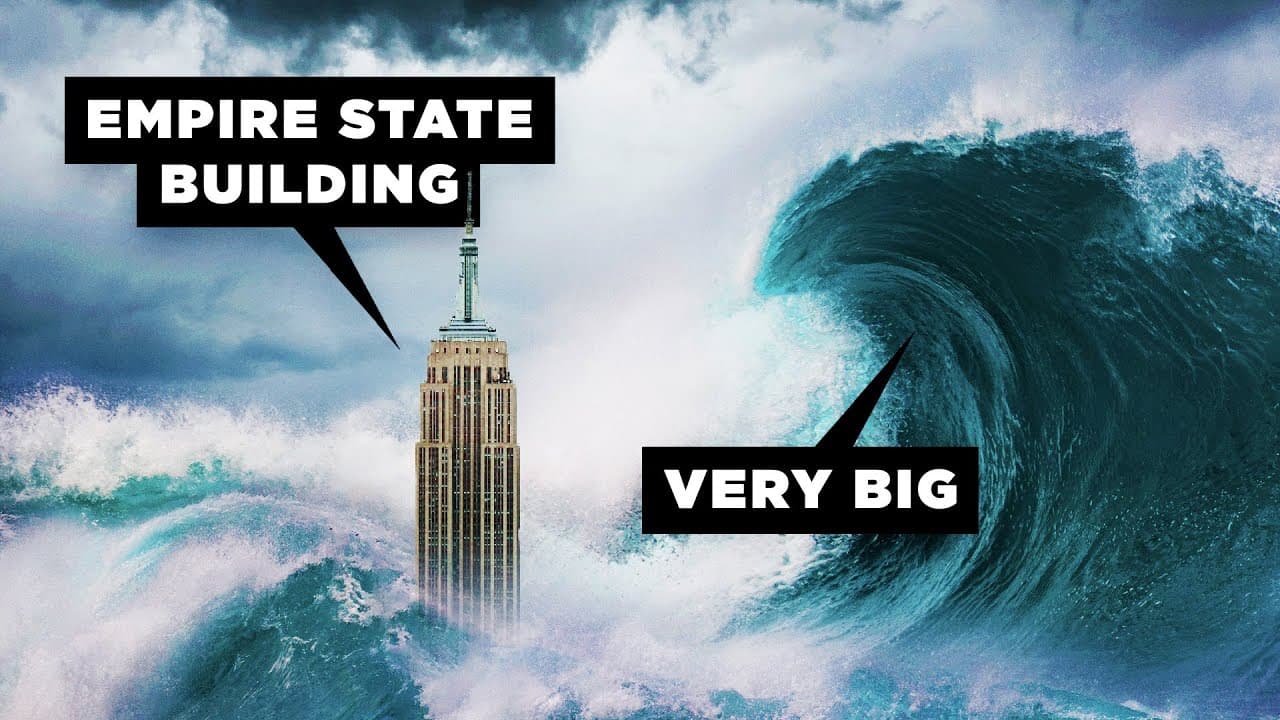
Tsunamis range from regular waves caused by earthquakes to megatsunamis formed by massive landslides or asteroid impacts. Regular tsunamis can reach tens of meters and cause widespread damage, while megatsunamis can tower hundreds of meters, destroying coastlines and altering landscapes. The video also contrasts deadly historical events with hypothetical extreme scenarios to illustrate scale.
Transcript
Tsunamis are some of the most powerful and deadliest forces of nature. Within recent memory, you may recall both the 2004 Indian Ocean Tsunami and the 2011 Japan Tsunami, both of which in resulted catastrophic damage and loss of life. The Indian Ocean Tsunami happened after a massive earthquake struck here in the Indian Ocean. The earthquake itself... Read More
Key Insights
- Tsunamis come in two broad classes: regular tsunamis from earthquakes and megatsunamis from large landslides or massive impacts.
- Regular tsunamis can reach significant heights and inland penetration, causing large economic and human losses in coastal regions.
- Megatsunamis can reach hundreds of meters in height, exceeding the scale of typical coastal flooding and posing existential threats to entire regions.
- The Longarone event in Italy demonstrates how a landslide into a reservoir can generate a wave hundreds of meters high and devastate villages below.
- Lituya Bay in Alaska hosts one of the tallest tsunamis, with a wave around 525 meters high caused by a massive landslide.
- Prehistoric megatsunamis, like the 66 million year event, illustrate energy releases vastly larger than modern nuclear weapons are capable of, reshaping coastlines and environments.
- The comparison to the Tsar Bomba highlights the enormous energy differences between human-made explosions and natural catastrophic events.
- Canary Island collapse scenarios show how even rare events could produce tsunamis on continental scales, underscoring low-probability but high-impact risks.
- More videos from this channel:
- More from this channel: RealLifeLore
Install to Summarize YouTube Videos and Get Transcripts
Explore YouTube Video Summarizer or Get YouTube Transcript Extractor
Questions & Answers
Q: What is the difference between a regular tsunami and a megatsunami?
A regular tsunami is usually generated by an undersea earthquake and involves displacement of water that propagates as a wave with height varying from tens of meters to potentially many tens of meters near shore. A megatsunami, on the other hand, is caused by a massive landslide or other large mass entering the ocean, displacing far more water and producing waves hundreds of meters high and far more destructive inland reach.
Q: How tall can the largest megatsunamis get according to the video?
The video cites a megatsunami height of 525 meters in Lituya Bay, Alaska, produced by a massive landslide, which went over the bay and caused extensive damage and tree destruction. It also mentions hypothetical megatsunamis on the scale of several hundred meters and up to 600 meters for a past Hawaiian event, illustrating the upper limits observed and discussed.
Q: What historical tsunamis are used to illustrate regular tsunami impacts?
The video references the 2004 Indian Ocean tsunami and the 2011 Japan tsunami. It notes that the Indian Ocean event reached high water levels and caused widespread damage and loss of life, while the Japan tsunami was extremely costly, with waves reaching up to about 40.5 meters and inland penetration that caused massive economic losses.
Q: What extreme scenario involves Madagascar and a potential 1 kilometer high wave?
The video mentions a scenario where a Canary Islands collapse into the ocean could generate a tsunami about 1 kilometer high, which would have catastrophic implications for the East Coast of the United States and coastal regions, illustrating a low probability but high consequence risk.
Q: How does the video describe the energy of a prehistoric asteroid impact?
It states that the asteroid would release about 100 teratons of TNT energy, vastly exceeding the energy of the largest nuclear bomb ever detonated by a factor of about 2 million, and would create a mega tsunami up to 5 kilometers high, illustrating the extreme scale of energy release in planetary history.
Q: What can be learned from the Longarone megatsunami example?
Longarone shows how a mountain landslide can suddenly collapse into a reservoir, generating a wave hundreds of meters high that destroys towns downstream, demonstrates the importance of heeding warning signs, and illustrates the dynamic coupling between land instability, water bodies, and coastal impact.
Q: Why is the Alaska megatsunami a key example in the video?
The Alaska example demonstrates a 525 meter high wave generated by a landslide, underlining how massive landslides can transform a coastal landscape, wipe out forests, and alter shorelines in ways that are far larger than typical earthquake driven tsunamis, highlighting the range of potential tsunami heights.
Q: Does the video propose any imminent risk from Canary Islands or other locations?
Yes, it suggests there is a small probability of a Canary Island collapse triggering a 1 kilometer high tsunami that could threaten the East Coast of the United States, providing a cautionary note about rare, high impact events and the need to consider extreme scenarios in risk assessments.
Summary & Key Takeaways
-
The video contrasts regular tsunamis and megatsunamis, showing how energy input from earthquakes or landslides creates very different wave heights and damage.
-
It presents historical examples from the 2004 Indian Ocean tsunami and the 2011 Japan tsunami to illustrate the damage and height ranges involved.
-
It discusses megatsunamis in Italy, Alaska, Hawaii, and a prehistoric asteroid impact to illustrate the upper limits of tsunami energy and height.
Read in Other Languages (beta)
Share This Summary 📚
Summarize YouTube Videos and Get Video Transcripts with 1-Click
Try YouTube Summary with ChatGPT & Claude or YouTube Transcript Generator
Explore More Summaries from RealLifeLore 📚
Summarize YouTube Videos and Get Video Transcripts with 1-Click
Try YouTube Summary with ChatGPT & Claude or YouTube Transcript Generator