Why Is Northern Italy Richer Than Southern Italy?
TL;DR
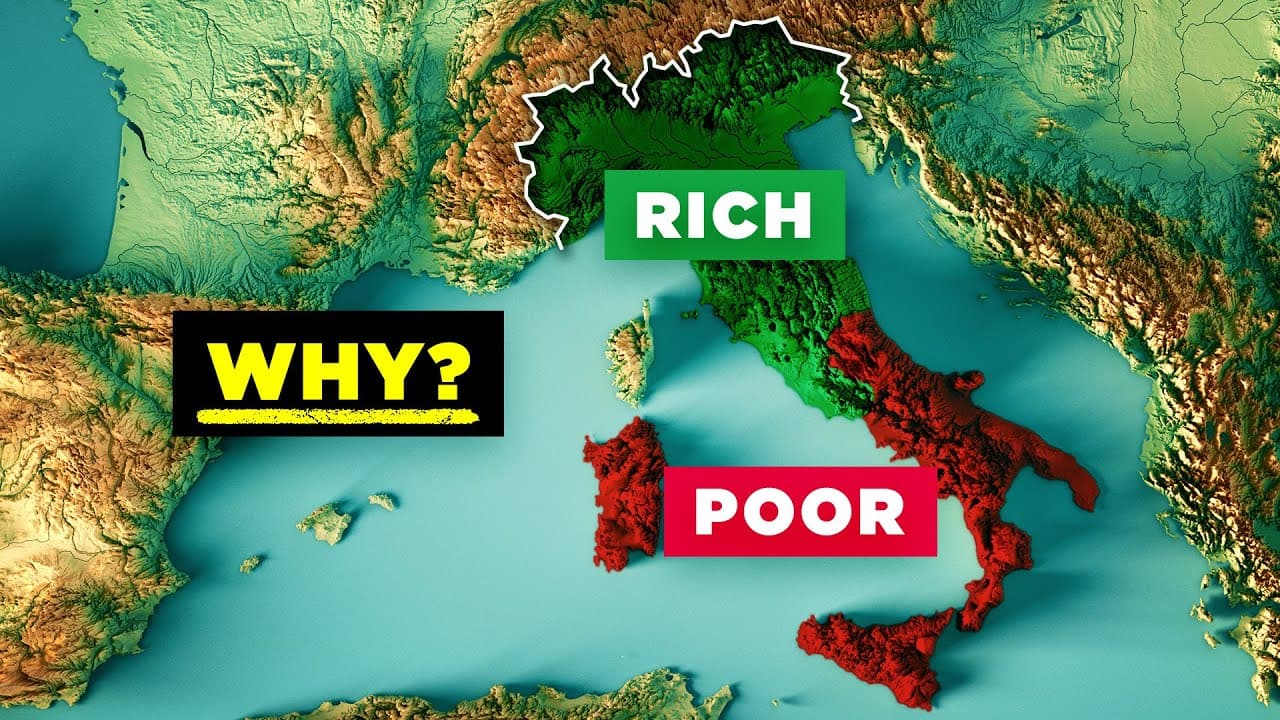
Northern Italy is more economically developed because geography has favored dense settlement, infrastructure, agriculture, and trade around the Po Valley. Southern Italy has lower GDP per capita, higher unemployment, greater water stress, rougher terrain, and more seismic exposure, although even its least-developed regions maintain relatively high human development by global standards.
Transcript
there is today no other country in Europe that is more heavily divided between two different regions than Italy it seems that nearly no matter what kind of map you show over Italy the country is sharply divided between its North and its South here's a map of Italy's population density from 2011 that shows significantly closer together major populat... Read More
Key Insights
- Italy’s north-south divide appears across many indicators, including population density, highway coverage, religious attendance, voter turnout, human development, GDP per capita, and unemployment. These patterns reveal that the disparity extends beyond income into infrastructure, civic participation, social behavior, and general living conditions.
- Southern Italy contains about one-third of Italy’s land and population but produces only about one-quarter of national GDP. Former prime minister Mario Draghi described the region as the largest and most populated underdeveloped area within the euro area.
- Southern Italy remains relatively developed by global standards despite lagging behind Western Europe. Calabria and Sicily recorded human development scores of 0.859 in 2017, approximately comparable to the averages cited for Argentina, Chile, or Turkey and still above the global average.
- Employment inequality is especially severe in southern Italy. Sicily, Calabria, and Campania each had unemployment above 16 percent in 2023, roughly four times the rates found in some northern regions and approaching levels reported in geopolitically troubled places such as Kosovo or Libya.
- The Po Valley gives northern Italy a major geographic advantage because it is the largest continuous flat area in southern Europe under the stated United Nations definition. Its terrain makes cities, transportation networks, and other infrastructure cheaper and easier to construct than in mountainous regions.
- The Po Valley supports dense settlement and productive agriculture through flat land, Alpine freshwater, glacial runoff, and numerous rivers and streams. About 17 million people, nearly one-third of Italy’s population, live there, producing an urban density compared in the transcript with the Netherlands.
- Northern Italy benefits from strong commercial connections through the Po River and nearby ports. Trieste and Genoa handle more gross tonnage than southern ports and serve as crossroads between Mediterranean trade and inland Europe, while the north’s location places it closer to major European markets.
- Southern Italy faces greater environmental constraints than the north. Historical data show more severe water stress, projections indicate a substantially greater risk of acute water scarcity by 2050, and the geologically active Apennine spine exposes central and southern areas to greater earthquake risk.
- More videos from this channel:
- More from this channel: RealLifeLore
Install to Summarize YouTube Videos and Get Transcripts
Explore YouTube Video Summarizer or Get YouTube Transcript Extractor
Questions & Answers
Q: Why is northern Italy richer than southern Italy?
Northern Italy benefits from the Po Valley’s flat terrain, abundant Alpine freshwater, fertile fields, navigable waterways, dense cities, and proximity to inland Europe. These conditions have made agriculture, urban growth, infrastructure construction, and international trade easier. Southern Italy has more rugged terrain, greater water stress, higher seismic exposure, and weaker infrastructure, contributing to a persistent economic disadvantage.
Q: How large is the economic divide between northern and southern Italy?
Southern Italy accounts for about one-third of Italy’s territory and population but only about one-quarter of its GDP. Calabria and Sicily had nominal GDP per capita levels in 2022 comparable to Uruguay and Greece, while northern regions such as Lombardy and Trentino exceeded Germany and the United Kingdom. The divide is described as wider than the gap between eastern and western Germany.
Q: Is southern Italy poor by global standards?
Southern Italy is underdeveloped relative to other parts of Western Europe, but it is not necessarily poor by global standards. In 2017, Calabria and Sicily had human development scores of 0.859. The transcript compares that level with the average scores of Argentina, Chile, or Turkey and notes that it remains above the global average.
Q: What is the Po Valley’s role in northern Italy’s development?
The Po Valley provides northern Italy with a large, continuous area of flat land where cities, farms, roads, and other infrastructure can be built more cheaply. Alpine runoff supplies freshwater and fertilizes extensive fields, while the Po River supports navigation and commerce. These advantages helped cities including Turin, Milan, Bologna, Padua, Verona, and Venice become major economic centers.
Q: How does water availability divide northern and southern Italy?
Northern Italy has better access to freshwater because rivers and streams descend from the Alps into the Po Valley. Data cited from 1995 show more severe water stress in southern Italy, while a 2022 risk map projects that the south faces a substantially greater danger of acute water scarcity by 2050. This difference has also shaped long-term agricultural prospects.
Q: Why are northern Italy’s ports important to its economy?
Trieste and Genoa are Italy’s busiest ports by gross tonnage according to the transcript. Their natural, defensible deep-water harbors sit near the large population centers of the Po Valley and flank it on the east and west. This positioning allows them to connect Mediterranean shipping routes with inland European markets and reinforces northern Italy’s commercial advantages.
Q: How different are unemployment rates across Italy?
The employment divide is substantial. In 2023, unemployment in Sicily, Calabria, and Campania exceeded 16 percent of each region’s labor force. That was about four times the rate in some northern regions, including Lombardy and Veneto. The transcript compares these southern rates with some of the world’s worst, approaching those reported in Kosovo or Libya.
Q: How does Italy’s terrain contribute to regional inequality?
Northern Italy contains the broad, low-lying Po Valley, while the Alps, Apennines, and surrounding hills make much of the remaining peninsula rugged and mountainous. Flat land lowers the cost and difficulty of building cities and infrastructure. The Apennine spine also forms a major fault zone, leaving central and southern Italy more exposed to earthquakes and other seismic events.
Summary & Key Takeaways
-
Italy displays a persistent north-south divide across population density, infrastructure, religious attendance, voter participation, human development, economic output, and employment. Southern Italy contains about one-third of the country’s territory and population but generates only about one-quarter of its GDP, while its unemployment rates substantially exceed those in several northern regions.
-
Geography gives northern Italy important structural advantages. The Po Valley is southern Europe’s largest continuous area of flat land under the cited United Nations definition, contains about 17 million people, and supports cheaper urban and infrastructure development. Alpine water, fertile fields, and the navigable Po River have also encouraged intensive agriculture and major cities.
-
Northern Italy is closer to inland European markets and benefits from major ports such as Trieste and Genoa, which flank the Po Valley and connect Mediterranean commerce with deeper Europe. Southern Italy faces more mountainous terrain, greater water stress, higher future scarcity risk, and stronger seismic exposure along the geologically active Apennine spine.
Read in Other Languages (beta)
Share This Summary 📚
Summarize YouTube Videos and Get Video Transcripts with 1-Click
Try YouTube Summary with ChatGPT & Claude or YouTube Transcript Generator
Explore More Summaries from RealLifeLore 📚

Summarize YouTube Videos and Get Video Transcripts with 1-Click
Try YouTube Summary with ChatGPT & Claude or YouTube Transcript Generator