Why is Kazakhstan so sparsely populated today
TL;DR
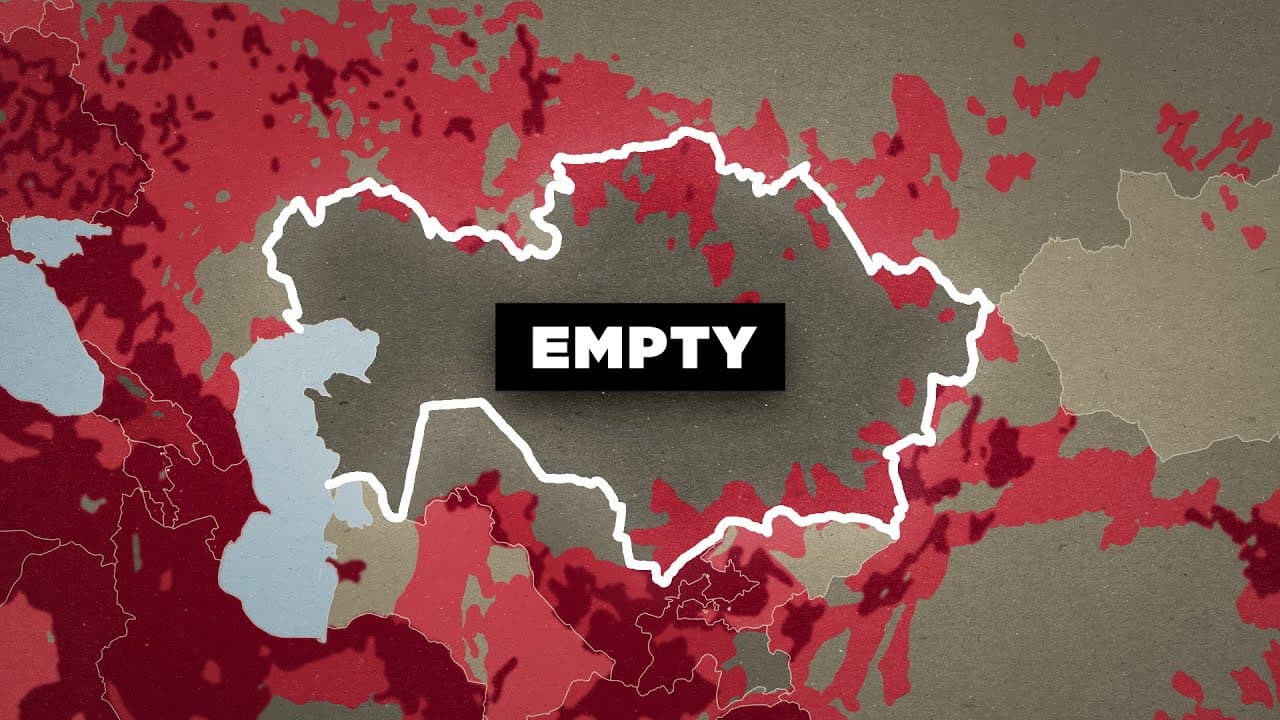
Kazakhstan has about 20 million people living on a land area roughly 16 times the size of Florida, which yields a population density around 7 people per square kilometer. This makes it one of the sparsest populated places on Earth despite its enormous size, and it is the second most sparsely populated country in Eurasia after Mongolia.
Transcript
geographically speaking it might surprise you to hear that Kazakhstan is the ninth largest country in the world it's a huge place that's roughly the same size as the whole of Western Europe stretching from Portugal to Poland and if it were placed over the continental United States kazakhstan's land mass would sprawl from San Diego in the southwest ... Read More
Key Insights
- Kazakhstan is the ninth largest country by area, highlighting its vast geography.
- The country recently reached a population milestone of 20 million in 2024.
- Population density is about 7 people per square kilometer, among the lowest globally.
- It is the second most sparsely populated country in Eurasia after Mongolia.
- Most surrounding regions are more densely populated than Kazakhstan.
- The climate is harsh, with cold winters and hot summers shaping habitability.
- About 11% of the land is arable, totaling 296,000 square kilometers.
- Demographic patterns were drastically altered by 20th century events and policies.
- More videos from this channel:
- More from this channel: RealLifeLore
Install to Summarize YouTube Videos and Get Transcripts
Explore YouTube Video Summarizer or Get YouTube Transcript Extractor
Questions & Answers
Q: A real search query question about the video (e.g. 'How to...', 'What is...', 'Why does...', 'When should...'). Question 1
How does Kazakhstan's size relate to its population density and why is it considered one of the sparsest populated places on the planet? The video explains that despite its enormous land area, only about 20 million people live there as of 2024, which results in a density of roughly 7 people per square kilometer. This low density is attributed to climate extremes, geographic isolation from oceans, and historical demographic shocks in the 20th century that reduced population growth and reshaped settlement patterns across the country.
Q: Question 2
Why is Kazakhstan described as surrounded by more densely populated lands, and what effect does this have on its demographic profile? The transcript notes that every neighboring region around Kazakhstan, including Russia to the north and west, Uzbekistan and Kyrgyzstan to the south, and China's Xinjiang to the east, is more densely populated. This creates a demographic void in the center of Eurasia, where Kazakhstan stands out for its sparse population despite its large land area and available arable land.
Q: Question 3
What climate characteristics contribute to Kazakhstan being sparsely populated, according to the video? The description highlights a harsh climate with bitterly cold winters and hot summers, and a landscape dominated by a cold desert climate in the center and a dry semi arid climate in the north and east. Such conditions limit large scale, year round habitation despite the country’s arable land and water resources.
Q: Question 4
How does arable land relate to Kazakhstan's population patterns as described in the video? The video states that about 11 percent of Kazakhstan's land is arable, totaling around 296,000 square kilometers, which is large and even exceeds the arable land area of some more densely populated nations. Yet this abundance does not translate into high population density due to other limiting factors like climate and historical events.
Q: Question 5
What historical factors shaped Kazakhstan's current demographics as presented in the video? The narrative traces 20th century upheavals, including Russian imperial and Soviet policies, famine, and population shifts, which caused demographic decline and diaspora movements. These events collectively contributed to Kazakhstan’s present-day sparse population relative to its geographic size.
Q: Question 6
What role did the trans Aral Railway play in Kazakhstan's demographic history according to the video? The video describes how the railway connected European Russia to Central Asia, encouraging settlement by Russians and Ukrainians in northern Kazakhstan and altering population patterns. This historic migration contributed to the region's evolving demographics and long-term shifts in where people chose to live within the country.
Q: Question 7
Why is Kazakhstan characterized as having renewable freshwater resources and arable land, yet a sparse population? The transcript notes substantial renewable water resources and arable land, including the Saria River and Lake Balkhash, which would seemingly support a larger population. The discrepancy is attributed to the harsh climate, geographic isolation, and century-long demographic challenges that hindered population growth despite resource abundance.
Q: Question 8
What does the video imply about Kazakhstan’s future demographic trajectory? While not stating a definite forecast, it suggests that the 2024 population level and the existing arable resources present a potential for growth if climate and historical legacies are managed. The emphasis remains on understanding how geography and past events shape current population distribution and future possibilities.
Summary & Key Takeaways
-
Kazakhstan is the ninth largest country by area and fans out across a vast region, yet its population remains comparatively small. The video explains how geography and climate play a major role in shaping population distribution across the land. It highlights the contrast between land size and people living there.
-
The narrative points out that even with large areas of arable land and renewable water resources, demographic patterns are heavily influenced by climate and historical events that reduced population numbers in the 20th century.
-
Overall, the video connects physical geography, climate variation, and historical upheavals to explain why Kazakhstan remains sparsely populated despite its vast resources and size.
Read in Other Languages (beta)
Share This Summary 📚
Summarize YouTube Videos and Get Video Transcripts with 1-Click
Try YouTube Summary with ChatGPT & Claude or YouTube Transcript Generator
Explore More Summaries from RealLifeLore 📚
Summarize YouTube Videos and Get Video Transcripts with 1-Click
Try YouTube Summary with ChatGPT & Claude or YouTube Transcript Generator