Why is Malay Island the world’s densest place?
TL;DR
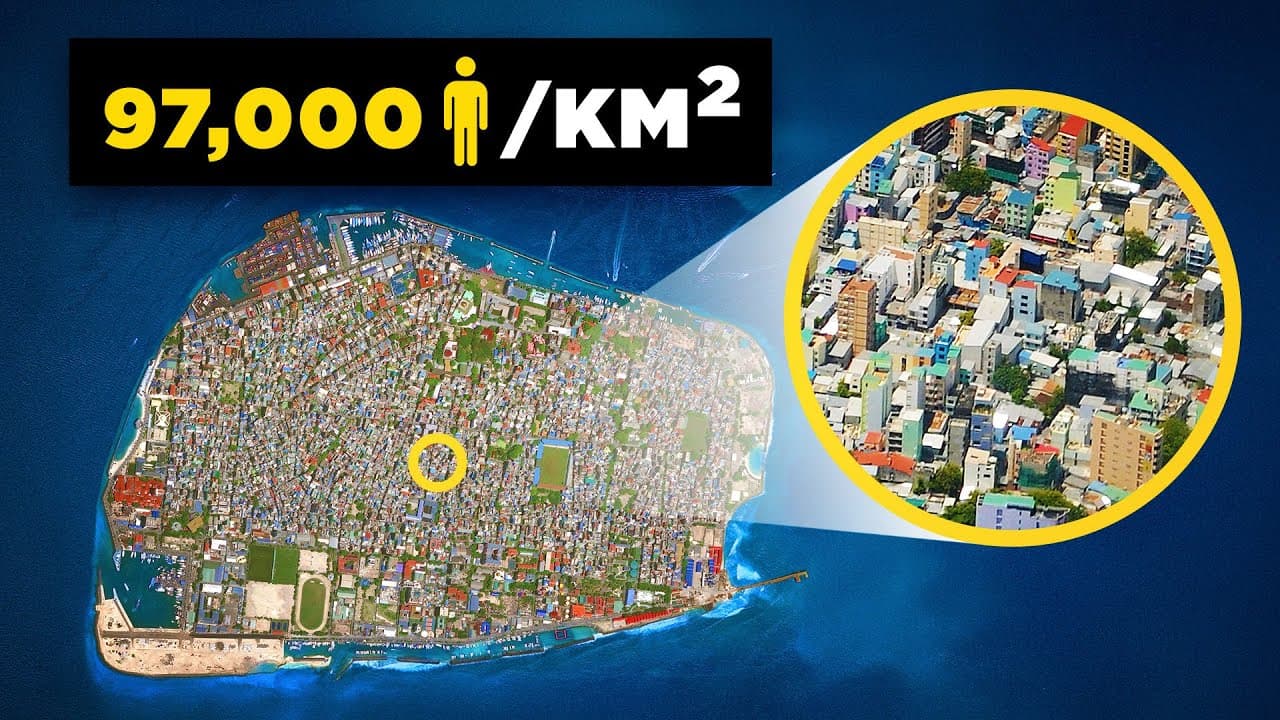
Malay holds about 190,000 people on just 1.95 square kilometers, making it far denser than most places. Half the population lives on two small nearby islands, while the rest are spread across several other tiny islands. The boom happened rapidly since 1967, turning Malay into a surprising urban anomaly.
Transcript
I've always been fascinated with the extremes of human population patterns. Both the parts of the world that are unusually empty and the parts of the world that are unusually crowded. And I recently came across what might just be the most interesting and most unusually crowded location in the entire world. This tiny little island in the middle of t... Read More
Key Insights
- Malay is the core of a country with 1,196 islands but only 298 square kilometers of land.
- About 190,000 people live on Malay, making it extremely dense per square kilometer.
- Nearly half the population concentrates on two islands that total only about 6 square kilometers.
- Hulhumalé Island adds to the high density, housing around 66,000 people on 4 square kilometers.
- Mallay’s population on the city level is about 263,000, showing clustering within a few islands.
- The island is less than 2 km wide at its widest point, enabling a complete cross in 20 minutes.
- The density of Malay is compared to Manhattan, highlighting extraordinary urban concentration.
- The Maldives archipelago is formed by coral atolls, with Malay sitting at the center of political power.
- More videos from this channel:
- More from this channel: RealLifeLore
Install to Summarize YouTube Videos and Get Transcripts
Explore YouTube Video Summarizer or Get YouTube Transcript Extractor
Questions & Answers
Q: A real search query question about the video (e.g. 'How to...', 'What is...', 'Why does...', 'When should...'). Question 1
Malay Island is the densest place because nearly half of the country’s population lives on just two small islands within a city that spans about 6 square kilometers. With about 190,000 residents on 1.95 square kilometers, its density is vastly higher than typical urban areas, and this concentration has grown dramatically since 1967.
Q: Question 2
The population of Malay Island is approximately 190,000 people as of 2024 estimates, which accounts for a large share of the Mald’s total population. This figure, when compared to the island’s small land area of 1.95 square kilometers, yields an extraordinarily high population density and underscores the compact living conditions present there.
Q: Question 3
Malay Island itself is less than 2 kilometers wide at its widest point, one of the factors enabling such intense crowding. The entire circumnavigation can be done in about 90 minutes on foot, and walking across the island from east to west takes roughly 20 minutes, illustrating how small the space to accommodate so many people is.
Q: Question 4
Compared to Manhattan, Malay is more densely populated on a per square kilometer basis. The density on Malay exceeds typical high density urban benchmarks, driven by thousands of residents living in a confined area, while Manhattan’s land area is much larger and houses its population across a broader, less congested footprint.
Q: Question 5
Hulhumalé is an artificially built island next to Mallay that has been under construction since 1997 and houses around 66,000 people on about 4 square kilometers. Its density adds to the overall crowded feel of the capital area, reflecting a deliberate expansion to accommodate population growth within a very small space.
Q: Question 6
The Maldives archipelago comprises about 1,196 atolls or islands, but only a portion of them are populated. The central city of Mallay comprises multiple nearby islands, with about 3 of them carrying the majority of the population while others remain sparsely inhabited, highlighting a highly concentrated urban core.
Q: Question 7
Mallay and the Maldives are located in the Indian Ocean, hundreds of kilometers away from the Asian mainland in India. The central city and its surrounding atolls form a geographic cluster that is remote from continental population centers, contributing to the remarkable density observed within a small geographic footprint.
Q: Question 8
Population distribution on the Maldives shows that nearly half the nation lives on just a few islands, with Mallay and Hulhumalé bearing a large share of residents. This concentration leads to intense urban density while much of the country remains open ocean, illustrating an unusual geographic phenomenon where population centers occupy a tiny fraction of land.
Summary & Key Takeaways
-
Malay is a tiny island with an extremely high population density, housing roughly 190,000 people on 1.95 square kilometers. The rapid growth over the past decades concentrates most residents on a few small islands, creating a perceived megacity in a minute space.
-
The Maldes archipelago contains nearly 1,196 islands, and only about 298 square kilometers are land, with most inhabited space clustered on a few islands, notably Mallay and Hulhumalé, driving intense density.
-
Malay's density ranks it among the most densely populated places globally, with comparisons to Manhattan and other dense areas, yet it remains geographically remote in the Indian Ocean, surrounded by vast water and distant from continental basins.
Read in Other Languages (beta)
Share This Summary 📚
Summarize YouTube Videos and Get Video Transcripts with 1-Click
Try YouTube Summary with ChatGPT & Claude or YouTube Transcript Generator
Explore More Summaries from RealLifeLore 📚



Summarize YouTube Videos and Get Video Transcripts with 1-Click
Try YouTube Summary with ChatGPT & Claude or YouTube Transcript Generator