How to Verify Multi-Agent Graph Workflows
TL;DR
Reliable graph workflows require strong verification at individual nodes, because one unchecked mistake can contaminate every downstream result. Split independent work across agents for speed, route outputs through explicit edges, preserve the original requirements for reviewers, and use a capable model for judgment tasks, since a cheap reviewer can create false findings that consume more time and tokens.
Transcript
There's a new term going around called graph engineering and everyone on X is talking about it. Before graphs, it was all loop engineering where you hand the agent a goal and it works toward it on its own. But with graphs, the work gets done faster and covers way more ground at once than a loop ever could. There's a huge problem with them though. O... Read More
Key Insights
- Graph engineering is a workflow design that divides one main task among multiple agents, allowing independent jobs to run concurrently before their outputs are combined or passed onward.
- Loop engineering is a linear working cycle in which an agent performs a task, verifies the result, and then advances to the next step, even when later work does not depend on the current step.
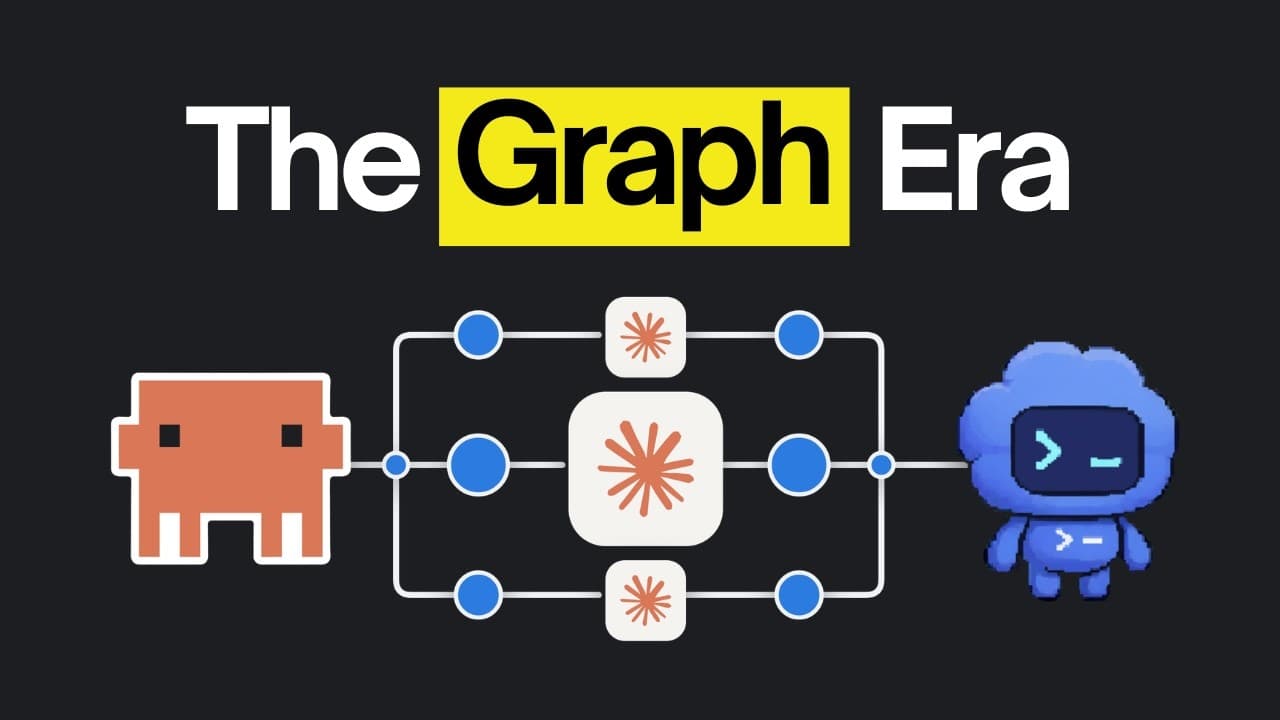
- A graph is built from nodes and edges: nodes perform isolated jobs in separate context windows, while edges route each node's output to the correct destination at the correct stage.
- Parallel agents can improve speed because unrelated work no longer waits in a single sequence, but the complete graph consumes more tokens because several agents operate instead of one.
- Model selection can reduce the cost of individual nodes by assigning cheaper models to simpler work, but overall usage can still rise enough to reach plan limits sooner.
- A diamond graph is a pattern where one task splits across several parallel agents and then converges on one agent that consolidates their findings into a single answer.
- A fan-in barrier graph is useful when work must be judged from several perspectives, because progression stops until every assigned reviewer has returned its assessment.
- Verification quality is controlled heavily by the judging model, because a weaker reviewer may misinterpret intentional choices as defects and cause agents to spend time and tokens fixing work that was not broken.
Install to Summarize YouTube Videos and Get Transcripts
Explore YouTube Video Summarizer or Get YouTube Transcript Extractor
Questions & Answers
Q: What is graph engineering for AI agents?
Graph engineering is a way to organize one larger task as several smaller jobs performed by separate AI agents. Each job becomes a node with its own isolated context, and edges determine where its output goes. Independent nodes can run simultaneously, while later nodes combine, review, or act on their results according to the graph's structure.
Q: How does graph engineering differ from loop engineering?
Loop engineering moves through work and verification in a straight line. Each step waits for the preceding step, even when the two jobs are independent. Graph engineering spreads the main task across multiple agents, allowing unrelated jobs to run at the same time. Their outputs can later converge into a reviewer, consolidator, or another dependent node.
Q: What are nodes and edges in an agent graph?
A node is one independent job within the larger assignment. It is performed by an agent operating in its own context window, which then reports its result. An edge is the connection that controls information flow between nodes. It ensures that an agent's output reaches the appropriate agent or consolidation point at the required stage.
Q: Why can one bad node damage an entire agent graph?
One bad node can damage the graph because later agents may treat its output as trustworthy input and build additional work on top of the original mistake. When many agents return results concurrently, the combined volume is difficult to inspect. If only the final result is visible, identifying which node introduced the problem becomes especially difficult.
Q: How should a multi-agent graph verify its work?
A multi-agent graph should place verification around the work performed by its nodes and compare outputs with the original requirements. Tests can expose major behavioral failures, while tool chaining lets agents run checks, read errors, and attempt corrections. A customized review skill can also assess implementation standards and whether each isolated contribution satisfies the larger request.
Q: Why should verification commands be added to Claude.md?
Adding project verification commands to Claude.md saves the agent from discovering the same commands repeatedly. Claude can work out which tools and commands the project uses, then run them, interpret returned errors, and make corrections. Recording the exact commands makes that checking process more direct and supports consistent verification whenever agents work within the project.
Q: Why can a cheap reviewer model increase graph costs?
A cheap reviewer can increase costs when it lacks enough contextual understanding to distinguish deliberate implementation choices from genuine defects. In the example described, Haiku returned many issues, but numerous findings concerned code that had intentionally been left as written. Those false findings required review and could trigger unnecessary fixes across multiple parallel nodes.
Q: When should a standalone review skill be used?
A standalone review skill should be invoked manually when a substantial output already exists and needs deep inspection. It should not necessarily run after every partial result, because repeated heavy reviews would consume tokens before the work is finished. The transcript's example is a security-focused code review that fans out multiple reviewers and consolidates their findings for coordinated fixes.
Summary & Key Takeaways
-
Loop engineering gives one agent an end goal and lets it progress through a linear cycle of work and verification. Graph engineering instead divides the goal into smaller jobs that multiple agents can perform concurrently, reducing unnecessary waiting when tasks are independent and allowing different models to be selected for different nodes.
-
A graph consists of nodes and edges. Each node is an isolated agent job, while each edge controls how information moves between jobs. Common arrangements include diamond graphs that split and recombine work, and fan-in barrier graphs that wait for several independent assessments before applying fixes or producing a consolidated result.
-
Verification determines whether parallel agent work remains reliable. Built-in tests and tool chaining catch major failures, but customized review skills can compare each isolated contribution with the original requirements and coding standards. The reviewer model must understand context well, because weak judgment can produce false findings and unnecessary changes across many nodes.
Read in Other Languages (beta)
Share This Summary 📚
Summarize YouTube Videos and Get Video Transcripts with 1-Click
Try YouTube Summary with ChatGPT & Claude or YouTube Transcript Generator
Explore More Summaries from AI LABS 📚

Summarize YouTube Videos and Get Video Transcripts with 1-Click
Try YouTube Summary with ChatGPT & Claude or YouTube Transcript Generator